Greater Earless Lizard

Greater Earless Lizard

Cophosaurus texanus

Silhouette: SeismicShrimp · PhyloPic

LCLeast ConcernNTVUENCR
Daily sighting probability ~30% · Possible
at Saguaro National Park

In 3 days ~60% in a week ~90%

198 Verified sightings at Saguaro National Park From 2019 to 2026
944 In all 4 parks
April Best month
☀️ Diurnal When it's spotted

About the Greater Earless Lizard

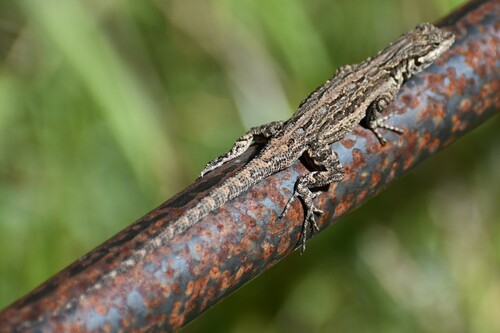
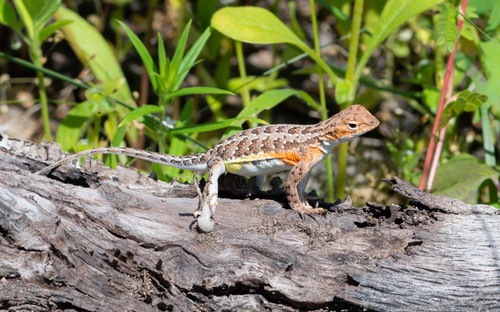
The greater earless lizard (Cophosaurus texanus) is the only species in the monotypic genus Cophosaurus. It is closely related to the smaller, lesser earless lizards and other species in the genus Holbrookia, and in fact was placed in that genus and referred to Holbrookia texana from 1852 into the 1970s. Earless lizards lack external ear openings, an adaptation to burrowing in the sand, as are the recessed lower jaw and flared upper labial scales. Greater earless lizards are sexually dimorphic, males grow larger and are more colorful than females, exhibiting pink and green colors that are particularly bright in the breeding season. Two bold black bars mark the lateral region of males but are greatly reduced and vague, or occasionally entirely absent in females.

The greater earless lizard is native to the Chihuahua Desert and other arid and semi-arid regions of Southwestern United States and northern Mexico, where they most often occupy moderately open areas of sparse vegetation with rocks, gravel, and sand. The overall color of individual lizards frequently match the colors of the rocks and soils of the local area they inhabit. They will often rely on camouflage and their speed to elude threats and predators before retreating into rock crevices. They are primarily insectivores, preying on wide variety of crickets, grasshoppers, caterpillars, ants, flies, beetles, and bugs. Spiders and small lizards are occasionally eaten as well. Cophosaurus are oviparous. Females lay 1 to 4 clutches of 2 – 9 eggs a year, with hatchlings emerging from June to October, and reaching adult size and sexual maturity in one year. Wikipedia →

Global Distribution

Parks Where Found

# Park Country Daily sighting probability
1 Guadalupe Mountains National Park 🇺🇸 United States
~80%
2 Big Bend National Park 🇺🇸 United States
~60%
3 Saguaro National Park 🇺🇸 United States
~30%
4 Cumbres de Monterrey National Park 🇲🇽 Mexico
~10%

Before you go

What are the chances of seeing a Greater Earless Lizard in Saguaro National Park?

Possible

About 30% of wildlife watchers report a Greater Earless Lizard sighting in Saguaro National Park on a given day, based on 198 verified sightings from GBIF citizen-science data from 2019 to 2026. It is the 9th most-seen of the 51 reptiles we can rate there. Over three days the chance rises to about 60%, and over a week to about 90%, if each day is a fresh chance.

When is the best time to see a Greater Earless Lizard in Saguaro National Park?

April

In that month about 40% of wildlife watchers report a Greater Earless Lizard in Saguaro National Park on a given day, against under 5% in December and January, the lowest months. That is one of Saguaro National Park's driest months, with about 5 mm of rain against 55 mm in July.

What time of day is best to see a Greater Earless Lizard?

Between 9 am and noon

Across all the parks we cover, that three-hour window holds the most Greater Earless Lizard sightings with a recorded time, and about 8 in 10 of them come between 6 am and 6 pm: it is a daytime animal.

Is Saguaro National Park the best place to see a Greater Earless Lizard?

3rd of 4

Of the 4 parks where we can rate Greater Earless Lizard sightings, Saguaro National Park ranks 3rd at about 30%. The best odds are in Guadalupe Mountains National Park (United States, about 80%) and Big Bend National Park (United States, about 60%).

Which relatives of the Greater Earless Lizard live in Saguaro National Park?

Same family: Phrynosomatidae

The closest relatives of the Greater Earless Lizard that you can see in Saguaro National Park (family Phrynosomatidae, Phrynosomatid Lizards) are Zebra-tailed Lizard (about 50%), Desert Spiny Lizard (about 40%) and Common Side-blotched Lizard (about 40%), with each one's daily chance of a sighting.

Where does the Greater Earless Lizard sighting chance come from?

GBIF citizen-science records

It is estimated from how often the Greater Earless Lizard is recorded against all the reptiles logged in Saguaro National Park (198 verified sightings from 2019 to 2026), calibrated against known sighting rates. Figures are rounded to the nearest 10% because citizen-science data supports honest approximations, not decimals, and months with records from fewer than five people show "—". How it works.

← Back to Saguaro National Park