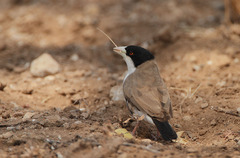

Black-capped Social-Weaver

Black-capped Social-Weaver

Pseudonigrita cabanisi

Silhouette: Sheatherius · PhyloPic

LCLeast ConcernNTVUENCR
Daily sighting probability ~40% · Likely
at Samburu National Reserve

In 3 days ~70% in a week >90%

412 Verified sightings at Samburu National Reserve From 2019 to 2026
699 In all 4 parks
July Best month
☀️ Diurnal When it's spotted

About the Black-capped Social-Weaver

The black-capped social weaver (Pseudonigrita cabanisi) is a sparrow-like species of bird that has been assigned to the weaverbird family. It was originally described by Fisher and Reichenow, and later re-classified by the latter to the genus Pseudonigrita. Adults have a large black cap, ivory-colored bill, red eyes, brown back and wings, blackish-brown tail, white throat and underparts with a black midline, and dark horn-colored legs. It breeds in colonies and roofed nests with an entrance at the bottom in thorny trees such as acacias are constructed by the male from grass stems. It is found in parts of Ethiopia, Kenya, Somalia, and Tanzania. It is sometimes kept and bred in captivity.

In 1884, the black-capped social weaver was first described by German East-Africa explorer Gustav Fischer and German ornithologist Anton Reichenow as Nigrita cabanisi, based on a specimen collected in 1883 by Fischer in the Pare Mountains. In 1903, Reichenow assigned the species to his newly erected genus Pseudonigrita, because he considered P. arnaudi and P. cabanisi related to weaverbirds (Ploceidae), while the other species Nigrita bicolor, N. canicapillus, N. fusconota... Wikipedia →

Sounds

Call0:28

Kenya · 2018

© Frank Lambert · XC451466 · CC BY-NC-ND 4.0

Call0:27

Kenya · 2017

© James Bradley · XC363492 · CC BY-NC-SA 4.0

Call0:41

Ethiopia · 2015

© Hans Matheve · XC305830 · CC BY-NC-ND 4.0

Global Distribution

Parks Where Found

# Park Country Daily sighting probability
1 Samburu National Reserve 🇰🇪 Kenya
~40%
2 Tsavo West National Park 🇰🇪 Kenya
~30%
3 Tsavo East National Park 🇰🇪 Kenya
~10%
4 Ngorongoro Conservation Area 🇹🇿 Tanzania
<5%

Zoos & Centres Where Found

# Zoo / Centre Country
1 Bronx Zoo 🇺🇸 United States In captivity

Before you go

What are the chances of seeing a Black-capped Social-Weaver in Samburu National Reserve?

Likely

About 40% of wildlife watchers report a Black-capped Social-Weaver sighting in Samburu National Reserve on a given day, based on 412 verified sightings from GBIF citizen-science data from 2019 to 2026. It is the 54th most-seen of the 341 birds we can rate there. Over three days the chance rises to about 70%, and over a week to over 90%, if each day is a fresh chance.

When is the best time to see a Black-capped Social-Weaver in Samburu National Reserve?

February–March, July and October–December

In those months about 40% of wildlife watchers report a Black-capped Social-Weaver in Samburu National Reserve on a given day, against about 30% in January, April–June and August–September, the lowest months.

What time of day is best to see a Black-capped Social-Weaver?

Between 7 and 10 am

Across all the parks we cover, that three-hour window holds the most Black-capped Social-Weaver sightings with a recorded time, and about 9 in 10 of them come between 6 am and 6 pm: it is a daytime animal.

Is Samburu National Reserve the best place to see a Black-capped Social-Weaver?

Yes

Of the 4 parks where we can rate Black-capped Social-Weaver sightings, Samburu National Reserve has the highest daily chance: about 40%. Next come Tsavo West National Park (Kenya, about 30%) and Tsavo East National Park (Kenya, about 10%).

Where does the Black-capped Social-Weaver sighting chance come from?

GBIF citizen-science records

It is estimated from how often the Black-capped Social-Weaver is recorded against all the birds logged in Samburu National Reserve (412 verified sightings from 2019 to 2026), calibrated against known sighting rates. Figures are rounded to the nearest 10% because citizen-science data supports honest approximations, not decimals, and months with records from fewer than five people show "—". How it works.

← Back to Samburu National Reserve