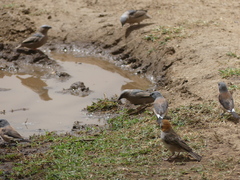
Gray-headed Social-Weaver

Gray-headed Social-Weaver

Pseudonigrita arnaudi

Silhouette: Sheatherius · PhyloPic

LCLeast ConcernNTVUENCR
Daily sighting probability <5% · Rare
at Samburu National Reserve

In 3 days ~10%

20 Verified sightings at Samburu National Reserve From 2019 to 2026
2,728 In all 11 parks
September Best month
☀️ Diurnal When it's spotted

About the Gray-headed Social-Weaver

The grey-capped social weaver (Pseudonigrita arnaudi) is a sparrow-like liver-colored bird, with a pale grey crown, a dark grey bill, a whitish eye-ring, horn-colored legs, with some black in the wing and a light terminal band in the tail, that builds roofed nests made of straws, breeds in colonies in thorny Acacia trees, and feeds in groups gathering grass seeds and insects. Male and female have near identical plumage. DNA-analysis confirms it is part of the weaver family. It is found in Ethiopia, Kenya, Somalia, South Sudan, Sudan, Tanzania, and Uganda.

The French naturalist Charles Lucien Bonaparte described the grey-capped social weaver as Nigrita arnaudi in 1850. He chose the specific epithet to honor Joseph Pons d'Arnaud, the French explorer who had collected a specimen around 1841 near Juba on the White Nile, and sent it to the French Museum of Natural History. In 1903, the German zoologist Anton Reichenow assigned the species to his newly erected genus Pseudonigrita, because he considered P. arnaudi and P. cabanisi related to weaverbirds (Ploceidae), while the other species Nigrita bicolor, N. canicapillus, N. fusconota and N. luteifrons are negrofinches assigned... Wikipedia →

Sounds

Call0:07

Kenya · 2022

© Lars Lachmann · XC753987 · CC BY-NC-SA 4.0

Song0:59

Tanzania · 2017

© Frank Lambert · XC429962 · CC BY-NC-ND 4.0

Call0:29

Tanzania · 2018

© Stein Ø. Nilsen · XC537708 · CC BY-NC-SA 4.0

Global Distribution

Parks Where Found

# Park Country Daily sighting probability
1 Ruaha National Park 🇹🇿 Tanzania
~50%
2 Serengeti National Park 🇹🇿 Tanzania
~40%
3 Kidepo Valley National Park 🇺🇬 Uganda
~20%
4 Masai Mara National Reserve 🇰🇪 Kenya
~20%
5 Ngorongoro Conservation Area 🇹🇿 Tanzania
~10%
6 Amboseli National Park 🇰🇪 Kenya
~10%
7 Tsavo West National Park 🇰🇪 Kenya
~10%
8 Nairobi National Park 🇰🇪 Kenya
<5%
9 Tarangire National Park 🇹🇿 Tanzania
<5%
10 Samburu National Reserve 🇰🇪 Kenya
<5%
11 Tsavo East National Park 🇰🇪 Kenya
<5%

Before you go

What are the chances of seeing a Gray-headed Social-Weaver in Samburu National Reserve?

Rare

Under 5% of wildlife watchers report a Gray-headed Social-Weaver sighting in Samburu National Reserve on a given day, based on 20 verified sightings from GBIF citizen-science data from 2019 to 2026. It is the 260th most-seen of the 341 birds we can rate there. Over three days the chance rises to about 10%, if each day is a fresh chance.

When is the best time to see a Gray-headed Social-Weaver in Samburu National Reserve?

September and December

In those months about 10% of wildlife watchers report a Gray-headed Social-Weaver in Samburu National Reserve on a given day, against under 5% in January–August and October–November, the lowest months.

What time of day is best to see a Gray-headed Social-Weaver?

Between 11 am and 2 pm

Across all the parks we cover, that three-hour window holds the most Gray-headed Social-Weaver sightings with a recorded time, and about 8 in 10 of them come between 6 am and 6 pm: it is a daytime animal.

Where does the Gray-headed Social-Weaver sighting chance come from?

GBIF citizen-science records

It is estimated from how often the Gray-headed Social-Weaver is recorded against all the birds logged in Samburu National Reserve (20 verified sightings from 2019 to 2026), calibrated against known sighting rates. Figures are rounded to the nearest 10% because citizen-science data supports honest approximations, not decimals, and months with records from fewer than five people show "—". How it works.

← Back to Samburu National Reserve