Barred Puffbird

Barred Puffbird

Nystalus radiatus

Silhouette: Matt Wilkins (Photo by Len Blumin) · PhyloPic

LCLeast ConcernNTVUENCR
Daily sighting probability ~10% · With luck
at San Lorenzo Protected Forest

In 3 days ~20% in a week ~40%

19 Verified sightings at San Lorenzo Protected Forest From 2019 to 2026
171 In all 3 parks
November Best month
☀️ Diurnal When it's spotted

About the Barred Puffbird

The barred puffbird (Nystalus radiatus) is a species of bird in the family Bucconidae, the puffbirds, nunlets, and nunbirds. It is found in Panama, Colombia and Ecuador. In the first half of the twentieth century the barred puffbird was treated by some authors as belonging to genus Ecchaunornis, but since then was returned to genus Nystalus. It is monotypic. A proposed subspecies, "N. r. fulvidus" is probably a color morph.

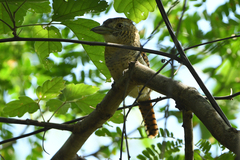
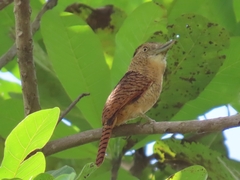
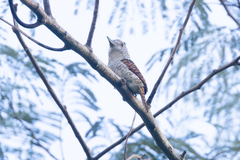
The barred puffbird is about 22 cm (8.7 in) long and weighs about 63 g (2.2 oz). Its crown is blackish with dark rufous bars. The upper nape is black, the lower nape yellowish red, and the upper mantle black. The rest of the upperparts and the wings are dark chestnut with narrow black bands. The tail is long, narrow, and chestnut with narrow black bands. The chin is whitish. The face and underparts are pale rufous with fine blackish bars except in the center of the belly. The bill is grayish yellow to blackish, the eye creamy yellow, and the feet greenish gray. The "fulvidus" morph is a deeper rufous overall.

The barred puffbird is resident from central Panama into northern Colombia and... Wikipedia →

Sounds

Song0:07

Ecuador · 2019

© rudy gelis · XC821896 · CC BY-NC-SA 4.0

Call0:10

Colombia · 2010

© Peter Boesman · XC273734 · CC BY-NC-ND 4.0

Song0:10

Colombia · 2014

© Hans Matheve · XC399820 · CC BY-NC-ND 4.0

Global Distribution

Parks Where Found

# Park Country Daily sighting probability
1 Darién National Park 🇵🇦 Panama
~10%
2 San Lorenzo Protected Forest 🇵🇦 Panama
~10%
3 Farallones de Cali National Natural Park 🇨🇴 Colombia
<5%

Before you go

What are the chances of seeing a Barred Puffbird in San Lorenzo Protected Forest?

With luck

About 10% of wildlife watchers report a Barred Puffbird sighting in San Lorenzo Protected Forest on a given day, based on 19 verified sightings from GBIF citizen-science data from 2019 to 2026. It is the 172nd most-seen of the 249 birds we can rate there. Over three days the chance rises to about 20%, and over a week to about 40%, if each day is a fresh chance.

When is the best time to see a Barred Puffbird in San Lorenzo Protected Forest?

November

In that month about 30% of wildlife watchers report a Barred Puffbird in San Lorenzo Protected Forest on a given day, against under 5% in July–October and December–April, the lowest months. That is one of San Lorenzo Protected Forest's wettest months, with about 380 mm of rain against 65 mm in February.

What time of day is best to see a Barred Puffbird?

Between 8 and 11 am

Across all the parks we cover, that three-hour window holds the most Barred Puffbird sightings with a recorded time, and about 9 in 10 of them come between 6 am and 6 pm: it is a daytime animal.

Is San Lorenzo Protected Forest the best place to see a Barred Puffbird?

Among the best

Of the 3 parks where we can rate Barred Puffbird sightings, San Lorenzo Protected Forest ranks 2nd at about 10%, level with the leaders once rounded. The best odds are in Darién National Park (Panama, about 10%).

Which relatives of the Barred Puffbird live in San Lorenzo Protected Forest?

Same family: Bucconidae

The closest relatives of the Barred Puffbird that you can see in San Lorenzo Protected Forest (family Bucconidae, Puffbirds) are Pied Puffbird (about 20%), Black-breasted Puffbird (about 10%) and White-whiskered Puffbird (about 10%), with each one's daily chance of a sighting.

Where does the Barred Puffbird sighting chance come from?

GBIF citizen-science records

It is estimated from how often the Barred Puffbird is recorded against all the birds logged in San Lorenzo Protected Forest (19 verified sightings from 2019 to 2026), calibrated against known sighting rates. Figures are rounded to the nearest 10% because citizen-science data supports honest approximations, not decimals, and months with records from fewer than five people show "—". How it works.

← Back to San Lorenzo Protected Forest