Peanut-Headed Lanternfly

Peanut-Headed Lanternfly

Fulgora laternaria

Daily sighting probability ~20% · Possible
at Santa Rosa National Park

In 3 days ~40% in a week ~70%

8 Verified sightings at Santa Rosa National Park From 2019 to 2026
13 In all 2 parks
October Best month
🌅 Crepuscular When it's spotted

About the Peanut-Headed Lanternfly

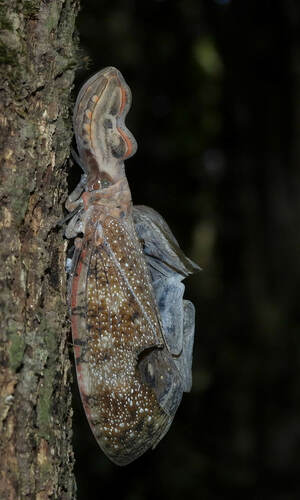
Fulgora laternaria (often misspelled "lanternaria") is a species of Neotropical fulgorid planthopper. It is known by a large variety of common names, among them lantern fly, peanut bug, peanut-headed lanternfly, alligator bug, jequitiranaboia, machaca, chicharra-machacuy, and cocoposa.

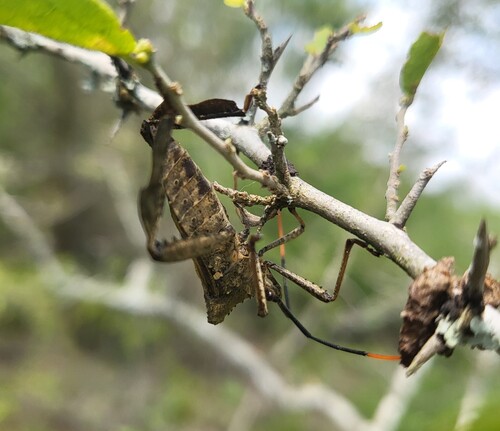
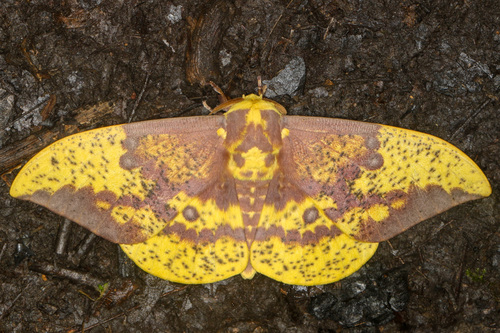
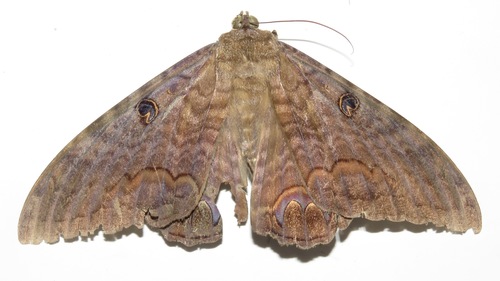
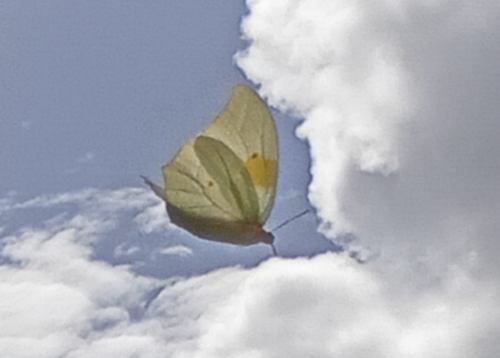
Fulgora laternaria can reach a length of 85–90 millimetres (3.3–3.5 in), with a wingspan up to 100–150 millimetres (3.9–5.9 in). This insect has a protuberance at its head as long as 10–15 millimetres (0.39–0.59 in), looking like a peanut and showing false eyes to resemble that of a lizard or a serpent. The insect was originally - and mistakenly - believed to be luminescent. When attacked, it protects itself by displaying large, yellow, fake eyes on its hind wings to frighten the aggressor, and releases a foul-smelling substance. Adults can be found from June to December. They feed on the sap of plants, mainly from some trees as Hymenaea courbaril, Simarouba amara and Zanthoxylum species. It will generally remain camouflaged on a tree trunk during the day.

It will knock its head on a hollow tree to create vibrations for mates. It will lay its eggs on the Hymenaea courbaril or quapinol... Wikipedia →
Global Distribution

Parks Where Found

# Park Country Daily sighting probability
1 Santa Rosa National Park 🇨🇷 Costa Rica
~20%
2 Carara National Park 🇨🇷 Costa Rica
~10%

Before you go

What are the chances of seeing a Peanut-Headed Lanternfly in Santa Rosa National Park?

Possible

About 20% of wildlife watchers report a Peanut-Headed Lanternfly sighting in Santa Rosa National Park on a given day, based on 8 verified sightings from GBIF citizen-science data from 2019 to 2026. It is the 12th most-seen of the 25 insects we can rate there. Over three days the chance rises to about 40%, and over a week to about 70%, if each day is a fresh chance.

When is the best time to see a Peanut-Headed Lanternfly in Santa Rosa National Park?

October

In that month about 40% of wildlife watchers report a Peanut-Headed Lanternfly in Santa Rosa National Park on a given day, against under 5% in July–September and December–May, the lowest months. That is one of Santa Rosa National Park's wettest months, with about 450 mm of rain against almost none in February.

What time of day is best to see a Peanut-Headed Lanternfly?

Between 7 and 10 am

Across all the parks we cover, that three-hour window holds the most Peanut-Headed Lanternfly sightings with a recorded time, and about 6 in 10 of them come between 6 am and 6 pm: it is most active around dawn and dusk.

Is Santa Rosa National Park the best place to see a Peanut-Headed Lanternfly?

Yes

Of the 2 parks where we can rate Peanut-Headed Lanternfly sightings, Santa Rosa National Park has the highest daily chance: about 20%. Next come Carara National Park (Costa Rica, about 10%).

Where does the Peanut-Headed Lanternfly sighting chance come from?

GBIF citizen-science records

It is estimated from how often the Peanut-Headed Lanternfly is recorded against all the insects logged in Santa Rosa National Park (8 verified sightings from 2019 to 2026), calibrated against known sighting rates. Figures are rounded to the nearest 10% because citizen-science data supports honest approximations, not decimals, and months with records from fewer than five people show "—". How it works.

← Back to Santa Rosa National Park