Least Honeyguide

Least Honeyguide

Indicator exilis

Silhouette: Sheatherius · PhyloPic

LCLeast ConcernNTVUENCR
Daily sighting probability ~10% · With luck
at Semuliki National Park

In 3 days ~20% in a week ~40%

31 Verified sightings at Semuliki National Park From 2019 to 2026
166 In all 4 parks
June Best month

About the Least Honeyguide

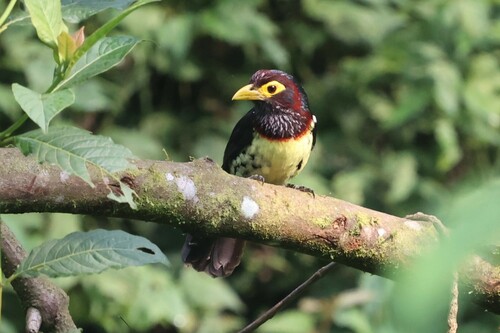
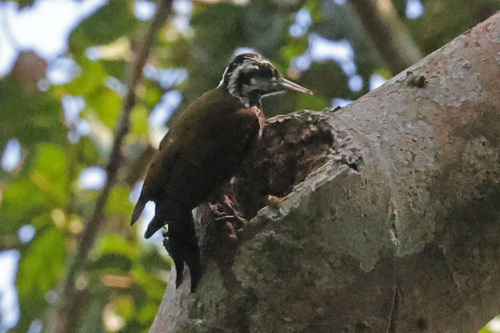
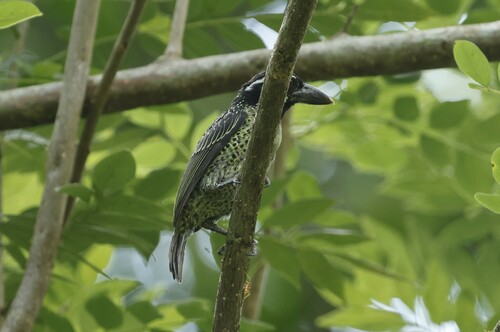
The least honeyguide (Indicator exilis) is a small species of bird in the family Indicatoridae. It is found in sub-Saharan Africa. The least honeyguide (Indicator exilis) is a small member of the family Indicatoridae. The plumage of the adult least honeyguide is an olive brown, with dark grey colouration on its underside and face. Pale spots are visible above the bill as well as on the tail when in flight. A narrow white line from the front of the eye to near the nostril can be seen on adult birds and a malar stripe can be seen stretching from the mandible to the birds ear-coverts.

A small bird, the least honey guide measures about 14 cm and weighs anywhere between 12 and 23 g. Males of the species tend to be noticeably larger in size than the females. The subspecies of I. exilis have often been confused for other closely related species. There are four known subspecies of I. exilis : I.e. exilis, I.e.poensis, I.e. cerophagus and I.e. pachyrhychus. These subspecies were initially thought to be the same as each other, however it came to researchers attention that they were in-fact separate. Even now there is some inconsistencies about the distribution... Wikipedia →

Sounds

Call0:53

Ghana · 2016

© Hans Matheve · XC351957 · CC BY-NC-ND 4.0

Song0:15

Ivory Coast · 2023

© Étienne Leroy · XC842390 · CC BY-NC-SA 4.0

Song0:05

Uganda · 2023

© Brendan Sloan · XC832156 · CC BY-NC-ND 4.0

Global Distribution

Parks Where Found

# Park Country Daily sighting probability
1 Semuliki National Park 🇺🇬 Uganda
~10%
2 Bwindi Impenetrable National Park 🇺🇬 Uganda
<5%
3 Kibale National Park 🇺🇬 Uganda
<5%
4 Nyungwe National Park 🇷🇼 Rwanda
<5%

Before you go

What are the chances of seeing a Least Honeyguide in Semuliki National Park?

With luck

About 10% of wildlife watchers report a Least Honeyguide sighting in Semuliki National Park on a given day, based on 31 verified sightings from GBIF citizen-science data from 2019 to 2026. It is the 150th most-seen of the 280 birds we can rate there. Over three days the chance rises to about 20%, and over a week to about 40%, if each day is a fresh chance.

When is the best time to see a Least Honeyguide in Semuliki National Park?

June and July

In those months about 20% of wildlife watchers report a Least Honeyguide in Semuliki National Park on a given day, against under 5% in March–May and August–November, the lowest months.

Is Semuliki National Park the best place to see a Least Honeyguide?

Yes

Of the 4 parks where we can rate Least Honeyguide sightings, Semuliki National Park has the highest daily chance: about 10%. Next come Bwindi Impenetrable National Park (Uganda, under 5%) and Kibale National Park (Uganda, under 5%).

Where does the Least Honeyguide sighting chance come from?

GBIF citizen-science records

It is estimated from how often the Least Honeyguide is recorded against all the birds logged in Semuliki National Park (31 verified sightings from 2019 to 2026), calibrated against known sighting rates. Figures are rounded to the nearest 10% because citizen-science data supports honest approximations, not decimals, and months with records from fewer than five people show "—". How it works.


← Back to Semuliki National Park