Golden-crowned Woodpecker

Golden-crowned Woodpecker

Chloropicus xantholophus

Silhouette: Pepe Reigada · PhyloPic

Daily sighting probability ~40% · Likely
at Semuliki National Park

In 3 days ~80% in a week >90%

171 Verified sightings at Semuliki National Park From 2019 to 2026
416 In all 4 parks
July Best month
☀️ Diurnal When it's spotted

About the Golden-crowned Woodpecker

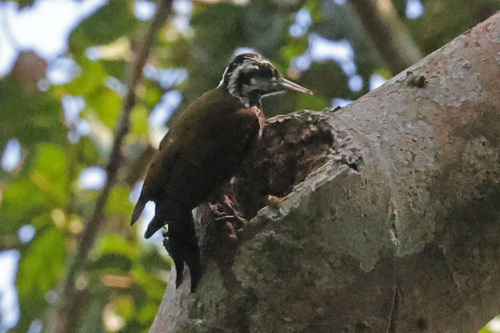
The yellow-crested woodpecker (Chloropicus xantholophus), also known as the golden-crowned woodpecker, is a species of bird in the family Picidae. Some taxonomic authorities place this species in Dendropicos. Its typical habitat is wet tropical forest and it is found in Angola, Cameroon, Central African Republic, Republic of the Congo, Democratic Republic of the Congo, Gabon, Kenya, Nigeria, South Sudan, Tanzania and Uganda.

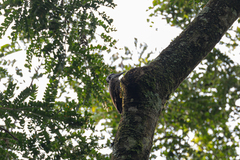
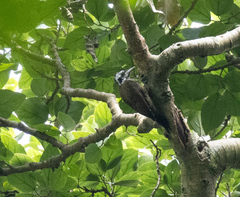
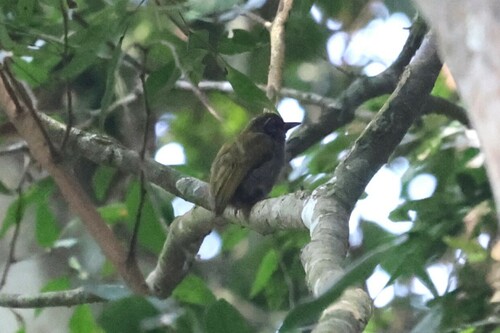
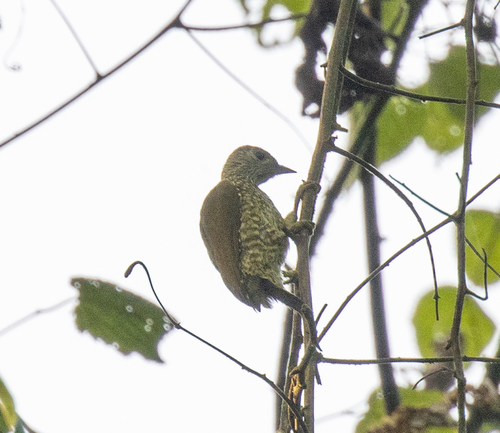
The yellow-crested woodpecker grows to a length of 22 to 25 cm (9 to 10 in). The male has a small golden patch with black flecking on the crown, most noticeable in display, but the female lacks this. In other respects, the sexes are similar, the forehead being brown and the cheeks and throat whitish; there is a broad black streak through the eye which extends to the sides of the neck. The nape is black and the upper parts of the body are dull brownish-olive, usually plain but sometimes slightly barred. The rump and upper tail coverts are yellowish and the tail chocolate-brown. The underparts are brown with white spotting on the breast and white barring on the flanks and lower belly. The beak is long, the upper mandible being darker than the lower... Wikipedia →
Sounds

Drumming0:30

Kenya · 2018

© Frank Lambert · XC451946 · CC BY-NC-ND 4.0

Drum0:39

Kenya · 2024

© Peter Boesman · XC948039 · CC BY-NC-ND 4.0

Call0:10

Uganda · 2015

© Martin St-Michel · XC291366 · CC BY-NC-SA 4.0

Global Distribution

Parks Where Found

# Park Country Daily sighting probability
1 Semuliki National Park 🇺🇬 Uganda
~40%
2 Kibale National Park 🇺🇬 Uganda
~10%
3 Bwindi Impenetrable National Park 🇺🇬 Uganda
<5%
4 Queen Elizabeth National Park 🇺🇬 Uganda
<5%

Before you go

What are the chances of seeing a Golden-crowned Woodpecker in Semuliki National Park?

Likely

About 40% of wildlife watchers report a Golden-crowned Woodpecker sighting in Semuliki National Park on a given day, based on 171 verified sightings from GBIF citizen-science data from 2019 to 2026. It is the 26th most-seen of the 280 birds we can rate there. Over three days the chance rises to about 80%, and over a week to over 90%, if each day is a fresh chance.

When is the best time to see a Golden-crowned Woodpecker in Semuliki National Park?

July

In that month about 70% of wildlife watchers report a Golden-crowned Woodpecker in Semuliki National Park on a given day, against about 20% in September, the lowest month.

What time of day is best to see a Golden-crowned Woodpecker?

Between 7 and 10 am

Across all the parks we cover, that three-hour window holds the most Golden-crowned Woodpecker sightings with a recorded time, and about 9 in 10 of them come between 6 am and 6 pm: it is a daytime animal.

Is Semuliki National Park the best place to see a Golden-crowned Woodpecker?

Yes

Of the 4 parks where we can rate Golden-crowned Woodpecker sightings, Semuliki National Park has the highest daily chance: about 40%. Next come Kibale National Park (Uganda, about 10%) and Bwindi Impenetrable National Park (Uganda, under 5%).

Which relatives of the Golden-crowned Woodpecker live in Semuliki National Park?

Same family: Picidae

The closest relatives of the Golden-crowned Woodpecker that you can see in Semuliki National Park (family Picidae, Woodpeckers) are Brown-Eared Woodpecker (about 30%) and African Piculet (about 20%), with each one's daily chance of a sighting.

Where does the Golden-crowned Woodpecker sighting chance come from?

GBIF citizen-science records

It is estimated from how often the Golden-crowned Woodpecker is recorded against all the birds logged in Semuliki National Park (171 verified sightings from 2019 to 2026), calibrated against known sighting rates. Figures are rounded to the nearest 10% because citizen-science data supports honest approximations, not decimals, and months with records from fewer than five people show "—". How it works.

← Back to Semuliki National Park