
Narrow-tailed Starling

Narrow-tailed Starling

Poeoptera lugubris

Silhouette: Rafael Maia · PhyloPic

LCLeast ConcernNTVUENCR
Daily sighting probability <5% · Rare
at Semuliki National Park

In 3 days <5% in a week ~10%

6 Verified sightings at Semuliki National Park From 2019 to 2026
315 In all 4 parks
May Best month
☀️ Diurnal When it's spotted

About the Narrow-tailed Starling

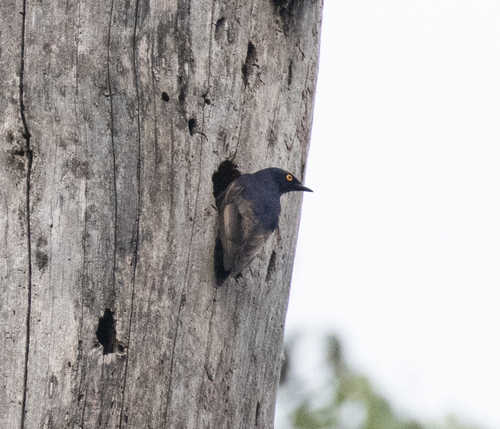
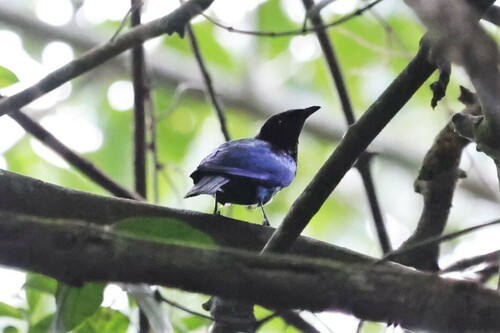
The narrow-tailed starling (Poeoptera lugubris) is a species of starling in the family Sturnidae. It is sparsely present across the African tropical rainforest. The male is dark blue and the female is dark gray with chestnut-colored patches on the wings, visible in flight. Both sexes have long, narrow tails. Not a very noisy bird, this starling's vocalizations include shrill chirps, cries, and whistles.

Its habitat is the canopy of lowland forest, making use of secondary forest and forest clearings. It eats mostly fruit, and sometimes insects or seeds. These starlings form flocks of 10-30 or more birds, and sometimes will mix with other fruit-eating birds. This bird is a colony-nester, making its nest high up in dead trees in holes originally excavated by colonial cavity-nesting barbets, sometimes with both birds nesting in close proximity. Eggs are pale blue-gray with brown spots.

Image at ADW Wikipedia →

Global Distribution

Parks Where Found

# Park Country Daily sighting probability
1 Bwindi Impenetrable National Park 🇺🇬 Uganda
~10%
2 Kibale National Park 🇺🇬 Uganda
<5%
3 Virunga National Park 🇨🇩 Democratic Republic of the Congo
<5%
4 Semuliki National Park 🇺🇬 Uganda
<5%

Before you go

What are the chances of seeing a Narrow-tailed Starling in Semuliki National Park?

Rare

Under 5% of wildlife watchers report a Narrow-tailed Starling sighting in Semuliki National Park on a given day, based on 6 verified sightings from GBIF citizen-science data from 2019 to 2026. It is the 247th most-seen of the 280 birds we can rate there. Over three days the chance rises to under 5%, and over a week to about 10%, if each day is a fresh chance.

When is the best time to see a Narrow-tailed Starling in Semuliki National Park?

May

In that month about 10% of wildlife watchers report a Narrow-tailed Starling in Semuliki National Park on a given day, against under 5% in June to April, the lowest months. That is one of Semuliki National Park's wettest months, with about 140 mm of rain against 5 mm in January.

What time of day is best to see a Narrow-tailed Starling?

Between 4 and 7 pm

Across all the parks we cover, that three-hour window holds the most Narrow-tailed Starling sightings with a recorded time, and about 8 in 10 of them come between 6 am and 6 pm: it is a daytime animal.

Is Semuliki National Park the best place to see a Narrow-tailed Starling?

4th of 4

Of the 4 parks where we can rate Narrow-tailed Starling sightings, Semuliki National Park ranks 4th at under 5%. The best odds are in Bwindi Impenetrable National Park (Uganda, about 10%), Kibale National Park (Uganda, under 5%) and Virunga National Park (Democratic Republic of the Congo, under 5%).

Which relatives of the Narrow-tailed Starling live in Semuliki National Park?

Same family: Sturnidae

The closest relatives of the Narrow-tailed Starling that you can see in Semuliki National Park (family Sturnidae, Starlings) are Purple-headed Starling (about 30%) and Splendid Glossy-starling (about 20%), with each one's daily chance of a sighting.

Where does the Narrow-tailed Starling sighting chance come from?

GBIF citizen-science records

It is estimated from how often the Narrow-tailed Starling is recorded against all the birds logged in Semuliki National Park (6 verified sightings from 2019 to 2026), calibrated against known sighting rates. Figures are rounded to the nearest 10% because citizen-science data supports honest approximations, not decimals, and months with records from fewer than five people show "—". How it works.

← Back to Semuliki National Park