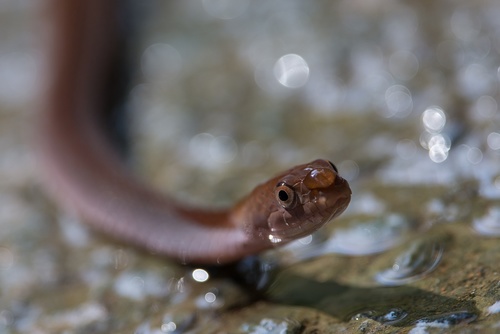

Blue-necked Keelback

Blue-necked Keelback

Rhabdophis rhodomelas

Silhouette: V. Deepak · PhyloPic

LCLeast ConcernNTVUENCR
Daily sighting probability ~10% · With luck
at Sepilok

In 3 days ~30% in a week ~50%

6 Verified sightings at Sepilok From 2019 to 2026
6 In 1 park
November Best month
☀️🌙 Day & Night When it's spotted

About the Blue-necked Keelback

Rhabdophis rhodomelas, the blueneck keelback or blue-necked keelback, is a species of snake in the subfamily Natricinae of the family Colubridae. It is found in the Malay Peninsula (southern Thailand, Peninsular Malaysia, Singapore), Borneo (Sarawak and Sabah, Malaysia; Kalimantan, Indonesia), and in the western parts of the Indonesian Archipelago (Sumatra, Java, Bangka Island).

Rhabdophis rhodomelas is an uncommon species found in lowland forest near streams and rivers at elevations less than 200 m (660 ft) above sea level. It is oviparous, laying up to 27 eggs per clutch. In the popular book, Fascinating Snakes of South East Asia - An Introduction. By Francis Lim Leong Keng & Monty Lee Tat-Mong. 1989 ISBN 967-73-0045-8. Page 61 There is a photo and short description of this snake. It states that " When disturbed, the Blue-Necked Keelback will rear up and flatten its neck like the Cobra. A whitish discharge, secreted by glands under the skin, oozes onto the blue patch of the neck-the purpose of this phenomenon is still a mystery." After much research we cannot find any further reference to this phenomenon. Wikipedia →

Global Distribution

Parks Where Found

# Park Country Daily sighting probability
1 Sepilok 🇲🇾 Malaysia
~10%

More parks will be added in future updates.

Before you go

What are the chances of seeing a Blue-necked Keelback in Sepilok?

With luck

About 10% of wildlife watchers report a Blue-necked Keelback sighting in Sepilok on a given day, based on 6 verified sightings from GBIF citizen-science data from 2019 to 2026. It is the 29th most-seen of the 34 reptiles we can rate there. Over three days the chance rises to about 30%, and over a week to about 50%, if each day is a fresh chance.

When is the best time to see a Blue-necked Keelback in Sepilok?

November

In that month about 30% of wildlife watchers report a Blue-necked Keelback in Sepilok on a given day, against under 5% in September–October and December–June, the lowest months. That is one of Sepilok's wettest months, with about 400 mm of rain against 170 mm in March.

What time of day is best to see a Blue-necked Keelback?

Between 10 pm and 1 am

Across all the parks we cover, that three-hour window holds the most Blue-necked Keelback sightings with a recorded time, and about half of them come between 6 am and 6 pm: it is seen both by day and at night.

Where else can you see a Blue-necked Keelback?

Only Sepilok, in our data

Sepilok is the only park on Wallace's Line with enough records to rate Blue-necked Keelback sightings: about 10% of wildlife watchers there report one on a given day.

Where does the Blue-necked Keelback sighting chance come from?

GBIF citizen-science records

It is estimated from how often the Blue-necked Keelback is recorded against all the reptiles logged in Sepilok (6 verified sightings from 2019 to 2026), calibrated against known sighting rates. Figures are rounded to the nearest 10% because citizen-science data supports honest approximations, not decimals, and months with records from fewer than five people show "—". How it works.

← Back to Sepilok