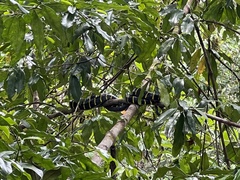

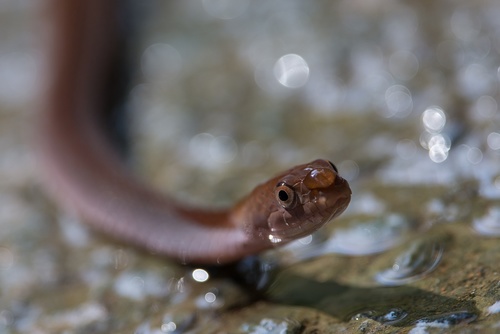
Gold-ringed Cat Snake

Gold-ringed Cat Snake

Boiga dendrophila

Silhouette: Alex Slavenko · PhyloPic

LCLeast ConcernNTVUENCR
Daily sighting probability ~20% · Possible
at Sepilok

In 3 days ~40% in a week ~70%

16 Verified sightings at Sepilok From 2019 to 2026
56 In all 3 parks
February Best month
☀️ Diurnal When it's spotted

About the Gold-ringed Cat Snake

Boiga dendrophila, commonly called the mangrove snake or the gold-ringed cat snake, is a species of rear-fanged venomous snake in the family Colubridae. The species is endemic to southeast Asia. It is one of the biggest cat snake species, averaging 8–9 feet (2.4–2.7 m) in length. It is considered mildly venomous. Although moderate envenomations resulting in intense swelling have been reported, there has never been a confirmed fatality.

B. dendrophila has the following characteristics: Snout longer than eye; rostral broader than deep, visible from above; internasals as long as or shorter than the prae-frontals; frontal as long as or slightly shorter than its distance from the tip of the snout; loreal at least as long as deep; a praeocular extending to the upper surface of the head, not reaching the frontal; two postoculars; temporals 2 + 2 or 2 + 3; eight (nine) upper labials, third to fifth entering the eye; four or five lower labials in contact with the anterior chin-shields; latter as long as or longer than the posterior; anterior palatine teeth not much larger than the posterior.

Scales in 21 (23) rows, vertebral row enlarged; ventrals 209–239; anal entire; subcaudals... Wikipedia →

Global Distribution

Parks Where Found

# Park Country Daily sighting probability
1 Kinabalu Park 🇲🇾 Malaysia
~30%
2 Kinabatangan Wildlife Sanctuary 🇲🇾 Malaysia
~20%
3 Sepilok 🇲🇾 Malaysia
~20%

Cities Where Found

# City Country Daily sighting probability
1 Denpasar 🇮🇩 Indonesia
~30%

Zoos & Centres Where Found

# Zoo / Centre Country
1 Prague Zoo 🇨🇿 Czechia In captivity
2 National Zoological Park 🇺🇸 United States In captivity
3 Tierpark Berlin 🇩🇪 Germany In captivity
4 Zoo Pilsen 🇨🇿 Czechia In captivity
5 Virginia Zoological Park 🇺🇸 United States In captivity
6 Zoo Atlanta 🇺🇸 United States In captivity
7 Budapest Zoo & Botanical Garden 🇭🇺 Hungary In captivity
8 Buffalo Zoo 🇺🇸 United States In captivity
9 Reptile Gardens 🇺🇸 United States In captivity
10 Davao Crocodile Park & Zoo 🇵🇭 Philippines In captivity
11 Clyde Peeling's Reptiland 🇺🇸 United States In captivity
12 Rákosův pavilon 🇨🇿 Czechia In captivity
13 Velemlokárium 🇨🇿 Czechia In captivity
14 Sea Life Bangkok Ocean World 🇹🇭 Thailand In captivity
15 Snake Discovery: A Reptile Experience 🇺🇸 United States In captivity

Before you go

What are the chances of seeing a Gold-ringed Cat Snake in Sepilok?

Possible

About 20% of wildlife watchers report a Gold-ringed Cat Snake sighting in Sepilok on a given day, based on 16 verified sightings from GBIF citizen-science data from 2019 to 2026. It is the 16th most-seen of the 34 reptiles we can rate there. Over three days the chance rises to about 40%, and over a week to about 70%, if each day is a fresh chance.

When is the best time to see a Gold-ringed Cat Snake in Sepilok?

February

In that month about 40% of wildlife watchers report a Gold-ringed Cat Snake in Sepilok on a given day, against under 5% in March, May, August and December–January, the lowest months.

What time of day is best to see a Gold-ringed Cat Snake?

Between 2 and 5 pm

Across all the parks we cover, that three-hour window holds the most Gold-ringed Cat Snake sightings with a recorded time, and about 8 in 10 of them come between 6 am and 6 pm: it is a daytime animal.

Is Sepilok the best place to see a Gold-ringed Cat Snake?

3rd of 3

Of the 3 parks where we can rate Gold-ringed Cat Snake sightings, Sepilok ranks 3rd at about 20%. The best odds are in Kinabalu Park (Malaysia, about 30%) and Kinabatangan Wildlife Sanctuary (Malaysia, about 20%).

Where does the Gold-ringed Cat Snake sighting chance come from?

GBIF citizen-science records

It is estimated from how often the Gold-ringed Cat Snake is recorded against all the reptiles logged in Sepilok (16 verified sightings from 2019 to 2026), calibrated against known sighting rates. Figures are rounded to the nearest 10% because citizen-science data supports honest approximations, not decimals, and months with records from fewer than five people show "—". How it works.

← Back to Sepilok