Equatorial Spitting Cobra

Equatorial Spitting Cobra

Naja sumatrana

Silhouette: V. Deepak · PhyloPic

LCLeast ConcernNTVUENCR
Daily sighting probability ~10% · With luck
at Sepilok

In 3 days ~30% in a week ~50%

7 Verified sightings at Sepilok From 2019 to 2026
7 In 1 park
August Best month
☀️ Diurnal When it's spotted

About the Equatorial Spitting Cobra

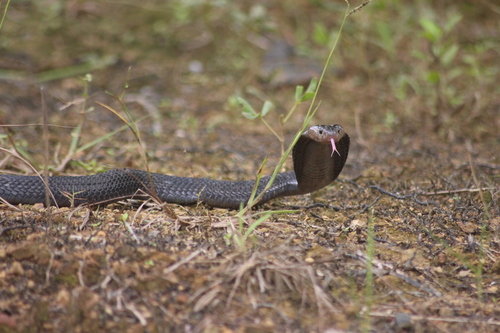
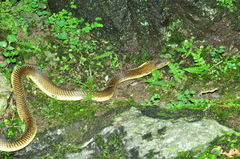
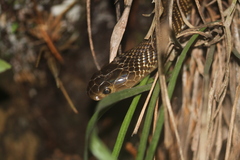
The Equatorial spitting cobra (Naja sumatrana) also called the Malayan spitting cobra, golden spitting cobra, Sumatran spitting cobra, or Palawan spitting cobra, is a species of spitting cobra found in Southeast Asia. This species is medium in length, averaging between 0.9 to 1.2 metres (3.0 to 3.9 ft) in length, though they can grow up to 1.5 metres (4.9 ft). The body is compressed dorsoventrally and sub-cylindrical posteriorly. The head of this species is elliptical, depressed, and slightly distinct from the neck with a short, rounded snout and large nostrils. Eyes are medium in size with round pupils. Dorsal scales are smooth and strongly oblique. This species of cobra has no hood marks and colouration varies based upon geographical location. There are two colour phases: a yellow form commonly found in Thailand and Northern Peninsular Malaysia, and a black form found in Peninsular Malaysia, Singapore, and the islands where it occurs in Indonesia and the Philippines. Juveniles and adults also tend to be of different colour.

19-27 rows around the hood (normally 21–25), 15-19 just ahead of the mid-body; 179-201 ventrals, 40-57 subcaudals; basal subcaudals... Wikipedia →

Global Distribution

Parks Where Found

# Park Country Daily sighting probability
1 Sepilok 🇲🇾 Malaysia
~10%

More parks will be added in future updates.

Cities Where Found

# City Country Daily sighting probability
1 Singapore 🇸🇬 Singapore
~10%

Zoos & Centres Where Found

# Zoo / Centre Country
1 National Zoo of Malaysia 🇲🇾 Malaysia In captivity
2 Siam Serpentarium 🇹🇭 Thailand In captivity
3 Snake Farm of Queen Saovabha Memorial Institute 🇹🇭 Thailand In captivity

Before you go

What are the chances of seeing an Equatorial Spitting Cobra in Sepilok?

With luck

About 10% of wildlife watchers report an Equatorial Spitting Cobra sighting in Sepilok on a given day, based on 7 verified sightings from GBIF citizen-science data from 2019 to 2026. It is the 27th most-seen of the 34 reptiles we can rate there. Over three days the chance rises to about 30%, and over a week to about 50%, if each day is a fresh chance.

When is the best time to see an Equatorial Spitting Cobra in Sepilok?

February and August

In those months about 20% of wildlife watchers report an Equatorial Spitting Cobra in Sepilok on a given day, against under 5% in March, May, July and November–January, the lowest months.

What time of day is best to see an Equatorial Spitting Cobra?

Between 9 am and noon

Across all the parks we cover, that three-hour window holds the most Equatorial Spitting Cobra sightings with a recorded time, and about 8 in 10 of them come between 6 am and 6 pm: it is a daytime animal.

Where else can you see an Equatorial Spitting Cobra?

Only Sepilok, in our data

Sepilok is the only park on Wallace's Line with enough records to rate Equatorial Spitting Cobra sightings: about 10% of wildlife watchers there report one on a given day.

Where does the Equatorial Spitting Cobra sighting chance come from?

GBIF citizen-science records

It is estimated from how often the Equatorial Spitting Cobra is recorded against all the reptiles logged in Sepilok (7 verified sightings from 2019 to 2026), calibrated against known sighting rates. Figures are rounded to the nearest 10% because citizen-science data supports honest approximations, not decimals, and months with records from fewer than five people show "—". How it works.

← Back to Sepilok