Spotted House Gecko

Spotted House Gecko

Gekko monarchus

Silhouette: Steven Traver · PhyloPic

LCLeast ConcernNTVUENCR
Daily sighting probability ~30% · Possible
at Sepilok

In 3 days ~70% in a week ~90%

53 Verified sightings at Sepilok From 2019 to 2026
244 In all 8 parks
January Best month
☀️ Diurnal When it's spotted

About the Spotted House Gecko

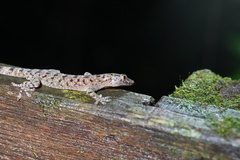
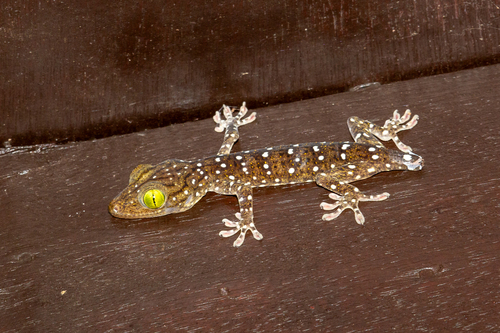
Gekko monarchus, also called the spotted house gecko, is a species of gecko found in the Malay Peninsula (including southern Thailand and Singapore), some smaller Malaysian islands, Borneo (Brunei, East Malaysia and Kalimantan), the Philippines, many Indonesian islands including Sumatra, Java, Sulawesi, and New Guinea (Irian Jaya and Papua New Guinea).

This lizard has the typical body build of the genus Gekko - it appears flat and has a rough skin with small bumps on its back. Their tails regenerate once dropped, as with most gecko species. The regenerated tail will never look the same as the original (it has a different texture and slightly odd color).

Similar to common house geckos and dtellas, males make quiet clicking sounds when courting a female; both sexes are capable of chirping and "barking". When startled or alarmed, the gecko waves its tail quickly and may breathe heavily, making a sound not unlike hissing.

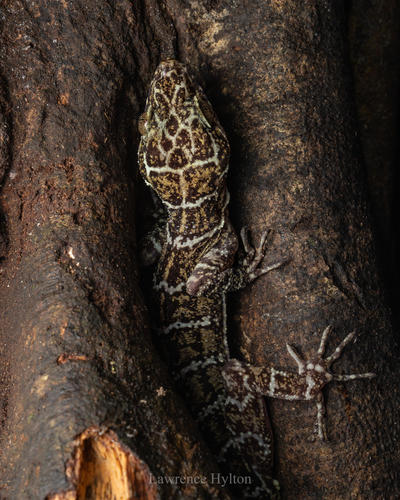
They have a W spot on the backs of their heads, typical for this species. Monarch geckos are strictly insectivorous, feeding on various types of insects (roaches, crickets, flies, spiders, even wasps). Wikipedia →

Global Distribution

Parks Where Found

# Park Country Daily sighting probability
1 Taman Negara National Park 🇲🇾 Malaysia
~40%
2 Danum Valley Conservation Area 🇲🇾 Malaysia
~40%
3 Bako National Park 🇲🇾 Malaysia
~40%
4 Kinabalu Park 🇲🇾 Malaysia
~30%
5 Sepilok 🇲🇾 Malaysia
~30%
6 Gunung Leuser National Park 🇮🇩 Indonesia
~30%
7 Kinabatangan Wildlife Sanctuary 🇲🇾 Malaysia
~30%
8 Tanjung Puting National Park 🇮🇩 Indonesia
~30%

Cities Where Found

# City Country Daily sighting probability
1 Kuching 🇲🇾 Malaysia
~40%
2 Johor Bahru 🇲🇾 Malaysia
~20%
3 Kuala Lumpur 🇲🇾 Malaysia
~10%
4 Singapore 🇸🇬 Singapore
~10%
5 Tainan 🇹🇼 Taiwan
~10%
6 Kaohsiung 🇹🇼 Taiwan
~10%

Before you go

What are the chances of seeing a Spotted House Gecko in Sepilok?

Possible

About 30% of wildlife watchers report a Spotted House Gecko sighting in Sepilok on a given day, based on 53 verified sightings from GBIF citizen-science data from 2019 to 2026. It is the 9th most-seen of the 34 reptiles we can rate there. Over three days the chance rises to about 70%, and over a week to about 90%, if each day is a fresh chance.

When is the best time to see a Spotted House Gecko in Sepilok?

January, April and October

In those months about 40% of wildlife watchers report a Spotted House Gecko in Sepilok on a given day, against under 5% in June, the lowest month.

What time of day is best to see a Spotted House Gecko?

Between 1 and 4 pm

Across all the parks we cover, that three-hour window holds the most Spotted House Gecko sightings with a recorded time, and about 8 in 10 of them come between 6 am and 6 pm: it is a daytime animal.

Which relatives of the Spotted House Gecko live in Sepilok?

Same genus: Gekko

The closest relatives of the Spotted House Gecko that you can see in Sepilok (genus Gekko, Calling Geckos) are White-banded Narrow-disked Gecko (about 20%) and Horsfield's Flying Gecko (about 10%), with each one's daily chance of a sighting.

Where does the Spotted House Gecko sighting chance come from?

GBIF citizen-science records

It is estimated from how often the Spotted House Gecko is recorded against all the reptiles logged in Sepilok (53 verified sightings from 2019 to 2026), calibrated against known sighting rates. Figures are rounded to the nearest 10% because citizen-science data supports honest approximations, not decimals, and months with records from fewer than five people show "—". How it works.

← Back to Sepilok