Pale Giant Squirrel

Pale Giant Squirrel

Ratufa affinis

Silhouette: Joseph Smit · PhyloPic

LCNTNear ThreatenedVUENCR
Daily sighting probability ~40% · Likely
at Sepilok

In 3 days ~80% in a week >90%

259 Verified sightings at Sepilok From 2019 to 2026
333 In all 4 parks
November Best month
🌅 Crepuscular When it's spotted

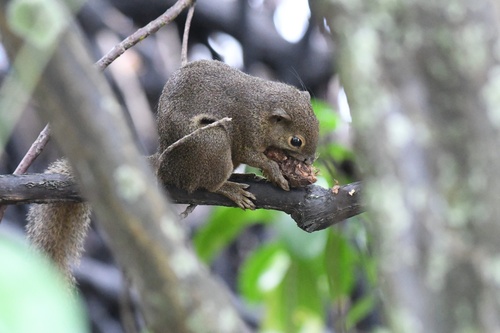
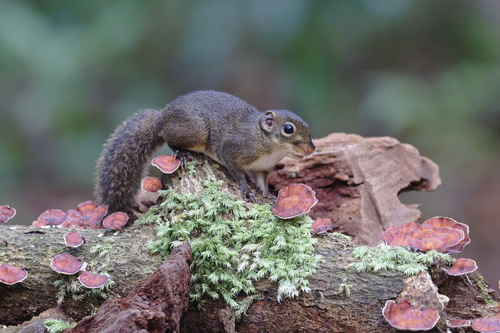
About the Pale Giant Squirrel

The cream-coloured giant squirrel or pale giant squirrel (Ratufa affinis) is a large tree squirrel in the genus Ratufa found in forests in the Thai-Malay Peninsula, Sumatra (Indonesia), Borneo (Brunei, Indonesia and Malaysia) and nearby small islands. The species is near threatened and vulnerable to habitat degradation, and it has probably been extirpated in Singapore where the last sighting was in 1995. Reported sightings in Vietnam in 1984 are considered to be dubious.

The cream-coloured giant squirrel is one of the largest squirrels. It has a head–and–body length of 31–38 cm (1 ft 0 in – 1 ft 3 in), a tail length of 37–44 cm (1 ft 3 in – 1 ft 5 in) and weighs 875–1,500 g (1.929–3.307 lb). On average, adults of both sexes have a head–and–body length of about 34 cm (1 ft 1 in) and tail length of 42 cm (1 ft 5 in), while females weight about 1,250 g (2.76 lb) and males 1,050 g (2.31 lb).

As suggested by its name, the cream-coloured giant squirrel is typically overall cream to very light orangish-brown, while the underparts are whitish-cream. In Borneo and nearby small islands where it is the only Ratufa giant squirrel, some populations resemble cream-coloured giant... Wikipedia →

Sounds

Call0:33

Malaysia · 2011

© Marc Anderson · XC1060958 · CC BY-NC-ND 4.0

Global Distribution

Parks Where Found

# Park Country Daily sighting probability
1 Sepilok 🇲🇾 Malaysia
~40%
2 Danum Valley Conservation Area 🇲🇾 Malaysia
~30%
3 Kinabalu Park 🇲🇾 Malaysia
~20%
4 Kinabatangan Wildlife Sanctuary 🇲🇾 Malaysia
~10%

Before you go

What are the chances of seeing a Pale Giant Squirrel in Sepilok?

Likely

About 40% of wildlife watchers report a Pale Giant Squirrel sighting in Sepilok on a given day, based on 259 verified sightings from GBIF citizen-science data from 2019 to 2026. It is the 5th most-seen of the 23 mammals we can rate there. Over three days the chance rises to about 80%, and over a week to over 90%, if each day is a fresh chance.

When is the best time to see a Pale Giant Squirrel in Sepilok?

January, April, July and October–November

In those months about 50% of wildlife watchers report a Pale Giant Squirrel in Sepilok on a given day, against about 20% in December, the lowest month.

What time of day is best to see a Pale Giant Squirrel?

Between 1 and 4 am

Across all the parks we cover, that three-hour window holds the most Pale Giant Squirrel sightings with a recorded time, and about 6 in 10 of them come between 6 pm and 6 am: it is most active around dawn and dusk.

Is Sepilok the best place to see a Pale Giant Squirrel?

Yes

Of the 4 parks where we can rate Pale Giant Squirrel sightings, Sepilok has the highest daily chance: about 40%. Next come Danum Valley Conservation Area (Malaysia, about 30%) and Kinabalu Park (Malaysia, about 20%).

Where does the Pale Giant Squirrel sighting chance come from?

GBIF citizen-science records

It is estimated from how often the Pale Giant Squirrel is recorded against all the mammals logged in Sepilok (259 verified sightings from 2019 to 2026), calibrated against known sighting rates. Figures are rounded to the nearest 10% because citizen-science data supports honest approximations, not decimals, and months with records from fewer than five people show "—". How it works.

← Back to Sepilok