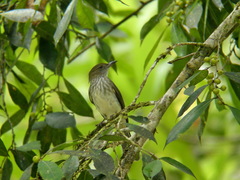
Streaked Bulbul

Streaked Bulbul

Ixos malaccensis

Silhouette: PhyloPic

LCNTNear ThreatenedVUENCR
Daily sighting probability ~20% · Possible
at Sepilok

In 3 days ~60% in a week ~90%

662 Verified sightings at Sepilok From 2019 to 2026
1,246 In all 8 parks
October Best month
☀️ Diurnal When it's spotted

About the Streaked Bulbul

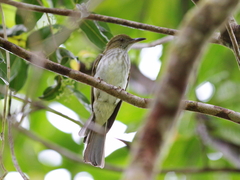
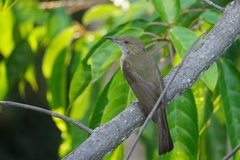
The streaked bulbul (Ixos malaccensis), or green-backed bulbul, is a songbird species in the bulbul family (Pycnonotidae). It is found on the Malay Peninsula, Sumatra, and Borneo. Its natural habitat is subtropical or tropical moist lowland forests. It is becoming rare due to habitat loss.

The current placement of the streaked bulbul in the genus Ixos is not fixed with any certainty. As the affiliations of the Javan bulbul (the type species of the genus) remain to be re-studied, it is not yet clear if the streaked bulbul should instead be placed in the genus Hemixos or possibly placed in a new genus. Both the alternate name 'green-backed bulbul' and the synonym Hypsipetes malaccensis are also shared with the eastern bearded greenbul. The name 'streaked bulbul' is also used as an alternate name for the Javan bulbul.

Gregory, Steven M. (2000): Nomenclature of the Hypsipetes Bulbuls (Pycnonotidae). Forktail Vol. 16: 164–166. PDF fulltext Moyle, Robert G. & Marks, Ben D. (2006): Phylogenetic relationships of the bulbuls (Aves: Pycnonotidae) based on mitochondrial and nuclear DNA sequence data. Mol. Phylogenet. Evol. Vol. 40... Wikipedia →

Sounds

Call0:07

Malaysia · 2025

© Nick Talbot · XC1036449 · CC BY-NC-SA 4.0

Song0:53

Malaysia · 2025

© Ding Li Yong · XC1024064 · CC BY-NC-ND 4.0

Recording0:27

Malaysia · 2022

© Wai Loon Wong · XC728375 · CC BY-NC-SA 4.0

Global Distribution

Parks Where Found

# Park Country Daily sighting probability
1 Sepilok 🇲🇾 Malaysia
~20%
2 Taman Negara National Park 🇲🇾 Malaysia
~20%
3 Khao Sok National Park 🇹🇭 Thailand
~10%
4 Khao Luang National Park 🇹🇭 Thailand
~10%
5 Danum Valley Conservation Area 🇲🇾 Malaysia
<5%
6 Kinabalu Park 🇲🇾 Malaysia
<5%
7 Gunung Leuser National Park 🇮🇩 Indonesia
<5%
8 Kinabatangan Wildlife Sanctuary 🇲🇾 Malaysia
<5%

Cities Where Found

# City Country Daily sighting probability
1 Kuala Lumpur 🇲🇾 Malaysia
<5%

Before you go

What are the chances of seeing a Streaked Bulbul in Sepilok?

Possible

About 20% of wildlife watchers report a Streaked Bulbul sighting in Sepilok on a given day, based on 662 verified sightings from GBIF citizen-science data from 2019 to 2026. It is the 51st most-seen of the 242 birds we can rate there. Over three days the chance rises to about 60%, and over a week to about 90%, if each day is a fresh chance.

When is the best time to see a Streaked Bulbul in Sepilok?

October

In that month about 50% of wildlife watchers report a Streaked Bulbul in Sepilok on a given day, against about 10% in August, the lowest month.

What time of day is best to see a Streaked Bulbul?

Between 9 am and noon

Across all the parks we cover, that three-hour window holds the most Streaked Bulbul sightings with a recorded time, and about 9 in 10 of them come between 6 am and 6 pm: it is a daytime animal.

Is Sepilok the best place to see a Streaked Bulbul?

Yes

Of the 8 parks where we can rate Streaked Bulbul sightings, Sepilok has the highest daily chance: about 20%. Next come Taman Negara National Park (Malaysia, about 20%) and Khao Sok National Park (Thailand, about 10%).

Which relatives of the Streaked Bulbul live in Sepilok?

Same family: Pycnonotidae

The closest relatives of the Streaked Bulbul that you can see in Sepilok (family Pycnonotidae, Bulbuls) are Red-eyed Bulbul (about 50%), Yellow-vented Bulbul (about 50%) and Olive-winged Bulbul (about 40%), with each one's daily chance of a sighting.

Where does the Streaked Bulbul sighting chance come from?

GBIF citizen-science records

It is estimated from how often the Streaked Bulbul is recorded against all the birds logged in Sepilok (662 verified sightings from 2019 to 2026), calibrated against known sighting rates. Figures are rounded to the nearest 10% because citizen-science data supports honest approximations, not decimals, and months with records from fewer than five people show "—". How it works.

← Back to Sepilok