Spotted Owl

Spotted Owl

Strix occidentalis

Silhouette: Sharon Wegner-Larsen · PhyloPic

LCNTNear ThreatenedVUENCR
Daily sighting probability ~20% · Possible
at Sequoia and Kings Canyon National Parks

In 3 days ~50% in a week ~80%

45 Verified sightings at Sequoia and Kings Canyon National Parks From 2019 to 2026
109 In all 4 parks
October Best month
☀️🌙 Day & Night When it's spotted

About the Spotted Owl

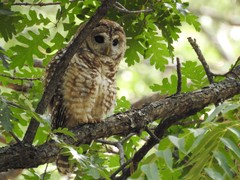
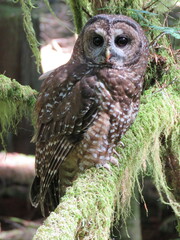
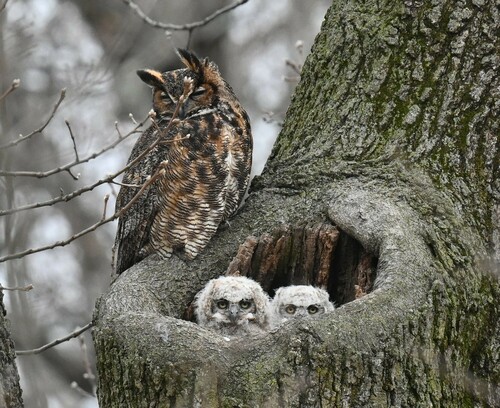
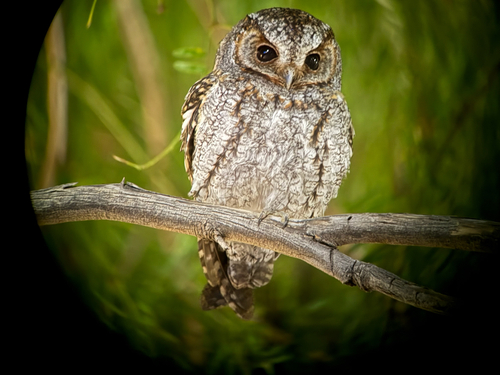
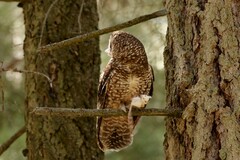
The spotted owl (Strix occidentalis) is a species of true owl. It is a resident species of old-growth forests in western North America, where it nests in tree hollows, old bird of prey nests, or rock crevices. Nests can be between 12 and 60 metres (40 and 200 ft) from the ground, and usually contain two eggs (though some contain as many as four). It is a nocturnal owl which feeds on small mammals and birds. Three subspecies are recognized, ranging in distribution from British Columbia to Mexico. The spotted owl is under pressure from habitat destruction throughout its range, and is currently classified as a near-threatened species.

The spotted owl has an average length of 43 cm (17 in), wingspan of 114 cm (45 in), and weight of 600 g (1.3 lb). Its eggs are a little over 50 mm (2.0 in) long, and are white and smooth with a slightly grainy texture. The spotted owl is similar in appearance to the barred owl, but has cross-shaped markings on the underparts, whereas the barred owl is alternately barred on the breast and streaked on the belly. Barred owls are larger and grayer than spotted owls. In recent years, the California and northern subspecies of spotted owl have... Wikipedia →

Sounds

Recording0:15

United States · 2026

© Beatrix AuYeung · iNaturalist · CC BY-NC 4.0

Recording0:43

United States · 2022

© Dean Lyons · iNaturalist · CC BY-NC 4.0

Recording0:32

United States · 2024

© Gregg Gorton · iNaturalist · CC BY-NC 4.0

Global Distribution

Parks Where Found

# Park Country Daily sighting probability
1 Zion National Park 🇺🇸 United States
~20%
2 Sequoia and Kings Canyon National Parks 🇺🇸 United States
~20%
3 Yosemite National Park 🇺🇸 United States
~10%
4 Cumbres de Monterrey National Park 🇲🇽 Mexico
<5%

Zoos & Centres Where Found

# Zoo / Centre Country
1 Sequoia Park Zoo 🇺🇸 United States In captivity
2 Bird Alliance of Oregon 🇺🇸 United States In captivity

Before you go

What are the chances of seeing a Spotted Owl in Sequoia and Kings Canyon National Parks?

Possible

About 20% of wildlife watchers report a Spotted Owl sighting in Sequoia and Kings Canyon National Parks on a given day, based on 45 verified sightings from GBIF citizen-science data from 2019 to 2026. It is the 40th most-seen of the 152 birds we can rate there. Over three days the chance rises to about 50%, and over a week to about 80%, if each day is a fresh chance.

When is the best time to see a Spotted Owl in Sequoia and Kings Canyon National Parks?

March, June–July and September–October

In those months about 20% of wildlife watchers report a Spotted Owl in Sequoia and Kings Canyon National Parks on a given day, against under 5% in April and November–February, the lowest months.

What time of day is best to see a Spotted Owl?

Between 9 am and noon

Across all the parks we cover, that three-hour window holds the most Spotted Owl sightings with a recorded time, and about 7 in 10 of them come between 6 am and 6 pm: it is seen both by day and at night.

Is Sequoia and Kings Canyon National Parks the best place to see a Spotted Owl?

Among the best

Of the 4 parks where we can rate Spotted Owl sightings, Sequoia and Kings Canyon National Parks ranks 2nd at about 20%, level with the leaders once rounded. The best odds are in Zion National Park (United States, about 20%).

Where does the Spotted Owl sighting chance come from?

GBIF citizen-science records

It is estimated from how often the Spotted Owl is recorded against all the birds logged in Sequoia and Kings Canyon National Parks (45 verified sightings from 2019 to 2026), calibrated against known sighting rates. Figures are rounded to the nearest 10% because citizen-science data supports honest approximations, not decimals, and months with records from fewer than five people show "—". How it works.

← Back to Sequoia and Kings Canyon National Parks