


Completed
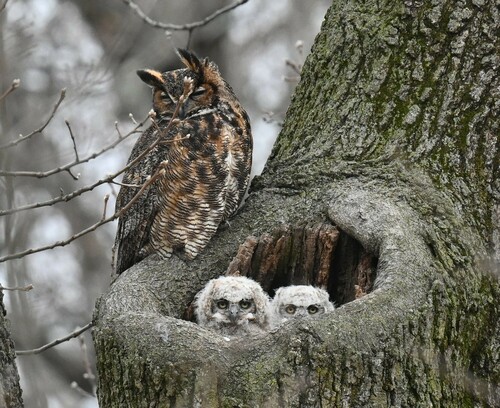

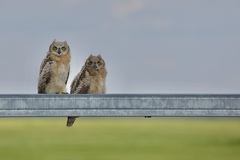
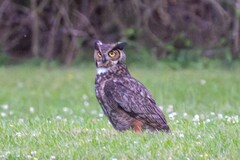
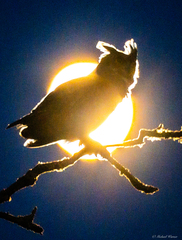
Great Horned Owl
Bubo virginianus
Silhouette: Steven Traver · PhyloPic
- KingdomAnimalia (Animals)
- PhylumChordata (Chordates)
- ClassAves (Birds)
- OrderStrigiformes (Owls)
- FamilyStrigidae (Typical Owls)
- GenusBubo (Typical Eagle-Owls and Horned Owls)
- SpeciesBubo virginianus (Great Horned Owl)
In 3 days ~10%
72 Verified sightings at Sequoia and Kings Canyon National Parks From 2019 to 2026
4,459 In all 44 parks
January Best month
🌅 Crepuscular When it's spotted
About the Great Horned Owl
The great horned owl (Bubo virginianus), also known as the tiger owl (originally derived from early naturalists' description as the "winged tiger" or "tiger of the air") or the hoot owl, is a large owl native to the Americas. It is an extremely adaptable bird with a vast range and is the most widely distributed true owl in the Americas. Its diet consists primarily of rabbits and hares, rats and mice, and voles; it remains one of the few regular predators of skunk. Hunting also includes rodents, larger mid-sized mammals, birds, reptiles, amphibians, and invertebrates.
In ornithological study, the great horned owl is often compared to the Eurasian eagle-owl (Bubo bubo), a closely related species, which occupies the same ecological niche in Eurasia despite its notably larger size. The great horned owl is also compared to the red-tailed hawk (Buteo jamaicensis), with which it often shares similar habitat, prey, and nesting habits by day; thus the red-tailed hawk is something of a diurnal ecological equivalent. The great horned owl is one of the earliest nesting birds in North America, often laying eggs weeks or even months before other raptorial birds.
The great horned... Wikipedia →
Recent sightings of Great Horned Owl in Sequoia and Kings Canyon National Parks
LIVEiNaturalistGlobal Distribution
Parks Where Found
Cities Where Found
| # | City | Country | Daily sighting probability |
|---|---|---|---|
| 1 | Toluca | 🇲🇽 México | |
| 2 | Phoenix | 🇺🇸 United States | |
| 3 | Edmonton | 🇨🇦 Canada | |
| 4 | Denver | 🇺🇸 United States | |
| 5 | Los Angeles | 🇺🇸 United States | |
| 6 | Calgary | 🇨🇦 Canada | |
| 7 | Sacramento | 🇺🇸 United States | |
| 8 | Mesa | 🇺🇸 United States | |
| 9 | San Francisco | 🇺🇸 United States | |
| 10 | Austin | 🇺🇸 United States |
Zoos & Centres Where Found
Closest Relatives at Sequoia and Kings Canyon National Parks







Before you go
What are the chances of seeing a Great Horned Owl in Sequoia and Kings Canyon National Parks?
Rare
Under 5% of wildlife watchers report a Great Horned Owl sighting in Sequoia and Kings Canyon National Parks on a given day, based on 72 verified sightings from GBIF citizen-science data from 2019 to 2026. It is the 116th most-seen of the 152 birds we can rate there. Over three days the chance rises to about 10%, if each day is a fresh chance.
When is the best time to see a Great Horned Owl in Sequoia and Kings Canyon National Parks?
January
In that month about 10% of wildlife watchers report a Great Horned Owl in Sequoia and Kings Canyon National Parks on a given day, against under 5% in February to December, the lowest months. That is one of Sequoia and Kings Canyon National Parks's wettest months, with about 190 mm of rain against 10 mm in September.
What time of day is best to see a Great Horned Owl?
Between 6 and 9 pm
Across all the parks we cover, that three-hour window holds the most Great Horned Owl sightings with a recorded time, and about 6 in 10 of them come between 6 am and 6 pm: it is most active around dawn and dusk.
Is Sequoia and Kings Canyon National Parks the best place to see a Great Horned Owl?
23rd of 44
Of the 44 parks where we can rate Great Horned Owl sightings, Sequoia and Kings Canyon National Parks ranks 23rd at under 5%. The best odds are in El Impenetrable National Park (Argentina, about 10%), El Palmar National Park (Argentina, about 10%) and Saguaro National Park (United States, about 10%).
Which relatives of the Great Horned Owl live in Sequoia and Kings Canyon National Parks?
Same family: Strigidae
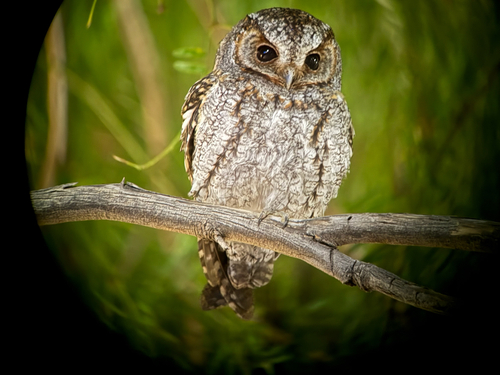
The closest relatives of the Great Horned Owl that you can see in Sequoia and Kings Canyon National Parks (family Strigidae, Typical Owls) are Spotted Owl (about 20%) and Long-eared Owl (about 10%), with each one's daily chance of a sighting.
Where does the Great Horned Owl sighting chance come from?
GBIF citizen-science records
It is estimated from how often the Great Horned Owl is recorded against all the birds logged in Sequoia and Kings Canyon National Parks (72 verified sightings from 2019 to 2026), calibrated against known sighting rates. Figures are rounded to the nearest 10% because citizen-science data supports honest approximations, not decimals, and months with records from fewer than five people show "—". How it works.
