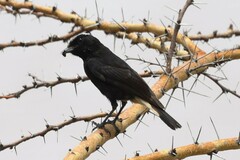
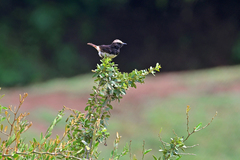
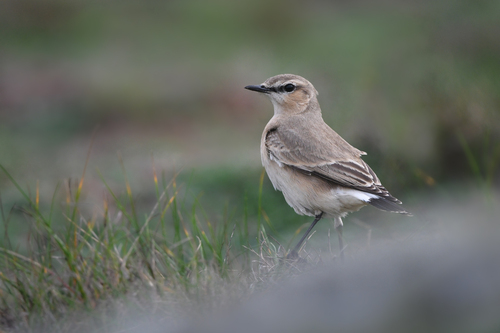
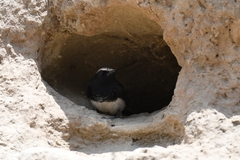
Abyssinian Wheatear

Abyssinian Wheatear

Oenanthe lugubris

Silhouette: PhyloPic

LCLeast ConcernNTVUENCR
Daily sighting probability <5% · Rare
at Serengeti National Park

In 3 days <5%

5 Verified sightings at Serengeti National Park From 2019 to 2026
484 In all 4 parks
March Best month
☀️ Diurnal When it's spotted

About the Abyssinian Wheatear

The Abyssinian wheatear (Oenanthe lugubris), or Abyssinian black wheatear, is a species of bird in the family Muscicapidae, the Old World flycatchers and chats. It is found from Ethiopia to southern Kenya and north-eastern Tanzania.

The Abyssinian wheatear was first formally described in 1837 as Saxicola lugubris by the German naturalist and explorer Eduard Rüppell with its type locality given as "the rocky valleys of the Abyssinian province of Simien, and on the volcanic hills around Gondar" (Vorkommen in der felsigen Thälern der Abyssinischen provinz Simen, und auf der vulkanischen Hügeln um Gondar). It is regarded, by some authorities, as being the same species as the mourning wheatear (Oenanthe lugens) of Northern Africa and the Middle East but the I.O.C. regard it as a valid species. The Abyssinian wheatear is regarded as closely related to the Arabian wheatear (Oenanthe lugentoides), which has also been regarded as being the same species as the mourning wheatear. These species may form a species complex.

The I.O.C. recognises the following subspecies: Oenanthe lugubris lugubris (Rüppell, 1837) Oenanthe lugubris schalowi (Fischer & Reichenow... Wikipedia →

Sounds

Song0:50

Tanzania · 2022

© isaac kilusu · XC760177 · CC BY-NC-SA 4.0

Call0:43

Tanzania · 2019

© Peter Boesman · XC510283 · CC BY-NC-ND 4.0

Song0:36

Kenya · 2022

© Oliver Fowler · XC746068 · CC BY-NC-SA 4.0

Global Distribution

Parks Where Found

# Park Country Daily sighting probability
1 Lake Nakuru National Park 🇰🇪 Kenya
~10%
2 Ngorongoro Conservation Area 🇹🇿 Tanzania
~10%
3 Arusha National Park 🇹🇿 Tanzania
<5%
4 Serengeti National Park 🇹🇿 Tanzania
<5%

Before you go

What are the chances of seeing an Abyssinian Wheatear in Serengeti National Park?

Rare

Under 5% of wildlife watchers report an Abyssinian Wheatear sighting in Serengeti National Park on a given day, based on 5 verified sightings from GBIF citizen-science data from 2019 to 2026. It is the 455th most-seen of the 469 birds we can rate there. Over three days the chance rises to under 5%, if each day is a fresh chance.

When is the best time to see an Abyssinian Wheatear in Serengeti National Park?

Any time of year

In every month with enough records, under 5% of wildlife watchers report an Abyssinian Wheatear in Serengeti National Park on a given day, so our monthly data shows no clear season.

What time of day is best to see an Abyssinian Wheatear?

Between 9 am and noon

Across all the parks we cover, that three-hour window holds the most Abyssinian Wheatear sightings with a recorded time, and about 8 in 10 of them come between 6 am and 6 pm: it is a daytime animal.

Which relatives of the Abyssinian Wheatear live in Serengeti National Park?

Same genus: Oenanthe

The closest relatives of the Abyssinian Wheatear that you can see in Serengeti National Park (genus Oenanthe, Wheatears and Allies) are Capped Wheatear (about 10%), Northern Wheatear (about 10%) and Isabelline Wheatear (about 10%), with each one's daily chance of a sighting.

Where does the Abyssinian Wheatear sighting chance come from?

GBIF citizen-science records

It is estimated from how often the Abyssinian Wheatear is recorded against all the birds logged in Serengeti National Park (5 verified sightings from 2019 to 2026), calibrated against known sighting rates. Figures are rounded to the nearest 10% because citizen-science data supports honest approximations, not decimals, and months with records from fewer than five people show "—". How it works.

← Back to Serengeti National Park