Brazilian Bush Anole

Brazilian Bush Anole

Polychrus acutirostris

Silhouette: SeismicShrimp · PhyloPic

LCLeast ConcernNTVUENCR
Daily sighting probability ~30% · Possible
at Serra da Canastra National Park

In 3 days ~70% in a week ~90%

7 Verified sightings at Serra da Canastra National Park From 2019 to 2026
7 In 1 park
January Best month
☀️ Diurnal When it's spotted

About the Brazilian Bush Anole

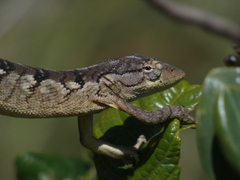
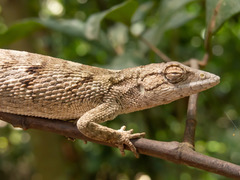
Polychrus acutirostris, the Brazilian bush anole, is a species of lizard native to southern and eastern Brazil, Paraguay, Argentina, and eastern Bolivia. It is diurnal. It is an oviparous animal with an arboreal habit, which inhabits a large part of South America. Its color becomes stronger during mating season, but it can also change to obtain better camouflage. Despite presenting several characteristics similar to those of "true chameleons", such as eyes that move independently and the ability to change color, the species does not belong to the same family as the Chameleon, but still has a level of kinship with the same, belonging to the same suborder: Sauria. Their diet basically consists of insects. The species is being threatened by habitat loss. With a calm temperament, it does not pose a danger to humans.

Another peculiar characteristic of the animal is the one that characterizes it by its popular name of "sloth lizard", its movements are slow, especially when compared to other reptiles that normally have agility in their locomotion. It tends to remain motionless most of the time to camouflage itself, which, along with its subtle ability to change color, is... Wikipedia →

Global Distribution

Parks Where Found

# Park Country Daily sighting probability
1 Serra da Canastra National Park 🇧🇷 Brazil
~30%

More parks will be added in future updates.

Cities Where Found

# City Country Daily sighting probability
1 Belo Horizonte 🇧🇷 Brazil
~10%

Before you go

What are the chances of seeing a Brazilian Bush Anole in Serra da Canastra National Park?

Possible

About 30% of wildlife watchers report a Brazilian Bush Anole sighting in Serra da Canastra National Park on a given day, based on 7 verified sightings from GBIF citizen-science data from 2019 to 2026. It is the 2nd most-seen of the 8 reptiles we can rate there. Over three days the chance rises to about 70%, and over a week to about 90%, if each day is a fresh chance.

When is the best time to see a Brazilian Bush Anole in Serra da Canastra National Park?

January and May–August

In those months about 40% of wildlife watchers report a Brazilian Bush Anole in Serra da Canastra National Park on a given day, against under 5% in February, April and October, the lowest months.

What time of day is best to see a Brazilian Bush Anole?

Between 9 am and noon

Across all the parks we cover, that three-hour window holds the most Brazilian Bush Anole sightings with a recorded time, and about 8 in 10 of them come between 6 am and 6 pm: it is a daytime animal.

Where else can you see a Brazilian Bush Anole?

Only Serra da Canastra National Park, in our data

Serra da Canastra National Park is the only park on Wallace's Line with enough records to rate Brazilian Bush Anole sightings: about 30% of wildlife watchers there report one on a given day.

Where does the Brazilian Bush Anole sighting chance come from?

GBIF citizen-science records

It is estimated from how often the Brazilian Bush Anole is recorded against all the reptiles logged in Serra da Canastra National Park (7 verified sightings from 2019 to 2026), calibrated against known sighting rates. Figures are rounded to the nearest 10% because citizen-science data supports honest approximations, not decimals, and months with records from fewer than five people show "—". How it works.

← Back to Serra da Canastra National Park