
Neotropical Rattlesnake

Neotropical Rattlesnake

Crotalus durissus

Silhouette: Bill Bouton (source photo) & T. Michael Keesey (vectorization) · PhyloPic

LCLeast ConcernNTVUENCR
Daily sighting probability ~30% · Possible
at Serra da Canastra National Park

In 3 days ~60% in a week ~90%

6 Verified sightings at Serra da Canastra National Park From 2019 to 2026
69 In all 5 parks
February Best month
☀️ Diurnal When it's spotted

About the Neotropical Rattlesnake

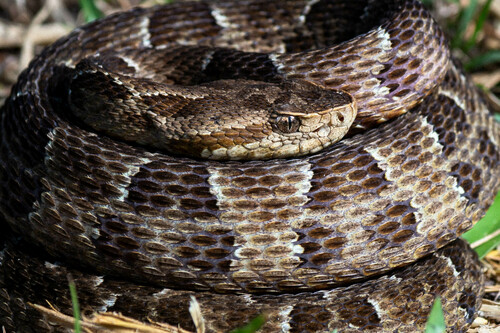
Crotalus durissus, known as the South American rattlesnake, tropical rattlesnake, and by other names, is a highly venomous pit viper species found in South America. It is the most widely distributed member of its genus. Currently, seven subspecies are recognized.

Table notes: A large Neotropical rattlesnake, it grows to a length of 1.5 m (4.9 ft), and rarely to a maximum length of 1.9 m (6.2 ft). It has two distinct stripes starting at the base of the head. Within the lines, the color is lighter than the stripes.

The color and pattern of the body are... Wikipedia →

Sounds

Recording0:41

Brazil · 2024

© Breno Farias · iNaturalist · CC BY-NC 4.0

Recording0:13

Brazil · 2026

© Matheus M. Santos · iNaturalist · CC BY-NC 4.0

Recording0:23

Brazil · 2026

© Ana Laura Campioto · iNaturalist · CC BY-NC 4.0

Global Distribution

Parks Where Found

# Park Country Daily sighting probability
1 Emas National Park 🇧🇷 Brazil
~50%
2 Serra da Canastra National Park 🇧🇷 Brazil
~30%
3 Chapada Diamantina National Park 🇧🇷 Brazil
~20%
4 Iguazú National Park 🇦🇷 Argentina
~10%
5 Iguaçu National Park 🇧🇷 Brazil
~10%

Zoos & Centres Where Found

# Zoo / Centre Country
1 San Diego Zoo 🇺🇸 United States In captivity
2 Cabarceno Natural Park 🇪🇸 Spain In captivity
3 Zoo Pilsen 🇨🇿 Czechia In captivity
4 Zoobotanic Park of Brusque 🇧🇷 Brazil In captivity
5 Zoo Miami 🇺🇸 United States In captivity
6 Zoological Garden of Belo Horizonte 🇧🇷 Brazil In captivity
7 Zoológico de Brasília 🇧🇷 Brazil In captivity
8 Parque Zoobotânico de Teresina 🇧🇷 Brazil In captivity
9 São Paulo Zoo 🇧🇷 Brazil In captivity
10 Zoológico de Goiânia 🇧🇷 Brazil In captivity
11 Parque Zoobotânico Arruda Câmara (BICA) 🇧🇷 Brazil In captivity
12 Bioparque Municipal Vesty Pakos 🇧🇴 Bolivia In captivity
13 Zoológico Municipal de Cascavel 🇧🇷 Brazil In captivity
14 Cameron Park Zoo 🇺🇸 United States In captivity
15 Pittsburgh Zoo & Aquarium 🇺🇸 United States In captivity
16 Municipal Zoological Park Quinzinho de Barros 🇧🇷 Brazil In captivity
17 Rio de Janeiro Zoological Garden 🇧🇷 Brazil In captivity
18 Parque Ecológico de São Carlos 🇧🇷 Brazil In captivity
19 Amaru 🇪🇨 Ecuador In captivity
20 Bauru Zoo 🇧🇷 Brazil In captivity
21 La Paz Waterfall Gardens 🇨🇷 Costa Rica In captivity
22 Bioparque Los Ocarros 🇨🇴 Colombia In captivity
23 Zoo Park da Montanha 🇧🇷 Brazil In captivity
24 Zoológico de Fauna Sudamericana 🇧🇴 Bolivia In captivity
25 Staten Island Zoo 🇺🇸 United States In captivity
26 Zoológico 🇧🇷 Brazil In captivity
27 zoologico de barranquilla 🇨🇴 Colombia In captivity
28 Dallas World Aquarium 🇺🇸 United States In captivity
29 Belo Horizonte Aquarium 🇧🇷 Brazil In captivity
30 Cali Zoo 🇨🇴 Colombia In captivity
31 Città della Domenica 🇮🇹 Italy In captivity

Before you go

What are the chances of seeing a Neotropical Rattlesnake in Serra da Canastra National Park?

Possible

About 30% of wildlife watchers report a Neotropical Rattlesnake sighting in Serra da Canastra National Park on a given day, based on 6 verified sightings from GBIF citizen-science data from 2019 to 2026. It is the 4th most-seen of the 8 reptiles we can rate there. Over three days the chance rises to about 60%, and over a week to about 90%, if each day is a fresh chance.

When is the best time to see a Neotropical Rattlesnake in Serra da Canastra National Park?

February

In that month about 60% of wildlife watchers report a Neotropical Rattlesnake in Serra da Canastra National Park on a given day, against under 5% in July to October, the lowest months. That is one of Serra da Canastra National Park's wettest months, with about 250 mm of rain against almost none in July.

What time of day is best to see a Neotropical Rattlesnake?

Between 8 and 11 am

Across all the parks we cover, that three-hour window holds the most Neotropical Rattlesnake sightings with a recorded time, and about 7 in 10 of them come between 6 am and 6 pm: it is a daytime animal.

Is Serra da Canastra National Park the best place to see a Neotropical Rattlesnake?

2nd of 5

Of the 5 parks where we can rate Neotropical Rattlesnake sightings, Serra da Canastra National Park ranks 2nd at about 30%. The best odds are in Emas National Park (Brazil, about 50%).

Where does the Neotropical Rattlesnake sighting chance come from?

GBIF citizen-science records

It is estimated from how often the Neotropical Rattlesnake is recorded against all the reptiles logged in Serra da Canastra National Park (6 verified sightings from 2019 to 2026), calibrated against known sighting rates. Figures are rounded to the nearest 10% because citizen-science data supports honest approximations, not decimals, and months with records from fewer than five people show "—". How it works.

← Back to Serra da Canastra National Park