Brazilian Merganser

Brazilian Merganser

Mergus octosetaceus

Silhouette: Sheatherius · PhyloPic

LCNTVUENCRCritically Endangered
Daily sighting probability ~20% · Possible
at Serra da Canastra National Park

In 3 days ~50% in a week ~80%

144 Verified sightings at Serra da Canastra National Park From 2019 to 2026
144 In 1 park
September Best month
☀️ Diurnal When it's spotted

About the Brazilian Merganser

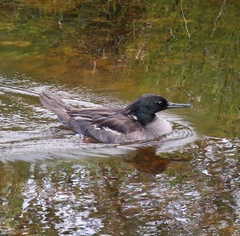
The Brazilian merganser (Mergus octosetaceus) is a South American diving duck in the Mergus genus. It is one of the most threatened waterfowl species in the world, with possibly fewer than 250 birds in the wild and a small number kept in captivity in Brazil and Czechia. It has a long, sharp-edged beak with a great number of tooth-like edges.

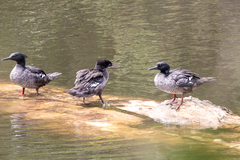
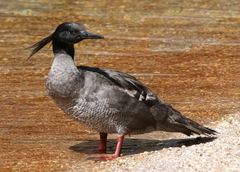
This merganser is a dark, slender duck with a shiny dark-green hood with a long crest, which is usually shorter and more worn-looking in females. Upperparts are dark grey while the breast is light grey, getting paler toward the whitish belly, and a white speculum is particularly noticeable in flight. It has a long thin jagged black bill with red feet and legs. Although females are smaller with a shorter bill and crest, both sexes are alike in color. The slender ducks range in size from 49 to 56 centimetres (19 to 22 in) as an adult. Young Brazilian mergansers are mainly black with white throat and breast.

The Brazilian mergansers are generally silent birds, but may make barking calls in certain situations. Four calls have been recorded. A harsh krack-krack acts as an alarm call emitted in flight. Males make a barking dog-like... Wikipedia →

Sounds

Chamado0:25

Brazil · 2017

© Caio Brito · XC427578 · CC BY-NC-SA 4.0

Call0:05

Brazil · 2015

© Robson Silva e Silva · XC306310 · CC BY-NC-SA 4.0

Alarm call0:11

Brazil · 2021

© JAYRSON ARAUJO DE OLIVEIRA · XC663236 · CC BY-NC-SA 4.0

Global Distribution

Parks Where Found

# Park Country Daily sighting probability
1 Serra da Canastra National Park 🇧🇷 Brazil
~20%

More parks will be added in future updates.

Before you go

What are the chances of seeing a Brazilian Merganser in Serra da Canastra National Park?

Possible

About 20% of wildlife watchers report a Brazilian Merganser sighting in Serra da Canastra National Park on a given day, based on 144 verified sightings from GBIF citizen-science data from 2019 to 2026. It is the 99th most-seen of the 294 birds we can rate there. Over three days the chance rises to about 50%, and over a week to about 80%, if each day is a fresh chance.

When is the best time to see a Brazilian Merganser in Serra da Canastra National Park?

May and September

In those months about 30% of wildlife watchers report a Brazilian Merganser in Serra da Canastra National Park on a given day, against about 10% in March, August and December, the lowest months. Those are among Serra da Canastra National Park's driest months, with about 45 mm of rain a month against 280 mm in January.

What time of day is best to see a Brazilian Merganser?

Between 8 and 11 am

Across all the parks we cover, that three-hour window holds the most Brazilian Merganser sightings with a recorded time, and about 8 in 10 of them come between 6 am and 6 pm: it is a daytime animal.

Where else can you see a Brazilian Merganser?

Only Serra da Canastra National Park, in our data

Serra da Canastra National Park is the only park on Wallace's Line with enough records to rate Brazilian Merganser sightings: about 20% of wildlife watchers there report one on a given day.

Where does the Brazilian Merganser sighting chance come from?

GBIF citizen-science records

It is estimated from how often the Brazilian Merganser is recorded against all the birds logged in Serra da Canastra National Park (144 verified sightings from 2019 to 2026), calibrated against known sighting rates. Figures are rounded to the nearest 10% because citizen-science data supports honest approximations, not decimals, and months with records from fewer than five people show "—". How it works.

← Back to Serra da Canastra National Park