

Ochre-breasted Pipit

Ochre-breasted Pipit

Anthus nattereri

Silhouette: Susan Murphy (original photograph), T. Michael Keesey (vectorization) · PhyloPic

LCNTVUVulnerableENCR
Daily sighting probability ~20% · Possible
at Serra da Canastra National Park

In 3 days ~40% in a week ~70%

96 Verified sightings at Serra da Canastra National Park From 2019 to 2026
144 In all 2 parks
October Best month
☀️ Diurnal When it's spotted

About the Ochre-breasted Pipit

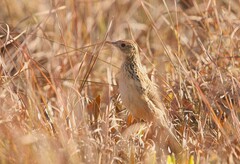
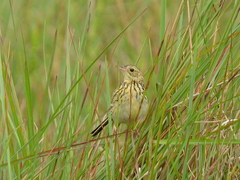
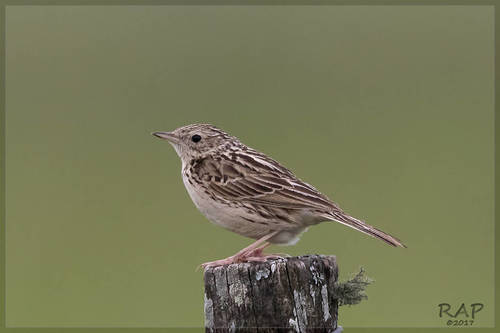
The ochre-breasted pipit (Anthus nattereri) is a Vulnerable species of bird in the family Motacillidae, the wagtails and pipits. It is found in Argentina, Brazil, Paraguay, and Uruguay. The ochre-breasted pipit was originally described by Philip Sclater in 1878 with its current binomial Anthus nattereri. What is now the type specimen had originally been identified as a correndera pipit (A. correndera) but Sclater noted enough differences to reclassify the bird. His specific epithet honors Johann Natterer, who had collected the type specimen.

The ochre-breasted pipit is monotypic. The ochre-breasted pipit is 13.5 to 15 cm (5.3 to 5.9 in) long. The sexes have the same plumage. Adults have a blackish brown head with a yellow-buff supercilium, a thin dark "moustache", and a black spot on the cheek. Their upperparts and wings are mostly blackish brown with bright buff or golden ochraceous-yellow feather edges that give a bold streaked appearance. Their rump is more rufous and less streaked than their back. Their tail's inner three pairs of feathers are dark brown. The next pair outward are medium brown with white tips, the next brownish white... Wikipedia →

Sounds

Call0:45

Brazil · 2013

© Helberth J. C. Peixoto · XC345600 · CC BY-NC-ND 4.0

Song0:38

Brazil · 2010

© Luiz Gabriel Mazzoni · XC198359 · CC BY-NC-SA 4.0

Song0:07

Brazil · 2021

© Ricardo José Mitidieri · XC689690 · CC BY-NC-SA 4.0

Global Distribution

Parks Where Found

# Park Country Daily sighting probability
1 Serra da Canastra National Park 🇧🇷 Brazil
~20%
2 Iberá National Park 🇦🇷 Argentina
<5%

Before you go

What are the chances of seeing an Ochre-breasted Pipit in Serra da Canastra National Park?

Possible

About 20% of wildlife watchers report an Ochre-breasted Pipit sighting in Serra da Canastra National Park on a given day, based on 96 verified sightings from GBIF citizen-science data from 2019 to 2026. It is the 109th most-seen of the 294 birds we can rate there. Over three days the chance rises to about 40%, and over a week to about 70%, if each day is a fresh chance.

When is the best time to see an Ochre-breasted Pipit in Serra da Canastra National Park?

September to November

In those months about 30% of wildlife watchers report an Ochre-breasted Pipit in Serra da Canastra National Park on a given day, against about 10% in March–August and December, the lowest months.

What time of day is best to see an Ochre-breasted Pipit?

Between 7 and 10 am

Across all the parks we cover, that three-hour window holds the most Ochre-breasted Pipit sightings with a recorded time, and about 8 in 10 of them come between 6 am and 6 pm: it is a daytime animal.

Is Serra da Canastra National Park the best place to see an Ochre-breasted Pipit?

Yes

Of the 2 parks where we can rate Ochre-breasted Pipit sightings, Serra da Canastra National Park has the highest daily chance: about 20%. Next come Iberá National Park (Argentina, under 5%).

Where does the Ochre-breasted Pipit sighting chance come from?

GBIF citizen-science records

It is estimated from how often the Ochre-breasted Pipit is recorded against all the birds logged in Serra da Canastra National Park (96 verified sightings from 2019 to 2026), calibrated against known sighting rates. Figures are rounded to the nearest 10% because citizen-science data supports honest approximations, not decimals, and months with records from fewer than five people show "—". How it works.

← Back to Serra da Canastra National Park