Boie's Frog

Boie's Frog

Proceratophrys boiei

Silhouette: Dmitry Bogdanov (vectorized by T. Michael Keesey) · PhyloPic

LCLeast ConcernNTVUENCR Endemic
Daily sighting probability ~20% · Possible
at Serra dos Órgãos National Park

In 3 days ~50% in a week ~80%

6 Verified sightings at Serra dos Órgãos National Park From 2019 to 2026
6 In 1 park
April Best month
☀️🌙 Day & Night When it's spotted

About the Boie's Frog

Proceratophrys boiei, commonly known as Boie's frog, is a species of frog in the family Odontophrynidae. It is endemic to eastern and southeastern Brazil. This common frog is found in primary and secondary forest, on the forest edge, and in degraded areas near forest. This species is present in the illegal pet trade. Its habitat is subject to loss caused by agriculture, wood plantations, livestock grazing, clear-cutting, human settlement and tourism. The specific name boiei was given in honour of German zoologist Heinrich Boie or his brother Friedrich Boie.

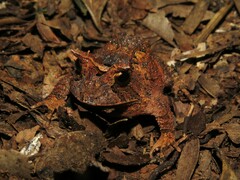
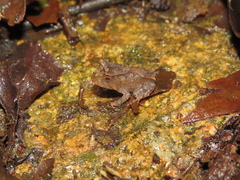
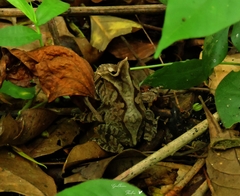
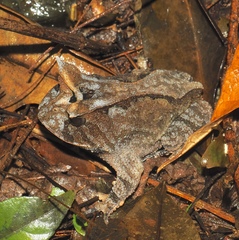
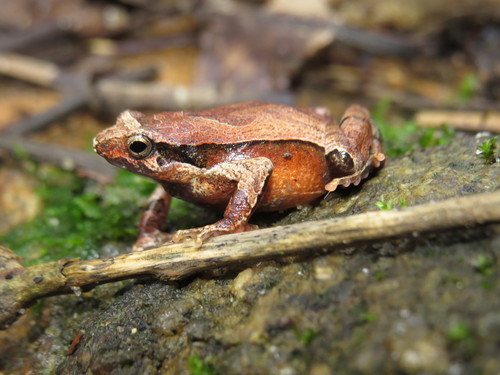
Proceratophrys boiei is a moderate-sized, robust frog, growing to a length of between 40 and 70 mm (1.6 and 2.8 in), with males tending to be slightly smaller than females. Both head and body are relatively broad, the snout is rounded, and long, tapering peaks of skin project from above the eyes. The surface of the skin on both back and flanks is covered with warts. The colouring is an irregular geometric pattern of brown, black, yellow, orange and red, such that the frog becomes nearly invisible against the background of leaf litter among which it lives. There is also a broad brown or grey dorsal stripe.

��2... Wikipedia →

Sounds

Recording0:15

Brazil · 2023

© Patrícia Mees · iNaturalist · CC BY 4.0

Recording0:24

Brazil · 2024

© Miguel Angelo Biz · iNaturalist · CC BY-NC 4.0

Recording0:12

Brazil · 2026

© Manequinho Correia · iNaturalist · CC BY-NC 4.0

Global Distribution

Parks Where Found

# Park Country Daily sighting probability
1 Serra dos Órgãos National Park 🇧🇷 Brazil
~20%

More parks will be added in future updates.

Cities Where Found

# City Country Daily sighting probability
1 Curitiba 🇧🇷 Brazil
~10%

Before you go

What are the chances of seeing a Boie's Frog in Serra dos Órgãos National Park?

Possible

About 20% of wildlife watchers report a Boie's Frog sighting in Serra dos Órgãos National Park on a given day, based on 6 verified sightings from GBIF citizen-science data from 2019 to 2026. It is the 7th most-seen of the 10 amphibians we can rate there. Over three days the chance rises to about 50%, and over a week to about 80%, if each day is a fresh chance.

When is the best time to see a Boie's Frog in Serra dos Órgãos National Park?

April and November

In those months about 40% of wildlife watchers report a Boie's Frog in Serra dos Órgãos National Park on a given day, against under 5% in February, May–October and December, the lowest months.

What time of day is best to see a Boie's Frog?

Between 7 and 10 pm

Across all the parks we cover, that three-hour window holds the most Boie's Frog sightings with a recorded time, and about 6 in 10 of them come between 6 pm and 6 am: it is seen both by day and at night.

Where else can you see a Boie's Frog?

Only Serra dos Órgãos National Park, in our data

Serra dos Órgãos National Park is the only park on Wallace's Line with enough records to rate Boie's Frog sightings: about 20% of wildlife watchers there report one on a given day.

Which relatives of the Boie's Frog live in Serra dos Órgãos National Park?

Same order: Anura

The closest relatives of the Boie's Frog that you can see in Serra dos Órgãos National Park (order Anura, Frogs and Toads) are Yellow Cururu Toad (about 40%), Blacksmith Tree Frog (about 40%) and Military River Frog (about 30%), with each one's daily chance of a sighting.

Where does the Boie's Frog sighting chance come from?

GBIF citizen-science records

It is estimated from how often the Boie's Frog is recorded against all the amphibians logged in Serra dos Órgãos National Park (6 verified sightings from 2019 to 2026), calibrated against known sighting rates. Figures are rounded to the nearest 10% because citizen-science data supports honest approximations, not decimals, and months with records from fewer than five people show "—". How it works.

← Back to Serra dos Órgãos National Park