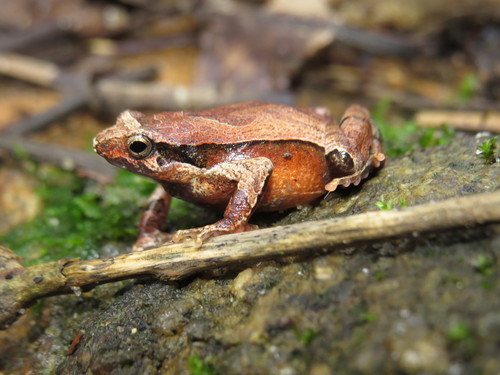
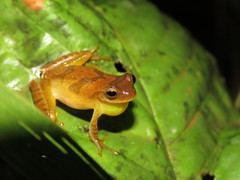
Lesser Tree Frog

Lesser Tree Frog

Dendropsophus minutus

Silhouette: Dmitry Bogdanov (vectorized by T. Michael Keesey) · PhyloPic

LCLeast ConcernNTVUENCR
Daily sighting probability ~20% · Possible
at Serra dos Órgãos National Park

In 3 days ~50% in a week ~80%

8 Verified sightings at Serra dos Órgãos National Park From 2019 to 2026
21 In all 3 parks
September Best month
🌙 Nocturnal When it's spotted

About the Lesser Tree Frog

Dendropsophus minutus (lesser treefrog) is a species of frog in the family Hylidae. It is found in Argentina, Bolivia, Brazil, Colombia, Ecuador, French Guiana, Guyana, Paraguay, Peru, Suriname, Trinidad and Tobago, Uruguay, and Venezuela. In Spanish it is known as ranita amarilla común.

Its natural habitats are subtropical or tropical dry forests, subtropical or tropical moist lowland forests, subtropical or tropical moist montane forests, dry savanna, moist savanna, subtropical or tropical seasonally wet or flooded lowland grassland, intermittent freshwater marshes, pastureland, rural gardens, urban areas, heavily degraded former forest, ponds, and canals and ditches. Scientists have seen it as high as 2000 meters above sea level and as low as at sea level.

During the breeding period, the male frogs perch on grass and shrubs near water and on plants mid-water. The male frogs have shown territorial and competitive behavior near preferred perches. The females lay eggs in still bodies of water, such as ponds and puddles.

This frog ranges across a very large part of South America, in a variety of habitats, so the individual frogs can be considerably different from each other. In 2014, a team of 30 scientists studied the mtDNA of this frog and found the species had 47 different groups in it. Wikipedia →

Sounds

Recording0:04

Brazil · 2026

© Manequinho Correia · XC1078448 · CC BY-NC-SA 4.0

Recording0:47

Brazil · 2024

© vinicius_s_domingues · iNaturalist · CC BY-NC 4.0

Recording0:52

Brazil · 2020

© JULIO CESAR GONZALEZ FILIPINO · iNaturalist · CC BY-NC 4.0

Global Distribution

Parks Where Found

# Park Country Daily sighting probability
1 Serra dos Órgãos National Park 🇧🇷 Brazil
~20%
2 Tambopata National Reserve 🇵🇪 Peru
~10%
3 Manu National Park 🇵🇪 Peru
~10%

Cities Where Found

# City Country Daily sighting probability
1 Brasilia 🇧🇷 Brazil
~10%

Before you go

What are the chances of seeing a Lesser Tree Frog in Serra dos Órgãos National Park?

Possible

About 20% of wildlife watchers report a Lesser Tree Frog sighting in Serra dos Órgãos National Park on a given day, based on 8 verified sightings from GBIF citizen-science data from 2019 to 2026. It is the 7th most-seen of the 10 amphibians we can rate there. Over three days the chance rises to about 50%, and over a week to about 80%, if each day is a fresh chance.

When is the best time to see a Lesser Tree Frog in Serra dos Órgãos National Park?

September

In that month about 40% of wildlife watchers report a Lesser Tree Frog in Serra dos Órgãos National Park on a given day, against under 5% in January–March and May–August, the lowest months.

What time of day is best to see a Lesser Tree Frog?

Between 7 and 10 pm

Across all the parks we cover, that three-hour window holds the most Lesser Tree Frog sightings with a recorded time, and about 9 in 10 of them come between 6 pm and 6 am: it is mostly seen at night.

Is Serra dos Órgãos National Park the best place to see a Lesser Tree Frog?

Yes

Of the 3 parks where we can rate Lesser Tree Frog sightings, Serra dos Órgãos National Park has the highest daily chance: about 20%. Next come Tambopata National Reserve (Peru, about 10%) and Manu National Park (Peru, about 10%).

Where does the Lesser Tree Frog sighting chance come from?

GBIF citizen-science records

It is estimated from how often the Lesser Tree Frog is recorded against all the amphibians logged in Serra dos Órgãos National Park (8 verified sightings from 2019 to 2026), calibrated against known sighting rates. Figures are rounded to the nearest 10% because citizen-science data supports honest approximations, not decimals, and months with records from fewer than five people show "—". How it works.

← Back to Serra dos Órgãos National Park