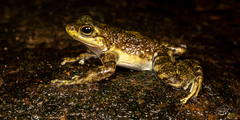
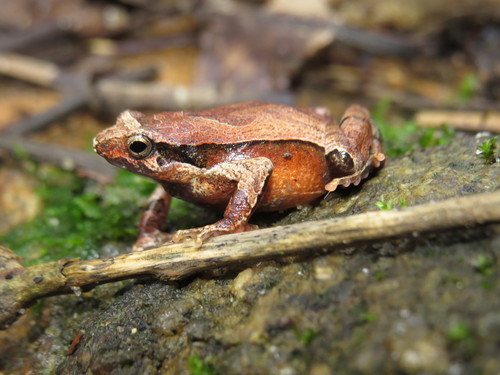
Brazilian Torrent Frog

Brazilian Torrent Frog

Hylodes asper

Silhouette: Jose Carlos Arenas-Monroy · PhyloPic

LCLeast ConcernNTVUENCR Endemic
Daily sighting probability ~20% · Possible
at Serra dos Órgãos National Park

In 3 days ~40% in a week ~70%

5 Verified sightings at Serra dos Órgãos National Park From 2019 to 2026
5 In 1 park
February Best month
☀️ Diurnal When it's spotted

About the Brazilian Torrent Frog

Hylodes asper, the warty tree toad or Brazilian torrent frog, is a species of frogs in the family Hylodidae. It is endemic to the Rio de Janeiro and São Paulo states in southeastern Brazil. Living in a high-noise environment, the species uses "semaphoring" to supplement acoustic signalling.

Hylodes asper are diurnal. Males use both visual and acoustic signalling to attract females and to maintain their territories. "Foot-flagging" is the most distinctive visual display, usually performed while calling. In foot-flagging, the raises one hind limb and extends it up and back, exposing the silvery colour of the dorsal surfaces of toes and toe fringes.

Male Hylodes asper have been observed to construct an underwater chamber, apparently for use as a nest for reproduction. This frog has been observed as high as 800 meters above sea level. The species' natural habitats are larger forest streams and small forest rivers in primary and old secondary forests. Active by day, it can be found on rocks and low vegetation along the streams.

Hylodes asper is patchily distributed but where it occurs it can be common. Declines have been reported for some sites... Wikipedia →

Sounds

Recording0:10

Brazil · 2024

© Augusto Matheus dos Santos · iNaturalist · CC BY-NC 4.0

Recording0:10

Brazil · 2022

© Luciano Bernardes · iNaturalist · CC BY-NC 4.0

Global Distribution

Parks Where Found

# Park Country Daily sighting probability
1 Serra dos Órgãos National Park 🇧🇷 Brazil
~20%

More parks will be added in future updates.

Before you go

What are the chances of seeing a Brazilian Torrent Frog in Serra dos Órgãos National Park?

Possible

About 20% of wildlife watchers report a Brazilian Torrent Frog sighting in Serra dos Órgãos National Park on a given day, based on 5 verified sightings from GBIF citizen-science data from 2019 to 2026. It is the 10th most-seen of the 10 amphibians we can rate there. Over three days the chance rises to about 40%, and over a week to about 70%, if each day is a fresh chance.

When is the best time to see a Brazilian Torrent Frog in Serra dos Órgãos National Park?

February and April

In those months about 40% of wildlife watchers report a Brazilian Torrent Frog in Serra dos Órgãos National Park on a given day, against under 5% in May and July–January, the lowest months.

What time of day is best to see a Brazilian Torrent Frog?

Between 10 am and 1 pm

Across all the parks we cover, that three-hour window holds the most Brazilian Torrent Frog sightings with a recorded time, and about 8 in 10 of them come between 6 am and 6 pm: it is a daytime animal.

Where else can you see a Brazilian Torrent Frog?

Only Serra dos Órgãos National Park, in our data

Serra dos Órgãos National Park is the only park on Wallace's Line with enough records to rate Brazilian Torrent Frog sightings: about 20% of wildlife watchers there report one on a given day.

Which relatives of the Brazilian Torrent Frog live in Serra dos Órgãos National Park?

Same order: Anura

The closest relatives of the Brazilian Torrent Frog that you can see in Serra dos Órgãos National Park (order Anura, Frogs and Toads) are Yellow Cururu Toad (about 40%), Blacksmith Tree Frog (about 40%) and Military River Frog (about 30%), with each one's daily chance of a sighting.

Where does the Brazilian Torrent Frog sighting chance come from?

GBIF citizen-science records

It is estimated from how often the Brazilian Torrent Frog is recorded against all the amphibians logged in Serra dos Órgãos National Park (5 verified sightings from 2019 to 2026), calibrated against known sighting rates. Figures are rounded to the nearest 10% because citizen-science data supports honest approximations, not decimals, and months with records from fewer than five people show "—". How it works.

← Back to Serra dos Órgãos National Park