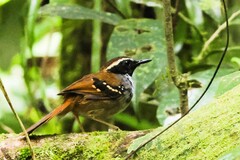
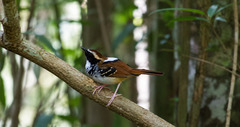

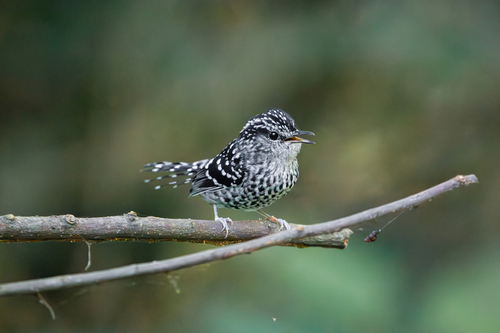
White-bibbed Antbird

White-bibbed Antbird

Myrmeciza loricata

Silhouette: Sheatherius · PhyloPic

Daily sighting probability <5% · Rare
at Serra dos Órgãos National Park

In 3 days ~10% in a week ~30%

29 Verified sightings at Serra dos Órgãos National Park From 2019 to 2026
341 In all 2 parks
February Best month
☀️ Diurnal When it's spotted

About the White-bibbed Antbird

The white-bibbed antbird (Myrmoderus loricatus) is a species of passerine bird in subfamily Thamnophilinae of family Thamnophilidae, the "typical antbirds". It is endemic to Brazil. The white-bibbed antbird was formerly included in the genus Myrmeciza. A molecular phylogenetic study published in 2013 found that Myrmeciza, as then defined, was polyphyletic. In the resulting rearrangement to create monotypic genera, four species including the white-bibbed antbird were moved to the resurrected genus Myrmoderus. Some authors have suggested that the white-bibbed antbird and the squamate antbird (M. squamosus) are conspecific but the 2013 study confirmed them as sister species.

The white-bibbed antbird is monotypic. The white-bibbed antbird is 14 to 15 cm (5.5 to 5.9 in) long. Adult males have a black crown with wide rufous-chestnut edges to the feathers. They have a long white supercilium on an otherwise mostly black face. Their upperparts and tail are mostly rufous-chestnut with a white patch between their scapulars. Their flight feathers are rufous-chestnut and their wing coverts black with wide white tips. Their chin is black. Their throat... Wikipedia →

Sounds

Recording0:11

Brazil · 2025

© esthernaara · iNaturalist · CC BY-NC 4.0

Recording0:09

Brazil · 2018

© Luciano Bernardes · iNaturalist · CC BY-NC 4.0

Recording0:33

Brazil · 2025

© Joshua Eastlake · iNaturalist · CC BY-NC 4.0

Global Distribution

Parks Where Found

# Park Country Daily sighting probability
1 Itatiaia National Park 🇧🇷 Brazil
~20%
2 Serra dos Órgãos National Park 🇧🇷 Brazil
<5%

Before you go

What are the chances of seeing a White-bibbed Antbird in Serra dos Órgãos National Park?

Rare

Under 5% of wildlife watchers report a White-bibbed Antbird sighting in Serra dos Órgãos National Park on a given day, based on 29 verified sightings from GBIF citizen-science data from 2019 to 2026. It is the 212th most-seen of the 336 birds we can rate there. Over three days the chance rises to about 10%, and over a week to about 30%, if each day is a fresh chance.

When is the best time to see a White-bibbed Antbird in Serra dos Órgãos National Park?

January–March, May and August–September

In those months about 10% of wildlife watchers report a White-bibbed Antbird in Serra dos Órgãos National Park on a given day, against under 5% in April, June–July and October–December, the lowest months.

What time of day is best to see a White-bibbed Antbird?

Between 8 and 11 am

Across all the parks we cover, that three-hour window holds the most White-bibbed Antbird sightings with a recorded time, and about 9 in 10 of them come between 6 am and 6 pm: it is a daytime animal.

Is Serra dos Órgãos National Park the best place to see a White-bibbed Antbird?

2nd of 2

Of the 2 parks where we can rate White-bibbed Antbird sightings, Serra dos Órgãos National Park ranks 2nd at under 5%. The best odds are in Itatiaia National Park (Brazil, about 20%).

Which relatives of the White-bibbed Antbird live in Serra dos Órgãos National Park?

Same family: Thamnophilidae

The closest relatives of the White-bibbed Antbird that you can see in Serra dos Órgãos National Park (family Thamnophilidae, Typical Antbirds) are Streak-capped Antwren (about 50%), Rufous-margined Antwren (about 50%) and Plain Antvireo (about 40%), with each one's daily chance of a sighting.

Where does the White-bibbed Antbird sighting chance come from?

GBIF citizen-science records

It is estimated from how often the White-bibbed Antbird is recorded against all the birds logged in Serra dos Órgãos National Park (29 verified sightings from 2019 to 2026), calibrated against known sighting rates. Figures are rounded to the nearest 10% because citizen-science data supports honest approximations, not decimals, and months with records from fewer than five people show "—". How it works.

← Back to Serra dos Órgãos National Park