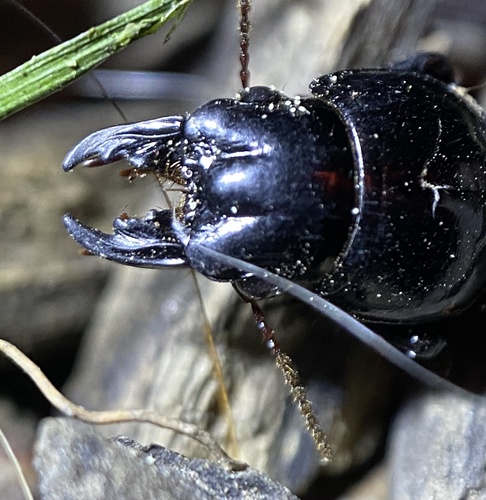
Big-Headed Ground Beetle

Big-Headed Ground Beetle

Scarites subterraneus

Daily sighting probability ~10% · With luck
at Shenandoah National Park

In 3 days ~10% in a week ~30%

8 Verified sightings at Shenandoah National Park From 2019 to 2026
8 In 1 park
September Best month
🌙 Nocturnal When it's spotted

About the Big-Headed Ground Beetle

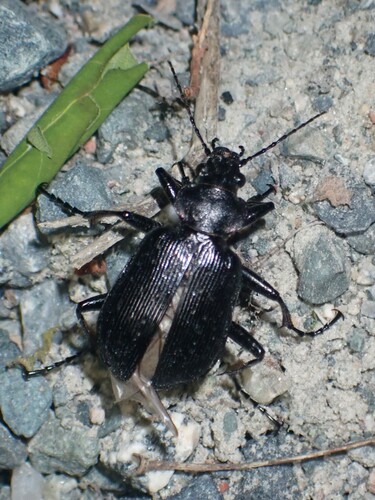
Scarites subterraneus, known generally as the big-headed ground beetle or (tunneling large) pedunculate ground beetle, is a species of ground beetle in the family Carabidae. It is found throughout the Caribbean, Central America, and North America.

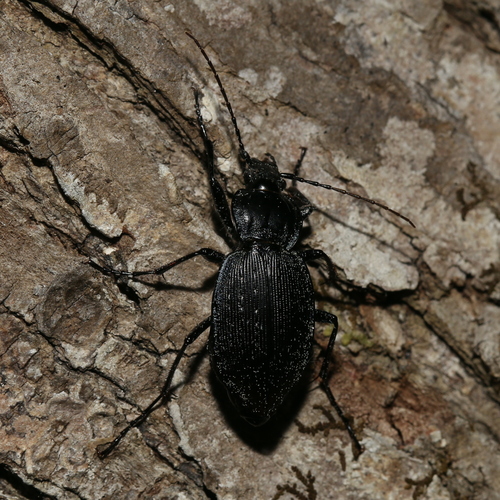
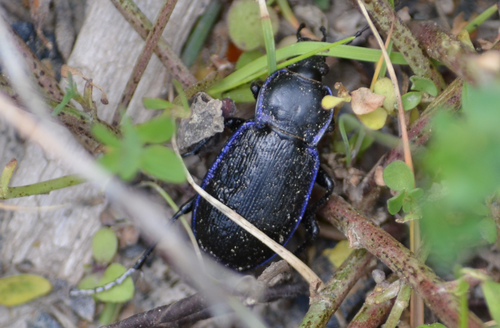
These beetles are generally between 15.0 and 30.0 mm. They have large mandibles, which have two teeth, for hunting and consuming their prey. The antenna of the creature are not clubbed or elbowed, rather, segmented. The elytra of S. subterraneus is fairly striated (streaked). Their front femora are adapted to dig. Wings present. Forebody loosely attached to the body. Antennomeres are 8–10 moniliform.

Scarites subterraneus, as its scientific name suggests, spends much of its time burrowing and hiding under logs, rocks, soil and leaf litter. They are found in a variety of habitats, such as forests and meadows. They are frequently encountered in residential areas, urban and rural alike. Their environment is generally defined as coastal.

Scarites subterraneus is a carnivorous beetle. This is clear when looking at its large jaws, which it uses to hunt its prey. The specific diet of S. subterraneus is not... Wikipedia →
Global Distribution

Parks Where Found

# Park Country Daily sighting probability
1 Shenandoah National Park 🇺🇸 United States
~10%

More parks will be added in future updates.

Cities Where Found

# City Country Daily sighting probability
1 Baltimore 🇺🇸 United States
<5%
2 Washington 🇺🇸 United States
<5%
3 Philadelphia 🇺🇸 United States
<5%
4 Dallas 🇺🇸 United States
<5%
5 Sacramento 🇺🇸 United States
<5%
6 New York City 🇺🇸 United States
<5%
7 Chicago 🇺🇸 United States
<5%
8 Denver 🇺🇸 United States
<5%
9 Minneapolis [Saint Paul] 🇺🇸 United States
<5%
10 Toronto 🇨🇦 Canada
<5%

Before you go

What are the chances of seeing a Big-Headed Ground Beetle in Shenandoah National Park?

With luck

About 10% of wildlife watchers report a Big-Headed Ground Beetle sighting in Shenandoah National Park on a given day, based on 8 verified sightings from GBIF citizen-science data from 2019 to 2026. It is the 447th most-seen of the 723 insects we can rate there. Over three days the chance rises to about 10%, and over a week to about 30%, if each day is a fresh chance.

When is the best time to see a Big-Headed Ground Beetle in Shenandoah National Park?

May–July and September

In those months about 10% of wildlife watchers report a Big-Headed Ground Beetle in Shenandoah National Park on a given day, against under 5% in August and October–April, the lowest months.

What time of day is best to see a Big-Headed Ground Beetle?

Between 6 and 9 pm

Across all the parks we cover, that three-hour window holds the most Big-Headed Ground Beetle sightings with a recorded time, and about 8 in 10 of them come between 6 pm and 6 am: it is mostly seen at night.

Where else can you see a Big-Headed Ground Beetle?

Only Shenandoah National Park, in our data

Shenandoah National Park is the only park on Wallace's Line with enough records to rate Big-Headed Ground Beetle sightings: about 10% of wildlife watchers there report one on a given day.

Which relatives of the Big-Headed Ground Beetle live in Shenandoah National Park?

Same family: Carabidae

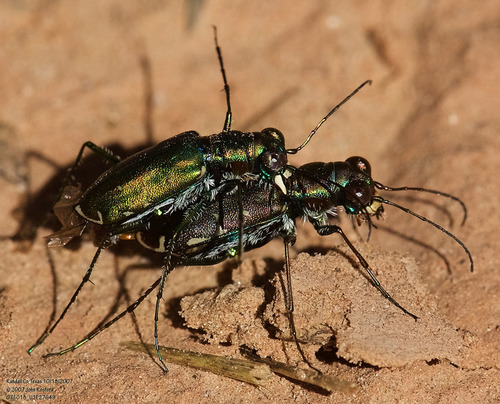
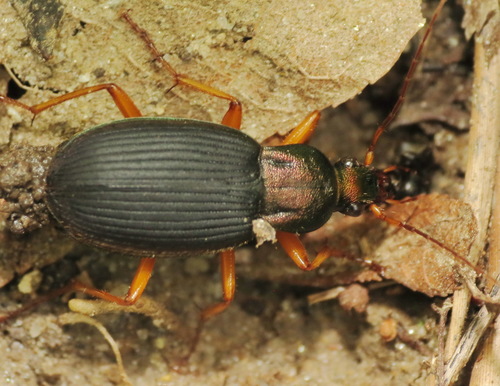
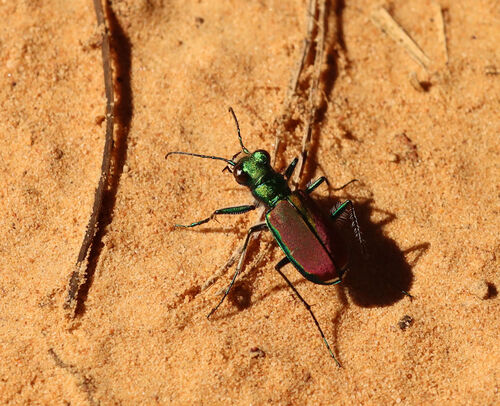
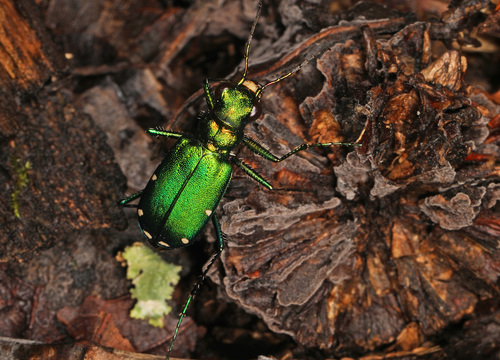
The closest relatives of the Big-Headed Ground Beetle that you can see in Shenandoah National Park (family Carabidae, Ground Beetles) are Six-Spotted Tiger Beetle (about 20%), Carabus goryi (about 10%) and Virginia Metallic Tiger Beetle (about 10%), with each one's daily chance of a sighting.

Where does the Big-Headed Ground Beetle sighting chance come from?

GBIF citizen-science records

It is estimated from how often the Big-Headed Ground Beetle is recorded against all the insects logged in Shenandoah National Park (8 verified sightings from 2019 to 2026), calibrated against known sighting rates. Figures are rounded to the nearest 10% because citizen-science data supports honest approximations, not decimals, and months with records from fewer than five people show "—". How it works.

← Back to Shenandoah National Park