Timber Rattlesnake

Timber Rattlesnake

Crotalus horridus

Silhouette: Andy Wilson · PhyloPic

LCLeast ConcernNTVUENCR
Daily sighting probability ~30% · Possible
at Shenandoah National Park

In 3 days ~70% in a week ~90%

248 Verified sightings at Shenandoah National Park From 2019 to 2026
505 In all 3 parks
July Best month
☀️ Diurnal When it's spotted

About the Timber Rattlesnake

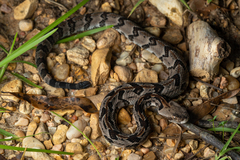
The timber rattlesnake (Crotalus horridus), also known commonly as the banded rattlesnake, and the canebrake rattlesnake in the southern United States, is a species of pit viper in the family Viperidae. The species is native to the eastern United States. Like all other pit vipers, it is venomous, with a very toxic bite. Its venom is extremely potent, and both hemorrhagic and neurotoxic venom are present depending on population and location. C. horridus is the only rattlesnake species in most of the populous Northeastern United States and is one of the most northerly distributed venomous snakes in North America. There are no subspecies that are recognized as being valid.

The timber rattlesnake was one of the many reptile species originally described by Carl Linnaeus in the landmark 1758 10th edition of his Systema Naturae, and still bears its original name Crotalus horridus. Based on an analysis of geographic variation, Pisani et al. (1972) concluded... Wikipedia →

Sounds

Recording0:08

United States · 2023

© Josh Emm · iNaturalist · CC BY-NC 4.0

Recording0:07

United States · 2026

© ccapp · iNaturalist · CC BY-NC 4.0

Recording0:04

United States · 2020

© Ty Smith · iNaturalist · CC BY-NC 4.0

Global Distribution

Parks Where Found

# Park Country Daily sighting probability
1 Shenandoah National Park 🇺🇸 United States
~30%
2 Great Smoky Mountains National Park 🇺🇸 United States
~30%
3 Congaree National Park 🇺🇸 United States
~10%

Zoos & Centres Where Found

# Zoo / Centre Country
1 Busch Gardens Tampa 🇺🇸 United States In captivity
2 San Diego Zoo 🇺🇸 United States In captivity
3 National Zoological Park 🇺🇸 United States In captivity
4 Cincinnati Zoo and Botanical Garden 🇺🇸 United States In captivity
5 California Academy of Sciences 🇺🇸 United States In captivity
6 North Carolina Zoo 🇺🇸 United States In captivity
7 Greensboro Science Center 🇺🇸 United States In captivity
8 Abilene Zoological Gardens 🇺🇸 United States In captivity
9 Toronto Zoo 🇨🇦 Canada In captivity
10 Columbus Zoo and Aquarium 🇺🇸 United States In captivity
11 Bronx Zoo 🇺🇸 United States In captivity
12 Sedgwick County Zoo 🇺🇸 United States In captivity
13 Milwaukee County Zoo 🇺🇸 United States In captivity
14 Dallas Zoo 🇺🇸 United States In captivity
15 Jacksonville Zoo and Gardens 🇺🇸 United States In captivity
16 Cape May County Park & Zoo 🇺🇸 United States In captivity
17 Birmingham Zoo 🇺🇸 United States In captivity
18 Louisville Zoo 🇺🇸 United States In captivity
19 Guadalajara Zoo 🇲🇽 Mexico In captivity
20 Audubon Zoo 🇺🇸 United States In captivity
21 Oklahoma City Zoo and Botanical Garden 🇺🇸 United States In captivity
22 Saint Louis Zoo 🇺🇸 United States In captivity
23 Caldwell Zoo 🇺🇸 United States In captivity
24 Franklin Park Zoo 🇺🇸 United States In captivity
25 Catoctin Wildlife Preserve and Zoo 🇺🇸 United States In captivity
26 Dickerson Park Zoo 🇺🇸 United States In captivity
27 Indianapolis Zoo 🇺🇸 United States In captivity
28 Zoo Knoxville 🇺🇸 United States In captivity
29 Memphis Zoo 🇺🇸 United States In captivity
30 Metro Richmond Zoo 🇺🇸 United States In captivity
31 Three Sisters Springs 🇺🇸 United States In captivity
32 Virginia Zoological Park 🇺🇸 United States In captivity
33 Houston Zoo 🇺🇸 United States In captivity
34 San Antonio Zoo 🇺🇸 United States In captivity
35 Cameron Park Zoo 🇺🇸 United States In captivity
36 Potter Park Zoo 🇺🇸 United States In captivity
37 Zoo Atlanta 🇺🇸 United States In captivity
38 The Wild Safari 🇺🇸 United States In captivity
39 Faunia 🇪🇸 Spain In captivity
40 Pittsburgh Zoo & Aquarium 🇺🇸 United States In captivity
41 Riverbanks Zoo 🇺🇸 United States In captivity
42 Western North Carolina Nature Center 🇺🇸 United States In captivity
43 Lehigh Valley Zoo 🇺🇸 United States In captivity
44 The Abilene Zoo 🇺🇸 United States In captivity
45 Henry Vilas Zoo 🇺🇸 United States In captivity
46 Safari Masai Mara 🇲🇽 Mexico In captivity
47 Alligator Adventure 🇺🇸 United States In captivity
48 Gator Country LA Alligator Park 🇺🇸 United States In captivity
49 North Carolina Aquarium at Fort Fisher 🇺🇸 United States In captivity
50 Reptile Gardens 🇺🇸 United States In captivity

Before you go

What are the chances of seeing a Timber Rattlesnake in Shenandoah National Park?

Possible

About 30% of wildlife watchers report a Timber Rattlesnake sighting in Shenandoah National Park on a given day, based on 248 verified sightings from GBIF citizen-science data from 2019 to 2026. It is the 7th most-seen of the 20 reptiles we can rate there. Over three days the chance rises to about 70%, and over a week to about 90%, if each day is a fresh chance.

When is the best time to see a Timber Rattlesnake in Shenandoah National Park?

July

In that month about 50% of wildlife watchers report a Timber Rattlesnake in Shenandoah National Park on a given day, against under 5% in November to March, the lowest months.

What time of day is best to see a Timber Rattlesnake?

Between 1 and 4 pm

Across all the parks we cover, that three-hour window holds the most Timber Rattlesnake sightings with a recorded time, and about 8 in 10 of them come between 6 am and 6 pm: it is a daytime animal.

Is Shenandoah National Park the best place to see a Timber Rattlesnake?

Yes

Of the 3 parks where we can rate Timber Rattlesnake sightings, Shenandoah National Park has the highest daily chance: about 30%. Next come Great Smoky Mountains National Park (United States, about 30%) and Congaree National Park (United States, about 10%).

Where does the Timber Rattlesnake sighting chance come from?

GBIF citizen-science records

It is estimated from how often the Timber Rattlesnake is recorded against all the reptiles logged in Shenandoah National Park (248 verified sightings from 2019 to 2026), calibrated against known sighting rates. Figures are rounded to the nearest 10% because citizen-science data supports honest approximations, not decimals, and months with records from fewer than five people show "—". How it works.

← Back to Shenandoah National Park