Speckled Racer

Speckled Racer

Drymobius margaritiferus

Silhouette: Alex Slavenko · PhyloPic

LCLeast ConcernNTVUENCR
Daily sighting probability ~10% · With luck
at Sian Ka'an Biosphere Reserve

In 3 days ~30% in a week ~60%

6 Verified sightings at Sian Ka'an Biosphere Reserve From 2019 to 2026
94 In all 6 parks
May Best month
☀️ Diurnal When it's spotted

About the Speckled Racer

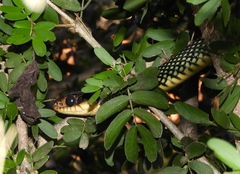
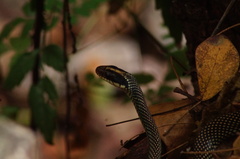
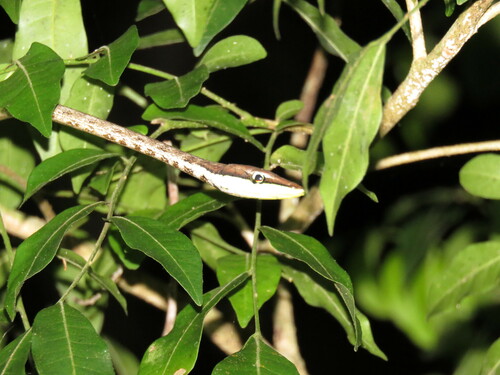
Drymobius margaritiferus, commonly known as the speckled racer, is a species of nonvenomous colubrid snake native to the Americas. The specific name, margaritiferus, means "pearl-bearing" in Latin, referring to the pearl-like spots on the dorsal scales.

This species ranges throughout Central America from the Isthmus of Tehuantepec and Yucatán Peninsula, southward to Panama and adjacent areas of northwest Colombia, occurring at elevations from sea level up to 4,750 feet (1,453 m). Northward, it is found in the coastal lowlands and lower exterior slopes of the Sierra Madres of Mexico, up the west coast to Sonora, and up the east coast to northern Tamaulipas. The northern limit of its distribution ranges into extreme south Texas, USA, where it is uncommon to rare in a few of the southernmost counties of the state.

Speckled racers occur in a wide variety of habitats, including: forest, forest edges and clearings, secondary growth, riparian zones, savannahs, marshlands, pastures, and roadsides. It is often said to favor humid and wet areas with permanent water sources. However, these snakes have been found in areas where no water was apparent, and habitats... Wikipedia →

Global Distribution

Parks Where Found

# Park Country Daily sighting probability
1 Calakmul Biosphere Reserve 🇲🇽 Mexico
~30%
2 Santa Rosa National Park 🇨🇷 Costa Rica
~20%
3 Sian Ka'an Biosphere Reserve 🇲🇽 Mexico
~10%
4 Cumbres de Monterrey National Park 🇲🇽 Mexico
~10%
5 La Amistad International Park (Panama) 🇵🇦 Panama
~10%
6 Arenal Volcano National Park 🇨🇷 Costa Rica
~10%

Cities Where Found

# City Country Daily sighting probability
1 San Pedro Sula 🇭🇳 Honduras
~10%

Before you go

What are the chances of seeing a Speckled Racer in Sian Ka'an Biosphere Reserve?

With luck

About 10% of wildlife watchers report a Speckled Racer sighting in Sian Ka'an Biosphere Reserve on a given day, based on 6 verified sightings from GBIF citizen-science data from 2019 to 2026. It is the 17th most-seen of the 23 reptiles we can rate there. Over three days the chance rises to about 30%, and over a week to about 60%, if each day is a fresh chance.

When is the best time to see a Speckled Racer in Sian Ka'an Biosphere Reserve?

May

In that month about 30% of wildlife watchers report a Speckled Racer in Sian Ka'an Biosphere Reserve on a given day, against under 5% in March–April, August–September and November–January, the lowest months.

What time of day is best to see a Speckled Racer?

Between 8 and 11 am

Across all the parks we cover, that three-hour window holds the most Speckled Racer sightings with a recorded time, and about 9 in 10 of them come between 6 am and 6 pm: it is a daytime animal.

Is Sian Ka'an Biosphere Reserve the best place to see a Speckled Racer?

3rd of 6

Of the 6 parks where we can rate Speckled Racer sightings, Sian Ka'an Biosphere Reserve ranks 3rd at about 10%. The best odds are in Calakmul Biosphere Reserve (Mexico, about 30%) and Santa Rosa National Park (Costa Rica, about 20%).

Which relatives of the Speckled Racer live in Sian Ka'an Biosphere Reserve?

Same family: Colubridae

The closest relatives of the Speckled Racer that you can see in Sian Ka'an Biosphere Reserve (family Colubridae, Colubrid Snakes) are Mexican Parrot Snake (about 20%), Gulf Coast Vine Snake (about 10%) and Chicken Snake (about 10%), with each one's daily chance of a sighting.

Where does the Speckled Racer sighting chance come from?

GBIF citizen-science records

It is estimated from how often the Speckled Racer is recorded against all the reptiles logged in Sian Ka'an Biosphere Reserve (6 verified sightings from 2019 to 2026), calibrated against known sighting rates. Figures are rounded to the nearest 10% because citizen-science data supports honest approximations, not decimals, and months with records from fewer than five people show "—". How it works.

← Back to Sian Ka'an Biosphere Reserve