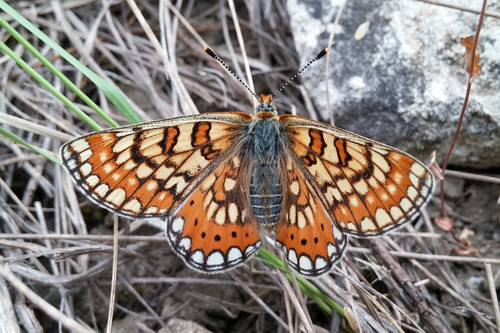
Lesser Spotted Fritillary

Lesser Spotted Fritillary

Melitaea trivia

Daily sighting probability ~10% · With luck
at Sierra de Guadarrama National Park

In 3 days ~20% in a week ~50%

35 Verified sightings at Sierra de Guadarrama National Park From 2019 to 2026
35 In 1 park
June Best month
☀️ Diurnal When it's spotted

About the Lesser Spotted Fritillary

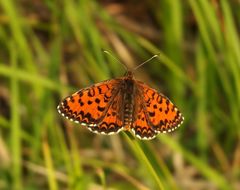
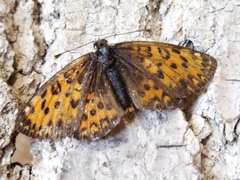
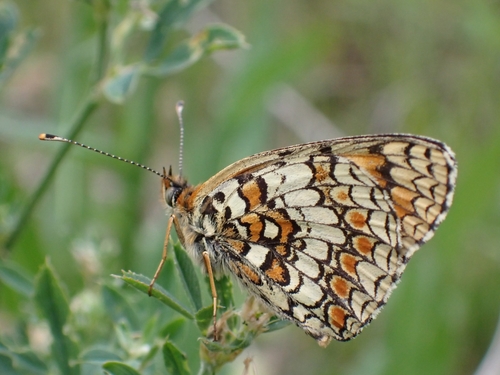
Melitaea trivia, the lesser spotted fritillary, is a butterfly of the family Nymphalidae, part of the sub-family Nymphalinae. It is found in the southern part of the Palearctic realm. In Europe it is sometimes called the desert fritillary, but this name also refers to the North African relative M. deserticola.

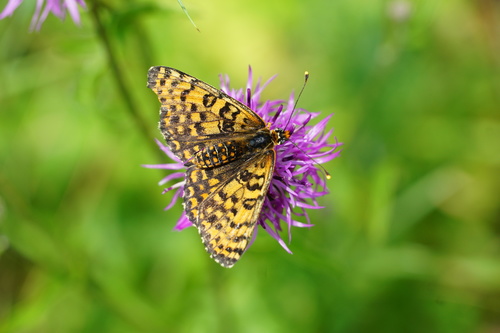
It was first described in 1775 by entomologists Michael Denis and Ignaz Schiffermüller under the basionym Papilio trivia. The wingspan is 15–23 mm. At first sight it is somewhat similar to Melitaea didyma but the black lunules before the margin united and the disc traversed by a strongly flexuose macular band, the hindwing with abundant, connected, black markings on the disc. The female with the ground-colour centrally more or less pale, especially on the forewing.

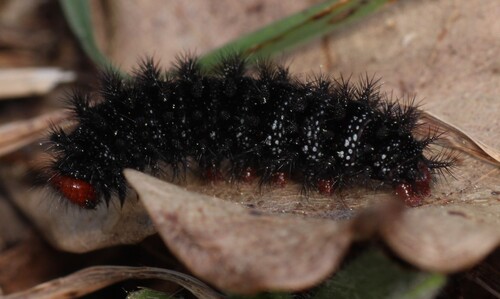
The larva of trivia is leaden grey, with bluish dots and dark dorsal stripe, the sides being striated with brownish, the soft spines whitish, the prolegs dotted with black. The pupa is very stout, anteriorly somewhat swollen, pearl-grey or dull whitish yellow, with small black dots, of which those on the wing-cases do not correspond to the spots of the wings. Some of the black spots... Wikipedia →
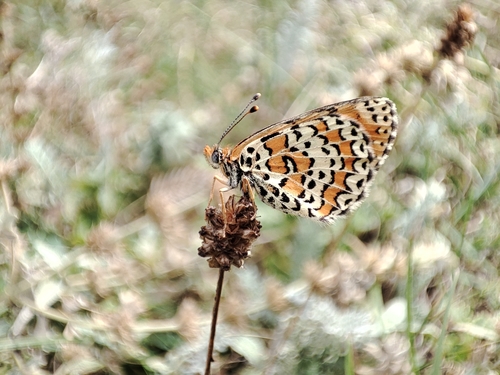
Global Distribution

Parks Where Found

# Park Country Daily sighting probability
1 Sierra de Guadarrama National Park 🇪🇸 Spain
~10%

More parks will be added in future updates.

Before you go

What are the chances of seeing a Lesser Spotted Fritillary in Sierra de Guadarrama National Park?

With luck

About 10% of wildlife watchers report a Lesser Spotted Fritillary sighting in Sierra de Guadarrama National Park on a given day, based on 35 verified sightings from GBIF citizen-science data from 2019 to 2026. It is the 109th most-seen of the 597 insects we can rate there. Over three days the chance rises to about 20%, and over a week to about 50%, if each day is a fresh chance.

When is the best time to see a Lesser Spotted Fritillary in Sierra de Guadarrama National Park?

May to August

In those months about 10% of wildlife watchers report a Lesser Spotted Fritillary in Sierra de Guadarrama National Park on a given day, against under 5% in September to April, the lowest months. Those are among Sierra de Guadarrama National Park's driest months, with about 45 mm of rain a month against 110 mm in November.

What time of day is best to see a Lesser Spotted Fritillary?

Between 10 am and 1 pm

Across all the parks we cover, that three-hour window holds the most Lesser Spotted Fritillary sightings with a recorded time, and about 9 in 10 of them come between 6 am and 6 pm: it is a daytime animal.

Where else can you see a Lesser Spotted Fritillary?

Only Sierra de Guadarrama National Park, in our data

Sierra de Guadarrama National Park is the only park on Wallace's Line with enough records to rate Lesser Spotted Fritillary sightings: about 10% of wildlife watchers there report one on a given day.

Which relatives of the Lesser Spotted Fritillary live in Sierra de Guadarrama National Park?

Same genus: Melitaea

The closest relatives of the Lesser Spotted Fritillary that you can see in Sierra de Guadarrama National Park (genus Melitaea) are Knapweed Fritillary (about 10%), Glanville Fritillary (about 10%) and Spotted Fritillary (about 10%), with each one's daily chance of a sighting.

Where does the Lesser Spotted Fritillary sighting chance come from?

GBIF citizen-science records

It is estimated from how often the Lesser Spotted Fritillary is recorded against all the insects logged in Sierra de Guadarrama National Park (35 verified sightings from 2019 to 2026), calibrated against known sighting rates. Figures are rounded to the nearest 10% because citizen-science data supports honest approximations, not decimals, and months with records from fewer than five people show "—". How it works.

← Back to Sierra de Guadarrama National Park