Little Bustard

Little Bustard

Tetrax tetrax

Silhouette: David González del Portillo · PhyloPic

LCNTNear ThreatenedVUENCR
Daily sighting probability ~10% · With luck
at Sierra de Guadarrama National Park

In 3 days ~30% in a week ~60%

451 Verified sightings at Sierra de Guadarrama National Park From 2019 to 2026
457 In all 2 parks
May Best month
☀️ Diurnal When it's spotted

About the Little Bustard

The little bustard (Tetrax tetrax) is a bird in the bustard family, the only member of the genus Tetrax. It breeds in Southern Europe and in Western and Central Asia. The little bustard was formally described in 1758 by the Swedish naturalist Carl Linnaeus in the tenth edition of his Systema Naturae. He placed it with the other bustards in the genus Otis and coined the binomial name Otis tetrax. Linnaeus designated the type locality as Europe but this has been restricted to France. The little bustard is now placed in its own genus Tetrax that was introduced in 1817 by Thomas Forster. The species is considered to be monotypic: no subspecies are recognised. The genus name and the specific epithet tetrax is the Latin word for an unidentified gamebird.

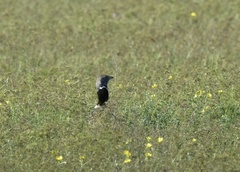
Although the smallest Palearctic bustard, the little bustard is still pheasant-sized at 42–45 cm (17–18 in) long with a 90–110 cm (35–43 in) wingspan and a weight of 830 g (29 oz). In flight, the long wings are extensively white. The breeding male is brown above and white below, with a grey head and a black neck bordered above and below by white.

The female and non-breeding male lack the dramatic neck pattern... Wikipedia →

Sounds

Song0:29

France · 2023

© Thierry THOMAS · XC856083 · CC BY-NC-SA 4.0

Call1:16

Spain · 2022

© SonoNatura · XC722333 · CC BY-NC-SA 4.0

Song0:15

France · 2023

© Manceau Lionel · XC801397 · CC BY-NC-SA 4.0

Global Distribution

Parks Where Found

# Park Country Daily sighting probability
1 Sierra de Guadarrama National Park 🇪🇸 Spain
~10%
2 Doñana National Park 🇪🇸 Spain
<5%

Zoos & Centres Where Found

# Zoo / Centre Country
1 Parc des oiseaux 🇫🇷 France In captivity

Before you go

What are the chances of seeing a Little Bustard in Sierra de Guadarrama National Park?

With luck

About 10% of wildlife watchers report a Little Bustard sighting in Sierra de Guadarrama National Park on a given day, based on 451 verified sightings from GBIF citizen-science data from 2019 to 2026. It is the 67th most-seen of the 202 birds we can rate there. Over three days the chance rises to about 30%, and over a week to about 60%, if each day is a fresh chance.

When is the best time to see a Little Bustard in Sierra de Guadarrama National Park?

May

In that month about 30% of wildlife watchers report a Little Bustard in Sierra de Guadarrama National Park on a given day, against under 5% in September to February, the lowest months.

What time of day is best to see a Little Bustard?

Between 9 am and noon

Across all the parks we cover, that three-hour window holds the most Little Bustard sightings with a recorded time, and about 7 in 10 of them come between 6 am and 6 pm: it is a daytime animal.

Is Sierra de Guadarrama National Park the best place to see a Little Bustard?

Yes

Of the 2 parks where we can rate Little Bustard sightings, Sierra de Guadarrama National Park has the highest daily chance: about 10%. Next come Doñana National Park (Spain, under 5%).

Where does the Little Bustard sighting chance come from?

GBIF citizen-science records

It is estimated from how often the Little Bustard is recorded against all the birds logged in Sierra de Guadarrama National Park (451 verified sightings from 2019 to 2026), calibrated against known sighting rates. Figures are rounded to the nearest 10% because citizen-science data supports honest approximations, not decimals, and months with records from fewer than five people show "—". How it works.

← Back to Sierra de Guadarrama National Park