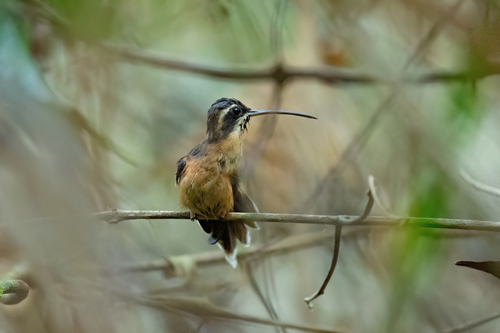
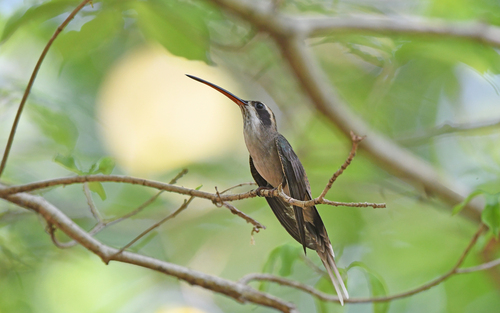
Black-throated Hermit

Black-throated Hermit

Phaethornis atrimentalis

Silhouette: Andy Wilson · PhyloPic

LCLeast ConcernNTVUENCR
Daily sighting probability <5% · Rare
at Sierra de la Macarena National Park

In 3 days <5% in a week ~10%

18 Verified sightings at Sierra de la Macarena National Park From 2019 to 2026
69 In all 3 parks
June Best month
☀️ Diurnal When it's spotted

About the Black-throated Hermit

The black-throated hermit (Phaethornis atrimentalis) is a species of hummingbird in the family Trochilidae. It is found in Colombia, Ecuador, and Peru. The black-throated hermit was for a time considered a subspecies of little hermit (P. longuemareus), but is more closely related to the reddish hermit (P. ruber) and grey-chinned hermit (P. griseogularis).

The black-chinned hermit is about 9 to 10 cm (3.5 to 3.9 in) long, with P. a. riojae being larger than the nominate. The species has generally greenish upperparts with a reddish rump and a white-tipped dark tail. The throat is dark brown and the rest of the underparts cinnamon red but for whitish undertail coverts. Males often have a dark band between the throat and breast. Females are similar to males but their throat is lighter and they generally have longer wings.

The nominate subspecies of black-chinned hermit is found in the eastern Andes of Colombia, Ecuador, and northern Peru's Loreto department. P. a. riojae is found further south, in central Peru between the departments of... Wikipedia →

Sounds

Song0:56

Colombia · 2022

© Mauricio Cuéllar Ramírez · XC706546 · CC BY-NC-SA 4.0

Call0:32

Colombia · 2021

© Mauricio Cuellar Ramirez (@Birding.travel) · XC683914 · CC BY-NC-SA 4.0

Flight call0:13

Ecuador · 2004

© John V. Moore · XC257800 · CC BY-NC-SA 4.0

Global Distribution

Parks Where Found

# Park Country Daily sighting probability
1 Cuyabeno Wildlife Reserve 🇪🇨 Ecuador
<5%
2 Sierra de la Macarena National Park 🇨🇴 Colombia
<5%
3 Yasuní National Park 🇪🇨 Ecuador
<5%

Before you go

What are the chances of seeing a Black-throated Hermit in Sierra de la Macarena National Park?

Rare

Under 5% of wildlife watchers report a Black-throated Hermit sighting in Sierra de la Macarena National Park on a given day, based on 18 verified sightings from GBIF citizen-science data from 2019 to 2026. It is the 322nd most-seen of the 418 birds we can rate there. Over three days the chance rises to under 5%, and over a week to about 10%, if each day is a fresh chance.

When is the best time to see a Black-throated Hermit in Sierra de la Macarena National Park?

Any time of year

In every month with enough records, under 5% of wildlife watchers report a Black-throated Hermit in Sierra de la Macarena National Park on a given day, so our monthly data shows no clear season.

What time of day is best to see a Black-throated Hermit?

Between 7 and 10 am

Across all the parks we cover, that three-hour window holds the most Black-throated Hermit sightings with a recorded time, and about 8 in 10 of them come between 6 am and 6 pm: it is a daytime animal.

Is Sierra de la Macarena National Park the best place to see a Black-throated Hermit?

Among the best

Of the 3 parks where we can rate Black-throated Hermit sightings, Sierra de la Macarena National Park ranks 2nd at under 5%, level with the leaders once rounded. The best odds are in Cuyabeno Wildlife Reserve (Ecuador, under 5%).

Which relatives of the Black-throated Hermit live in Sierra de la Macarena National Park?

Same genus: Phaethornis

The closest relatives of the Black-throated Hermit that you can see in Sierra de la Macarena National Park (genus Phaethornis, Typical Hermits) are Sooty-capped Hermit (about 10%) and Gray-chinned Hermit (about 10%), with each one's daily chance of a sighting.

Where does the Black-throated Hermit sighting chance come from?

GBIF citizen-science records

It is estimated from how often the Black-throated Hermit is recorded against all the birds logged in Sierra de la Macarena National Park (18 verified sightings from 2019 to 2026), calibrated against known sighting rates. Figures are rounded to the nearest 10% because citizen-science data supports honest approximations, not decimals, and months with records from fewer than five people show "—". How it works.

← Back to Sierra de la Macarena National Park