
Green-billed Coucal

Green-billed Coucal

Centropus chlororhynchos

Silhouette: Nicolas Huet le Jeune and Jean-Gabriel Prêtre (vectorized by T. Michael Keesey) · PhyloPic

LCNTVUVulnerableENCR Endemic
Daily sighting probability ~40% · Likely
at Sinharaja Forest Reserve

In 3 days ~70% in a week >90%

603 Verified sightings at Sinharaja Forest Reserve From 2019 to 2026
603 In 1 park
May Best month
🌅 Crepuscular When it's spotted

About the Green-billed Coucal

The green-billed coucal (Centropus chlororhynchos) is a member of the cuckoos. It is endemic to Sri Lanka's wet zone and listed as Vulnerable on the IUCN Red List, as the small population declined due to forest destruction and fragmentation.

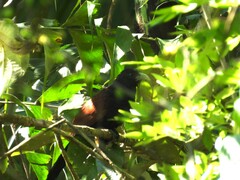
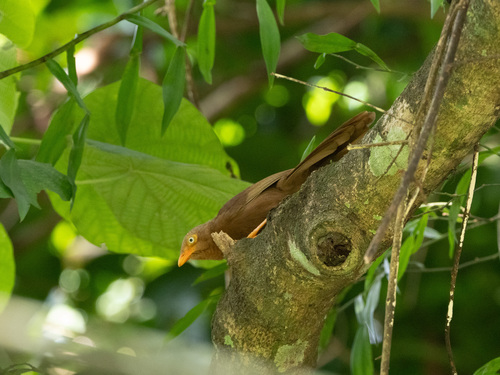
It inhabits the tall rainforests of southwest Sri Lanka and nests in bushes. Its typical clutch is 2–3 eggs. It is a medium to large bird at 43 cm. Its head and body is purple-black, the wings are maroon above and black below, and the long tail is dark green. The bill is a distinctive light green. Sexes are similar, but juveniles are duller and streaked. It is somewhat smaller and less contrasted than the more widespread greater coucal. Despite its size and distinctive call, this is a difficult species to see because of the dense habitat in which it lives and its retiring nature. It feeds on a wide range of insects, caterpillars and small vertebrates, but snails are a favourite.

In Sri Lanka, this bird is known as bata atti-kukula – or, wal atti-kukula in the Sinhala language. This bird appears in a 20 rupee Sri Lankan postal stamp. BirdLife Species Factsheet. Wikipedia →

Sounds

Alarm call0:10

Sri Lanka · 2026

© Uku Paal · XC1097217 · CC BY-NC-SA 4.0

Song0:11

Sri Lanka · 2007

© Jelle Scharringa · XC605498 · CC BY-NC-SA 4.0

Call0:52

Sri Lanka · 2014

© Andrew Spencer · XC190811 · CC BY-NC-SA 3.0

Global Distribution

Parks Where Found

# Park Country Daily sighting probability
1 Sinharaja Forest Reserve 🇱🇰 Sri Lanka
~40%

More parks will be added in future updates.

Before you go

What are the chances of seeing a Green-billed Coucal in Sinharaja Forest Reserve?

Likely

About 40% of wildlife watchers report a Green-billed Coucal sighting in Sinharaja Forest Reserve on a given day, based on 603 verified sightings from GBIF citizen-science data from 2019 to 2026. It is the 34th most-seen of the 156 birds we can rate there. Over three days the chance rises to about 70%, and over a week to over 90%, if each day is a fresh chance.

When is the best time to see a Green-billed Coucal in Sinharaja Forest Reserve?

February and May

In those months about 50% of wildlife watchers report a Green-billed Coucal in Sinharaja Forest Reserve on a given day, against about 20% in August, the lowest month.

What time of day is best to see a Green-billed Coucal?

Between 3 and 6 am

Across all the parks we cover, that three-hour window holds the most Green-billed Coucal sightings with a recorded time, and about 6 in 10 of them come between 6 am and 6 pm: it is most active around dawn and dusk.

Where else can you see a Green-billed Coucal?

Only Sinharaja Forest Reserve, in our data

Sinharaja Forest Reserve is the only park on Wallace's Line with enough records to rate Green-billed Coucal sightings: about 40% of wildlife watchers there report one on a given day.

Where does the Green-billed Coucal sighting chance come from?

GBIF citizen-science records

It is estimated from how often the Green-billed Coucal is recorded against all the birds logged in Sinharaja Forest Reserve (603 verified sightings from 2019 to 2026), calibrated against known sighting rates. Figures are rounded to the nearest 10% because citizen-science data supports honest approximations, not decimals, and months with records from fewer than five people show "—". How it works.

← Back to Sinharaja Forest Reserve