Red-faced Malkoha

Red-faced Malkoha

Phaenicophaeus pyrrhocephalus

Silhouette: Lip Kee Yap (modified) · PhyloPic

LCNTVUVulnerableENCR Endemic
Daily sighting probability ~30% · Possible
at Sinharaja Forest Reserve

In 3 days ~70% in a week ~90%

587 Verified sightings at Sinharaja Forest Reserve From 2019 to 2026
587 In 1 park
September Best month
🌅 Crepuscular When it's spotted

About the Red-faced Malkoha

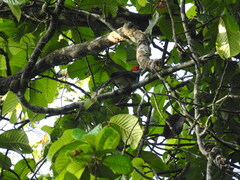
The red-faced malkoha (Phaenicophaeus pyrrhocephalus) is a member of the cuckoo order of birds, the Cuculiformes. This malkoha species is endemic to Sri Lanka This is a large species at 46 cm (18 in) with a long graduated tail. Its back is dark green, and the uppertail is green edged with white. The belly and undertail are white, the latter being barred black. The crown and throat are black, and the lower face white. There is a large red patch around the eye and the bill is green. Sexual dimorphism present where males having dark brown iris and females are creamy white. Juveniles are with much duller plumage.

The red-faced malkoha takes a variety of insects including caterpillars, giant stick insects, mantises and small vertebrates such as lizard. It occasionally may eat berries but this needs confirmation. Unlike most cuckoos, this is a quiet species, making only the odd soft grunt.

It is endemic to Sri Lanka although some old records have apparently erroneously referred to its presence in southern India. According to Baker (1934), it is found in the 'South of Travancore, where it was obtained by Stewart together with its nests'. Later, Biddulph... Wikipedia →

Global Distribution

Parks Where Found

# Park Country Daily sighting probability
1 Sinharaja Forest Reserve 🇱🇰 Sri Lanka
~30%

More parks will be added in future updates.

Before you go

What are the chances of seeing a Red-faced Malkoha in Sinharaja Forest Reserve?

Possible

About 30% of wildlife watchers report a Red-faced Malkoha sighting in Sinharaja Forest Reserve on a given day, based on 587 verified sightings from GBIF citizen-science data from 2019 to 2026. It is the 40th most-seen of the 156 birds we can rate there. Over three days the chance rises to about 70%, and over a week to about 90%, if each day is a fresh chance.

When is the best time to see a Red-faced Malkoha in Sinharaja Forest Reserve?

September

In that month about 50% of wildlife watchers report a Red-faced Malkoha in Sinharaja Forest Reserve on a given day, against about 30% in January to August, the lowest months.

What time of day is best to see a Red-faced Malkoha?

Between 6 and 9 am

Across all the parks we cover, that three-hour window holds the most Red-faced Malkoha sightings with a recorded time, and about 7 in 10 of them come between 6 am and 6 pm: it is most active around dawn and dusk.

Where else can you see a Red-faced Malkoha?

Only Sinharaja Forest Reserve, in our data

Sinharaja Forest Reserve is the only park on Wallace's Line with enough records to rate Red-faced Malkoha sightings: about 30% of wildlife watchers there report one on a given day.

Which relatives of the Red-faced Malkoha live in Sinharaja Forest Reserve?

Same family: Cuculidae

The closest relatives of the Red-faced Malkoha that you can see in Sinharaja Forest Reserve (family Cuculidae, Cuckoos) are Green-billed Coucal (about 40%) and Greater Coucal (about 20%), with each one's daily chance of a sighting.

Where does the Red-faced Malkoha sighting chance come from?

GBIF citizen-science records

It is estimated from how often the Red-faced Malkoha is recorded against all the birds logged in Sinharaja Forest Reserve (587 verified sightings from 2019 to 2026), calibrated against known sighting rates. Figures are rounded to the nearest 10% because citizen-science data supports honest approximations, not decimals, and months with records from fewer than five people show "—". How it works.

← Back to Sinharaja Forest Reserve