Layard's Palm Squirrel

Layard's Palm Squirrel

Funambulus layardi

Silhouette: Andy Wilson · PhyloPic

LCNTVUVulnerableENCR Endemic
Daily sighting probability ~40% · Likely
at Sinharaja Forest Reserve

In 3 days ~70% in a week >90%

83 Verified sightings at Sinharaja Forest Reserve From 2019 to 2026
83 In 1 park
April Best month
🌅 Crepuscular When it's spotted

About the Layard's Palm Squirrel

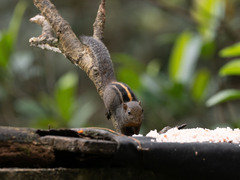
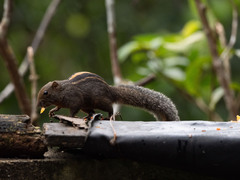
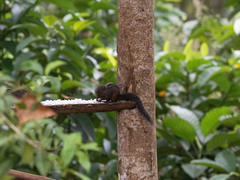
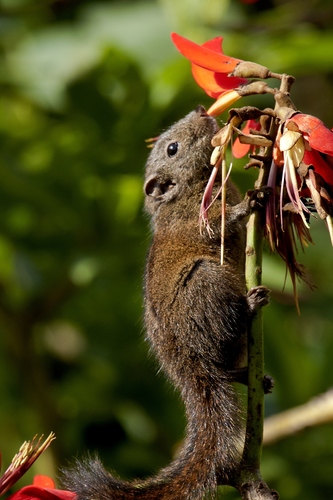
Layard's palm squirrel or flame-striped jungle squirrel (Funambulus layardi) is a species of rodent in the family Sciuridae endemic to Sri Lanka. The validity of the subspecies F. l. dravidianus based on a single specimen from the southern tip of India has been questioned, and is probably a juvenile F. sublineatus. Known as මූකලන් ලේනා (mukalan lena) in Sinhala.

It is endemic to the central highlands of Sri Lanka. Few observations are known out of central hills, such as from Trincomalee and Matara districts, but it remains unresolved. It can be seen in Knuckles mountain range and other high altitude ranges in western basin of the central hills.

Its head and body length is 12–17 cm, with a 14-cm tail. In color, it is blackish brown with three stripes on its dorsum; the central stripe is broadest and longest with an orange hue in F. signatus, yellow in F. layardi. Its underparts are reddish orange in color, and its snout is small. Tail bushy and blackish brown with some red in it. Some individuals also possess some grizzling appearance on it. Fur is soft, short and dense.

Its natural habitat is subtropical and tropical moist... Wikipedia →

Global Distribution

Parks Where Found

# Park Country Daily sighting probability
1 Sinharaja Forest Reserve 🇱🇰 Sri Lanka
~40%

More parks will be added in future updates.

Before you go

What are the chances of seeing a Layard's Palm Squirrel in Sinharaja Forest Reserve?

Likely

About 40% of wildlife watchers report a Layard's Palm Squirrel sighting in Sinharaja Forest Reserve on a given day, based on 83 verified sightings from GBIF citizen-science data from 2019 to 2026. It is the 5th most-seen of the 8 mammals we can rate there. Over three days the chance rises to about 70%, and over a week to over 90%, if each day is a fresh chance.

When is the best time to see a Layard's Palm Squirrel in Sinharaja Forest Reserve?

April and October

In those months about 50% of wildlife watchers report a Layard's Palm Squirrel in Sinharaja Forest Reserve on a given day, against under 5% in June and November, the lowest months.

What time of day is best to see a Layard's Palm Squirrel?

Between 2 and 5 am

Across all the parks we cover, that three-hour window holds the most Layard's Palm Squirrel sightings with a recorded time, and about 6 in 10 of them come between 6 am and 6 pm: it is most active around dawn and dusk.

Where else can you see a Layard's Palm Squirrel?

Only Sinharaja Forest Reserve, in our data

Sinharaja Forest Reserve is the only park on Wallace's Line with enough records to rate Layard's Palm Squirrel sightings: about 40% of wildlife watchers there report one on a given day.

Which relatives of the Layard's Palm Squirrel live in Sinharaja Forest Reserve?

Same genus: Funambulus

The closest relatives of the Layard's Palm Squirrel that you can see in Sinharaja Forest Reserve (genus Funambulus, Palm Squirrels) are Indian Palm Squirrel (about 50%) and Nilgiri Palm Squirrel (about 20%), with each one's daily chance of a sighting.

Where does the Layard's Palm Squirrel sighting chance come from?

GBIF citizen-science records

It is estimated from how often the Layard's Palm Squirrel is recorded against all the mammals logged in Sinharaja Forest Reserve (83 verified sightings from 2019 to 2026), calibrated against known sighting rates. Figures are rounded to the nearest 10% because citizen-science data supports honest approximations, not decimals, and months with records from fewer than five people show "—". How it works.

← Back to Sinharaja Forest Reserve