Nilgiri Palm Squirrel

Nilgiri Palm Squirrel

Funambulus sublineatus

Silhouette: Andy Wilson · PhyloPic

LCNTVUVulnerableENCR
Daily sighting probability ~20% · Possible
at Sinharaja Forest Reserve

In 3 days ~50% in a week ~80%

19 Verified sightings at Sinharaja Forest Reserve From 2019 to 2026
95 In all 3 parks
January Best month
🌅 Crepuscular When it's spotted

About the Nilgiri Palm Squirrel

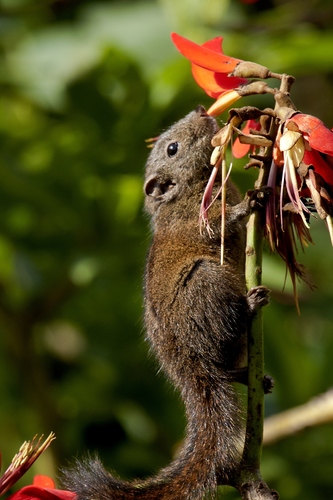
The Nilgiri striped squirrel (Funambulus sublineatus) is a threatened species of rodent, a small squirrel (Sciuridae) from rainforests in the southern Western Ghats, including the Nilgiris, in Peninsular India. It formerly included Funambulus obscurus from Sri Lanka as a subspecies, at which point the English name of the "combined species" also was dusky striped squirrel (a name now restricted to the Sri Lankan species).

Funambulus sublineatus was scientifically described in 1838. Later it was merged with the Sri Lankan obscurus, then regarded as a subspecies of Funambulus sublineatus. In 2012, a review found that the two were highly distinct and recommended that they should be recognized as separate species.

The former range of the species, before the taxonomic split, was in both India and Sri Lanka, though the Nilgiri palm squirrel (F. sublineatus) is now restricted in distribution to the Western Ghats of India. Very little is known of this squirrel, probably the smallest in the genus weighing about 40g. Its new status as an endemic mammal to India means records need updating.

The species is confined to wet humid forests either in the Western Ghats... Wikipedia →
Global Distribution

Parks Where Found

# Park Country Daily sighting probability
1 Horton Plains National Park 🇱🇰 Sri Lanka
~40%
2 Sinharaja Forest Reserve 🇱🇰 Sri Lanka
~20%
3 Eravikulam National Park 🇮🇳 India
~20%

Before you go

What are the chances of seeing a Nilgiri Palm Squirrel in Sinharaja Forest Reserve?

Possible

About 20% of wildlife watchers report a Nilgiri Palm Squirrel sighting in Sinharaja Forest Reserve on a given day, based on 19 verified sightings from GBIF citizen-science data from 2019 to 2026. It is the 7th most-seen of the 8 mammals we can rate there. Over three days the chance rises to about 50%, and over a week to about 80%, if each day is a fresh chance.

When is the best time to see a Nilgiri Palm Squirrel in Sinharaja Forest Reserve?

January and March

In those months about 30% of wildlife watchers report a Nilgiri Palm Squirrel in Sinharaja Forest Reserve on a given day, against under 5% in May–July and October, the lowest months. Those are among Sinharaja Forest Reserve's driest months, with about 160 mm of rain a month against 490 mm in November.

What time of day is best to see a Nilgiri Palm Squirrel?

Between 10 am and 1 pm

Across all the parks we cover, that three-hour window holds the most Nilgiri Palm Squirrel sightings with a recorded time, and about 6 in 10 of them come between 6 am and 6 pm: it is most active around dawn and dusk.

Is Sinharaja Forest Reserve the best place to see a Nilgiri Palm Squirrel?

2nd of 3

Of the 3 parks where we can rate Nilgiri Palm Squirrel sightings, Sinharaja Forest Reserve ranks 2nd at about 20%. The best odds are in Horton Plains National Park (Sri Lanka, about 40%).

Which relatives of the Nilgiri Palm Squirrel live in Sinharaja Forest Reserve?

Same genus: Funambulus

The closest relatives of the Nilgiri Palm Squirrel that you can see in Sinharaja Forest Reserve (genus Funambulus, Palm Squirrels) are Indian Palm Squirrel (about 50%) and Layard's Palm Squirrel (about 40%), with each one's daily chance of a sighting.

Where does the Nilgiri Palm Squirrel sighting chance come from?

GBIF citizen-science records

It is estimated from how often the Nilgiri Palm Squirrel is recorded against all the mammals logged in Sinharaja Forest Reserve (19 verified sightings from 2019 to 2026), calibrated against known sighting rates. Figures are rounded to the nearest 10% because citizen-science data supports honest approximations, not decimals, and months with records from fewer than five people show "—". How it works.

← Back to Sinharaja Forest Reserve