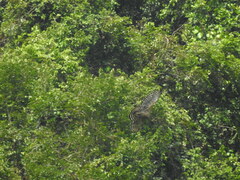
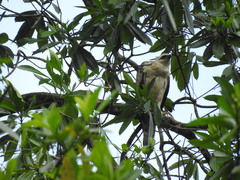
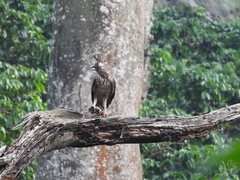
Legge's Hawk-Eagle

Legge's Hawk-Eagle

Nisaetus kelaarti

Silhouette: Sheatherius · PhyloPic

Daily sighting probability ~10% · With luck
at Sinharaja Forest Reserve

In 3 days ~20% in a week ~50%

139 Verified sightings at Sinharaja Forest Reserve From 2019 to 2026
253 In all 3 parks
December Best month
☀️ Diurnal When it's spotted

About the Legge's Hawk-Eagle

Legge's hawk-eagle (Nisaetus kelaarti) is a bird of prey. Like all eagles, it is in the family Accipitridae. It breeds in the Indian subcontinent, from southern India to Sri Lanka. Its specific name kelaarti honors the physician-zoologist E.F. Kelaart. The English common name honours William Vincent Legge, who described the species in 1878.

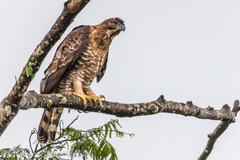
Legge's hawk-eagle is a medium-sized eagle and fairly large-sized raptor. The typical adult has brown upperparts and pale underparts, with barring on the undersides of the flight feathers and tail. The breast and belly are heavily streaked. The wings are broad with a curved trailing edge, and are held in a shallow V in flight. Sexes are similar, but young birds are often whiter-headed.

Legge's hawk-eagle was formerly considered to be a subspecies of the mountain hawk-eagle, but it is smaller and has unstreaked buff underwing coverts. A 2008 study based on the geographic isolation and differences in call suggested that this be treated as a full species, Nisaetus kelaarti. When all standard measurements are considered, Legge's hawk-eagles average about 5-10% smaller than mountain hawk eagles, although Legge's tail length is slightly greater on average. Furthermore, one male from Sri Lanka weighed 1.93 kg (4.3 lb), slightly less than most male mountain hawk-eagles. In average total length, males Legge's hawk-eagles average about 70 cm (28 in) and females average about 76 cm (30 in).

It is a bird of mountain woodland that builds a stick nest in a tree and lays usually a single egg in a clutch. Legge's hawk-eagles eat small mammals, birds and reptiles. Despite its relatively modest size, Legge's hawk-eagle is a powerful predator with large talons, like many booted eagles, and is sometimes known to occasionally pursue prey as heavy or heavier than itself. This may include Indian peafowl, estimated to weigh 2.8 to 4 kg (6.2 to 8.8 lb). Wikipedia →

Sounds

Recording0:36

India · 2021

© Jyotsana Jetley Nirula · XC685080 · CC BY-NC-SA 4.0

Call0:41

India · 2021

© Viral joshi · XC673405 · CC BY-NC-SA 4.0

Call0:17

India · 2016

© Neelakantan · XC343717 · CC BY-NC-SA 4.0

Global Distribution

Parks Where Found

# Park Country Daily sighting probability
1 Sinharaja Forest Reserve 🇱🇰 Sri Lanka
~10%
2 Periyar National Park 🇮🇳 India
<5%
3 Horton Plains National Park 🇱🇰 Sri Lanka
<5%

Before you go

What are the chances of seeing a Legge's Hawk-Eagle in Sinharaja Forest Reserve?

With luck

About 10% of wildlife watchers report a Legge's Hawk-Eagle sighting in Sinharaja Forest Reserve on a given day, based on 139 verified sightings from GBIF citizen-science data from 2019 to 2026. It is the 82nd most-seen of the 156 birds we can rate there. Over three days the chance rises to about 20%, and over a week to about 50%, if each day is a fresh chance.

When is the best time to see a Legge's Hawk-Eagle in Sinharaja Forest Reserve?

April–June, September and November–February

In those months about 10% of wildlife watchers report a Legge's Hawk-Eagle in Sinharaja Forest Reserve on a given day, against under 5% in March, July–August and October, the lowest months.

What time of day is best to see a Legge's Hawk-Eagle?

Between 9 am and noon

Across all the parks we cover, that three-hour window holds the most Legge's Hawk-Eagle sightings with a recorded time, and about 9 in 10 of them come between 6 am and 6 pm: it is a daytime animal.

Is Sinharaja Forest Reserve the best place to see a Legge's Hawk-Eagle?

Yes

Of the 3 parks where we can rate Legge's Hawk-Eagle sightings, Sinharaja Forest Reserve has the highest daily chance: about 10%. Next come Periyar National Park (India, under 5%) and Horton Plains National Park (Sri Lanka, under 5%).

Where does the Legge's Hawk-Eagle sighting chance come from?

GBIF citizen-science records

It is estimated from how often the Legge's Hawk-Eagle is recorded against all the birds logged in Sinharaja Forest Reserve (139 verified sightings from 2019 to 2026), calibrated against known sighting rates. Figures are rounded to the nearest 10% because citizen-science data supports honest approximations, not decimals, and months with records from fewer than five people show "—". How it works.

← Back to Sinharaja Forest Reserve