Serendib Scops Owl

Serendib Scops Owl

Otus thilohoffmanni

Silhouette: Armelle Ansart (photograph), Maxime Dahirel (digitisation) · PhyloPic

LCNTVUENEndangeredCR Endemic
Daily sighting probability ~20% · Possible
at Sinharaja Forest Reserve

In 3 days ~60% in a week ~90%

432 Verified sightings at Sinharaja Forest Reserve From 2019 to 2026
432 In 1 park
November Best month
☀️ Diurnal When it's spotted

About the Serendib Scops Owl

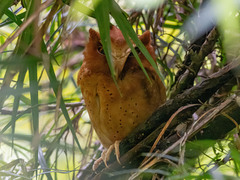
The Serendib scops owl (Otus thilohoffmanni) is the most recently discovered bird of Sri Lanka. It was originally located by its unfamiliar poo-ooo call in the Kitulgala rainforest by prominent Sri Lankan ornithologist Deepal Warakagoda. Six years later, it was finally seen by him on 23 January 2001 in Sinharaja, and formally described as a species new to science in 2004. Apart from Sinharaja and Kitulgala, it has also been found at Runakanda Reserve in Morapitiya and Eratna Gilimale. It is known as පඬුවන් බස්සා in Sinhala.

It is the first new bird to be discovered in Sri Lanka since 1868, when the Sri Lanka whistling thrush—then Ceylon whistling thrush—(Myophonus blighi) was discovered. It is also the 24th (according to some authorities the 27th) endemic bird species for Sri Lanka.

The habitat of the Serendib scops owl is in the southern rainforests of Sri Lanka. There is an altitudinal range from 30 to 50 metres. This owl has no competition from other nocturnal birds, as the territories are completely different. This species has a very small population: at the end of January 2006 only 80 of them were known to exist. The places that it is expected to be found are in five protected areas, like the Forest Reserve or the Proposed Reserve of Sri Lanka. They seem to be declining because of the loss of habitat and the degradation. The first two hours of darkness are when the owl hunts for its food.

This rare species inhabits the rainforests in the southwestern part of Sri Lanka. Like most owls, it is strictly nocturnal and hunts insects (e.g. beetles and moths) close to the ground. It begins calling at dusk, then its frequency rises again some two hours before dawn.

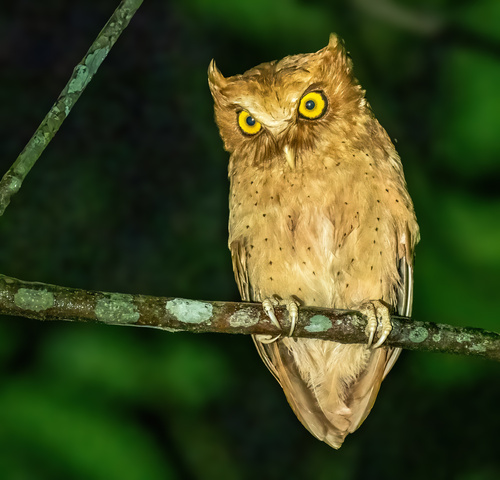
Unlike the other two species of scops owl in Sri Lanka, Indian scops owl (Otus bakkamoena) and oriental scops owl (Otus sunia), it does not have ear-tufts and its facial disc is only weakly defined. The general colour of this 16.5 cm (6.5 in) long, short-tailed owl is reddish-brown with paler underparts, spotted all over with fine black markings. The irides are tawny yellow (more orangish in male) and the feet are a pale fleshy colour. Tarsi are feathered for less than half their length. The claws and bill are a pale ivory colour. Wikipedia →
Sounds

Song0:59

Sri Lanka · 2016

© Peter Boesman · XC311407 · CC BY-NC-ND 4.0

Call1:11

Sri Lanka · 2005

© George Wagner · XC43645 · CC BY-NC-ND 2.5

Song0:28

Sri Lanka

© Craig Robson · XC19358 · CC BY-NC-ND 2.5

Global Distribution

Parks Where Found

# Park Country Daily sighting probability
1 Sinharaja Forest Reserve 🇱🇰 Sri Lanka
~20%

More parks will be added in future updates.

Before you go

What are the chances of seeing a Serendib Scops Owl in Sinharaja Forest Reserve?

Possible

About 20% of wildlife watchers report a Serendib Scops Owl sighting in Sinharaja Forest Reserve on a given day, based on 432 verified sightings from GBIF citizen-science data from 2019 to 2026. It is the 53rd most-seen of the 156 birds we can rate there. Over three days the chance rises to about 60%, and over a week to about 90%, if each day is a fresh chance.

When is the best time to see a Serendib Scops Owl in Sinharaja Forest Reserve?

November

In that month about 40% of wildlife watchers report a Serendib Scops Owl in Sinharaja Forest Reserve on a given day, against about 20% in January and April–September, the lowest months. That is one of Sinharaja Forest Reserve's wettest months, with about 490 mm of rain against 150 mm in March.

What time of day is best to see a Serendib Scops Owl?

Between 2 and 5 pm

Across all the parks we cover, that three-hour window holds the most Serendib Scops Owl sightings with a recorded time, and about 7 in 10 of them come between 6 am and 6 pm: it is a daytime animal.

Where else can you see a Serendib Scops Owl?

Only Sinharaja Forest Reserve, in our data

Sinharaja Forest Reserve is the only park on Wallace's Line with enough records to rate Serendib Scops Owl sightings: about 20% of wildlife watchers there report one on a given day.

Where does the Serendib Scops Owl sighting chance come from?

GBIF citizen-science records

It is estimated from how often the Serendib Scops Owl is recorded against all the birds logged in Sinharaja Forest Reserve (432 verified sightings from 2019 to 2026), calibrated against known sighting rates. Figures are rounded to the nearest 10% because citizen-science data supports honest approximations, not decimals, and months with records from fewer than five people show "—". How it works.

← Back to Sinharaja Forest Reserve