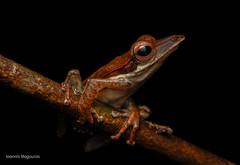
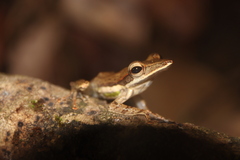
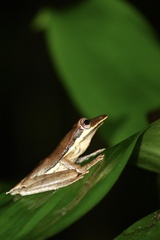
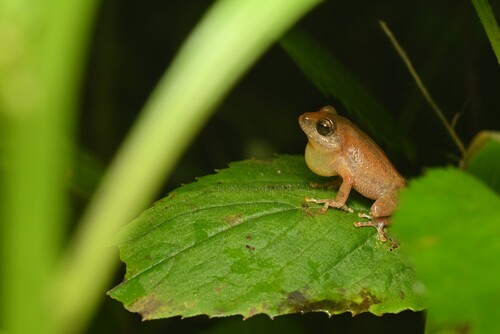
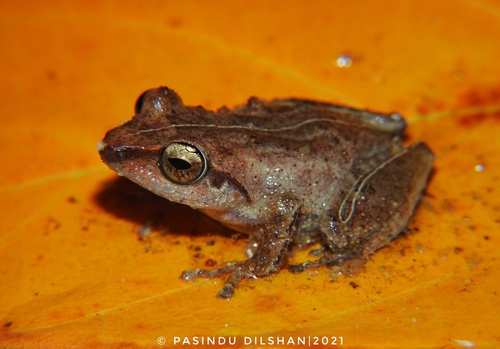
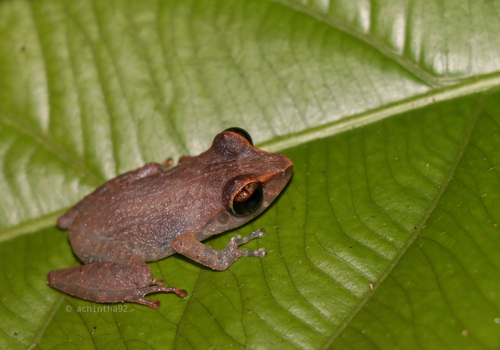
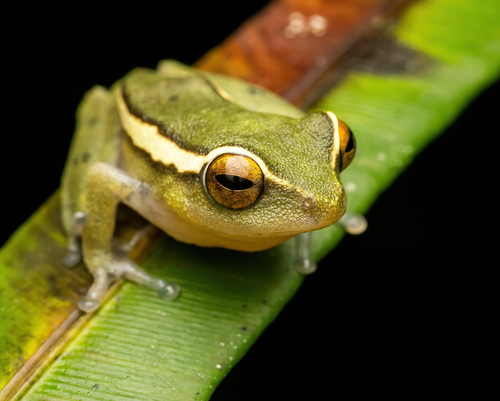
Sharp-snout Saddled Tree Frog

Sharp-snout Saddled Tree Frog

Taruga longinasus

Silhouette: Jose Carlos Arenas-Monroy · PhyloPic

LCNTVUENEndangeredCR Endemic
Daily sighting probability ~30% · Possible
at Sinharaja Forest Reserve

In 3 days ~70% in a week ~90%

49 Verified sightings at Sinharaja Forest Reserve From 2019 to 2026
49 In 1 park
December Best month
🌅 Crepuscular When it's spotted

About the Sharp-snout Saddled Tree Frog

Taruga longinasus (common names: southern whipping frog, long-snouted tree-frog) is a species of frog in the family Rhacophoridae. It is endemic to Sri Lanka. It has been observed between 150 and 1300 m above sea level. The adult male frog measures about 41–47 mm in snout-vent length and the adult female frog 57–60 mm. The skin of the dorsum is dark brown or red-brown in color with a red stripe from the nose to the middle of each flank. The frog's lips are white or yellow. Its legs are brown with marks.

These frogs are arboreal and live high in the trees. They can jump very well. When it is time to lay eggs, the adult frogs climb down to pools of water near streams. They female frog lays 28 to 42 eggs per clutch. The tadpoles grow into frogs in ten weeks.

The IUCN classifies this frog as endangered due to habitat loss. The frog is threatened by firewood collection and conversion of forest to both small- and large-scale farms, including those for cash crops like tea, cinnamon, rubber, and palm oil. The pesticides and fertilizers involved can also kill the frog directly.. Small hydroelectric projects also disrupt its habitat... Wikipedia →

Global Distribution

Parks Where Found

# Park Country Daily sighting probability
1 Sinharaja Forest Reserve 🇱🇰 Sri Lanka
~30%

More parks will be added in future updates.

Closest Relatives at Sinharaja Forest Reserve

Before you go

What are the chances of seeing a Sharp-snout Saddled Tree Frog in Sinharaja Forest Reserve?

Possible

About 30% of wildlife watchers report a Sharp-snout Saddled Tree Frog sighting in Sinharaja Forest Reserve on a given day, based on 49 verified sightings from GBIF citizen-science data from 2019 to 2026. It is the 4th most-seen of the 25 amphibians we can rate there. Over three days the chance rises to about 70%, and over a week to about 90%, if each day is a fresh chance.

When is the best time to see a Sharp-snout Saddled Tree Frog in Sinharaja Forest Reserve?

April, July and December

In those months about 40% of wildlife watchers report a Sharp-snout Saddled Tree Frog in Sinharaja Forest Reserve on a given day, against under 5% in October, the lowest month.

What time of day is best to see a Sharp-snout Saddled Tree Frog?

Between 3 and 6 pm

Across all the parks we cover, that three-hour window holds the most Sharp-snout Saddled Tree Frog sightings with a recorded time, and about 6 in 10 of them come between 6 am and 6 pm: it is most active around dawn and dusk.

Where else can you see a Sharp-snout Saddled Tree Frog?

Only Sinharaja Forest Reserve, in our data

Sinharaja Forest Reserve is the only park on Wallace's Line with enough records to rate Sharp-snout Saddled Tree Frog sightings: about 30% of wildlife watchers there report one on a given day.

Which relatives of the Sharp-snout Saddled Tree Frog live in Sinharaja Forest Reserve?

Same family: Rhacophoridae

The closest relatives of the Sharp-snout Saddled Tree Frog that you can see in Sinharaja Forest Reserve (family Rhacophoridae, Old World Tree Frogs) are Common Hourglass Tree Frog (about 40%), Common Shrub Frog (about 30%) and Sharp-snouted Shrub Frog (about 30%), with each one's daily chance of a sighting.

Where does the Sharp-snout Saddled Tree Frog sighting chance come from?

GBIF citizen-science records

It is estimated from how often the Sharp-snout Saddled Tree Frog is recorded against all the amphibians logged in Sinharaja Forest Reserve (49 verified sightings from 2019 to 2026), calibrated against known sighting rates. Figures are rounded to the nearest 10% because citizen-science data supports honest approximations, not decimals, and months with records from fewer than five people show "—". How it works.

← Back to Sinharaja Forest Reserve