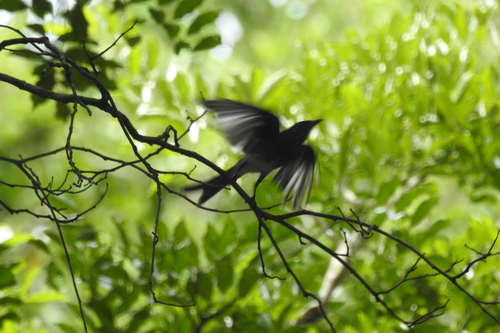
Spot-winged Thrush

Spot-winged Thrush

Geokichla spiloptera

Silhouette: Francesco "Architetto" Rollandin · PhyloPic

LCNTNear ThreatenedVUENCR Endemic
Daily sighting probability ~50% · Likely
at Sinharaja Forest Reserve

In 3 days ~90% in a week >90%

914 Verified sightings at Sinharaja Forest Reserve From 2019 to 2026
948 In all 2 parks
February Best month
🌅 Crepuscular When it's spotted

About the Spot-winged Thrush

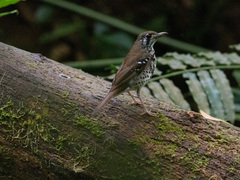
The spot-winged thrush (Geokichla spiloptera) is an Asian thrush, a group within the large thrush family Turdidae. It is an endemic resident breeder in Sri Lanka. Adults of this medium-sized thrush, which measures 21 to 23 cm (8.3 to 9.1 in) in total length and weighs 70 g (2.5 oz) are light brown above with a double wing bar of white spots. The pale face has two dark bars. The underparts are white with heavy spotting. The bill is black and legs are yellow. The song is a rich and varied whistling. Young birds have buff streaking on the upperparts, and the face and the underparts are light brown with heavy streaking.

This uncommon species breeds in hill rainforests, and to a lesser extent in drier woodlands, at altitudes between 500 and 2000 m. The wintering areas are similar but include less well-wooded areas, and are generally at 750 to 1500 m altitude. The spot-winged thrush is generally solitary and can be quite secretive, especially in the dense undergrowth and bamboo clumps it favours.

The loose cup nests are lined with vegetation and placed in a tree fork. 2-3 buff or bluish-green eggs are laid. This species raises two broods each year... Wikipedia →

Sounds

Song0:36

Sri Lanka · 2022

© Okamoto Keita Sin · XC756592 · CC BY-NC-SA 4.0

Call0:17

Sri Lanka · 2016

© Tejaswini Limaye · XC345001 · CC BY-NC-SA 4.0

Song1:04

Sri Lanka · 2007

© Jelle Scharringa · XC648205 · CC BY-NC-SA 4.0

Global Distribution

Parks Where Found

# Park Country Daily sighting probability
1 Sinharaja Forest Reserve 🇱🇰 Sri Lanka
~50%
2 Horton Plains National Park 🇱🇰 Sri Lanka
~10%

Before you go

What are the chances of seeing a Spot-winged Thrush in Sinharaja Forest Reserve?

Likely

About 50% of wildlife watchers report a Spot-winged Thrush sighting in Sinharaja Forest Reserve on a given day, based on 914 verified sightings from GBIF citizen-science data from 2019 to 2026. It is the 19th most-seen of the 156 birds we can rate there. Over three days the chance rises to about 90%, and over a week to over 90%, if each day is a fresh chance.

When is the best time to see a Spot-winged Thrush in Sinharaja Forest Reserve?

February, June and December

In those months about 60% of wildlife watchers report a Spot-winged Thrush in Sinharaja Forest Reserve on a given day, against about 40% in July and August, the lowest months.

What time of day is best to see a Spot-winged Thrush?

Between 2 and 5 am

Across all the parks we cover, that three-hour window holds the most Spot-winged Thrush sightings with a recorded time, and about 6 in 10 of them come between 6 am and 6 pm: it is most active around dawn and dusk.

Is Sinharaja Forest Reserve the best place to see a Spot-winged Thrush?

Yes

Of the 2 parks where we can rate Spot-winged Thrush sightings, Sinharaja Forest Reserve has the highest daily chance: about 50%. Next come Horton Plains National Park (Sri Lanka, about 10%).

Where does the Spot-winged Thrush sighting chance come from?

GBIF citizen-science records

It is estimated from how often the Spot-winged Thrush is recorded against all the birds logged in Sinharaja Forest Reserve (914 verified sightings from 2019 to 2026), calibrated against known sighting rates. Figures are rounded to the nearest 10% because citizen-science data supports honest approximations, not decimals, and months with records from fewer than five people show "—". How it works.

← Back to Sinharaja Forest Reserve