About the Panamanian Night Monkey
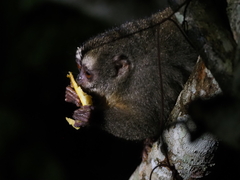
The Panamanian night monkey or Chocoan night monkey (Aotus zonalis) is a species of night monkey formerly considered a subspecies of the gray-bellied night monkey of the family Aotidae. Its range consists of Panama and the Chocó region of Colombia. There are also unconfirmed reports of its occurrence in Costa Rica, especially on the Caribbean coast of Costa Rica. The species definitely occurs in the Atlantic lowlands of Panama close to the Costa Rica border.
The exact classification of the Panamanian Night Monkey is uncertain. While some authors consider it a subspecies of the gray-bellied night monkey, A. lemurinus, other authors follow a study by Thomas Defler from 2001, which concluded that it is a separate species, A. zonalis.
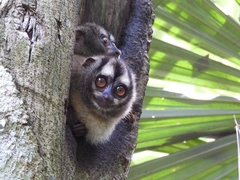
The Panamanian night monkey is a relatively small monkey, with males weighing approximately 889 grams (31.4 oz) and females weighing about 916 grams (32.3 oz). The fur on the back ranges from grayish brown to reddish brown. The belly is yellow. The hair on the back of the hands and feet is black or dark brown, which is a key distinguishing feature from other northern "gray-necked" Aotus species; also, its hair is shorter. Other distinguishing features relate to its skull, which has a broad braincase, a depressed interorbital region, and large molariform teeth.
Like other night monkeys, the Panamanian night monkey has large eyes, befitting its nocturnal lifestyle. But unlike many nocturnal animal species, its eyes do not have a tapetum lucidum. Also like other night monkeys, it has a short tail relative to the body size.
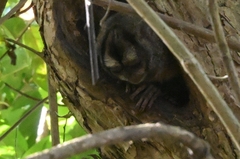
The Panamanian night monkey is arboreal and nocturnal. It and the other members of the genus Aotus are the only nocturnal monkeys. It is found in several types of forest, including secondary forest and coffee plantations. It lives in small groups of between two and six monkeys, consisting of an adult pair and one infant and several juveniles and/or subadults. Groups are territorial, and groups occupy ranges that overlap only slightly.
Vocal, olfactory and behavioral forms of communication have all been recorded. At least nine vocal calls have been reported, including various types of grunts, screams, squeals, moans and trills. Males develop a scent gland near their tail at the age of about one year that is used for scent marking. Urine washing, in which urine is rubbed on the hands and feet, is also used. Wikipedia →