South American Boxer Mantis

South American Boxer Mantis

Acanthops falcata

Daily sighting probability ~10% · With luck
at Soberanía National Park

In 3 days ~10% in a week ~30%

5 Verified sightings at Soberanía National Park From 2019 to 2026
5 In 1 park
August Best month
☀️ Diurnal When it's spotted

About the South American Boxer Mantis

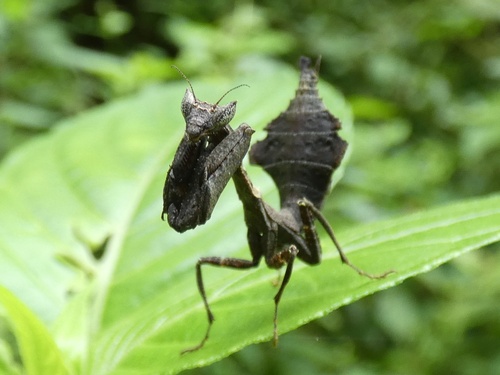
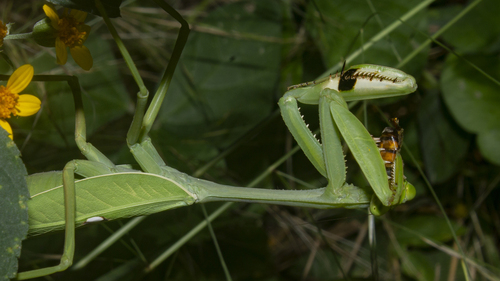
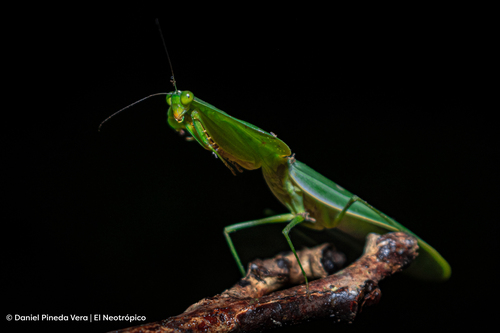
Acanthops falcata, common name South American dead leaf mantis or boxer mantis, is a species of praying mantis in the subfamily Acanthopinae of the family Acanthopidae and is one of many praying mantises from various genera that resembles a dead leaf.

As the common name describes, A. falcata resembles shriveled or dead leaves. It is not to be confused with Acanthops falcataria, a different species in the same genus that is often referred to with the same common name. Acanthops species have an unusual degree of sexual dimorphism compared to other mantids. The flightless female of A. falcata resembles a curled dead leaf and weighs 400–500 mg. It has reduced wings that can be lifted to reveal brightly colored warning colors on the abdomen. The male weighs under 200 mg and has long functional wings that resemble a flat or rolled-up dead leaf at rest. When perched, males often assume a posture where the head, grasping legs and prothorax add to the camouflage by recreating the appearance of a dead leaf's shriveled petiole and stipules.

A. falcata is relatively easy to breed in captivity and has become widely distributed through the pet trade. Females have a... Wikipedia →

Global Distribution

Parks Where Found

# Park Country Daily sighting probability
1 Soberanía National Park 🇵🇦 Panama
~10%

More parks will be added in future updates.

Before you go

What are the chances of seeing a South American Boxer Mantis in Soberanía National Park?

With luck

About 10% of wildlife watchers report a South American Boxer Mantis sighting in Soberanía National Park on a given day, based on 5 verified sightings from GBIF citizen-science data from 2019 to 2026. It is the 208th most-seen of the 253 insects we can rate there. Over three days the chance rises to about 10%, and over a week to about 30%, if each day is a fresh chance.

When is the best time to see a South American Boxer Mantis in Soberanía National Park?

August

In that month about 20% of wildlife watchers report a South American Boxer Mantis in Soberanía National Park on a given day, against under 5% in May–July and September–February, the lowest months. That is one of Soberanía National Park's wettest months, with about 320 mm of rain against 25 mm in February.

What time of day is best to see a South American Boxer Mantis?

Between 6 and 9 am

Across all the parks we cover, that three-hour window holds the most South American Boxer Mantis sightings with a recorded time, and about 8 in 10 of them come between 6 am and 6 pm: it is a daytime animal.

Where else can you see a South American Boxer Mantis?

Only Soberanía National Park, in our data

Soberanía National Park is the only park on Wallace's Line with enough records to rate South American Boxer Mantis sightings: about 10% of wildlife watchers there report one on a given day.

Which relatives of the South American Boxer Mantis live in Soberanía National Park?

Same order: Mantodea

The closest relatives of the South American Boxer Mantis that you can see in Soberanía National Park (order Mantodea, Mantises) are Stagmatoptera septentrionalis (about 10%) and Peruvian Shield Mantis (about 10%), with each one's daily chance of a sighting.

Where does the South American Boxer Mantis sighting chance come from?

GBIF citizen-science records

It is estimated from how often the South American Boxer Mantis is recorded against all the insects logged in Soberanía National Park (5 verified sightings from 2019 to 2026), calibrated against known sighting rates. Figures are rounded to the nearest 10% because citizen-science data supports honest approximations, not decimals, and months with records from fewer than five people show "—". How it works.

← Back to Soberanía National Park