Blue-Winged Helicopter

Blue-Winged Helicopter

Megaloprepus caerulatus

Daily sighting probability ~30% · Possible
at Soberanía National Park

In 3 days ~60% in a week ~90%

90 Verified sightings at Soberanía National Park From 2019 to 2026
238 In all 8 parks
November Best month
☀️ Diurnal When it's spotted

About the Blue-Winged Helicopter

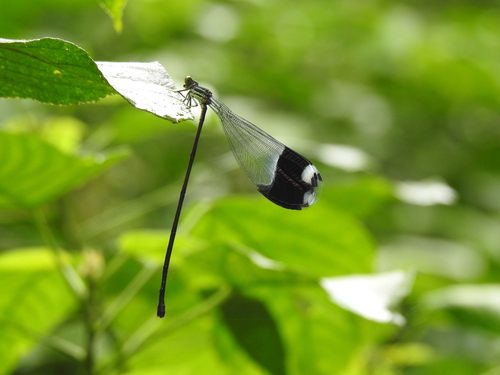
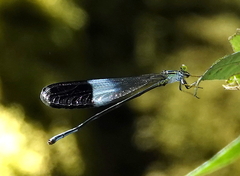
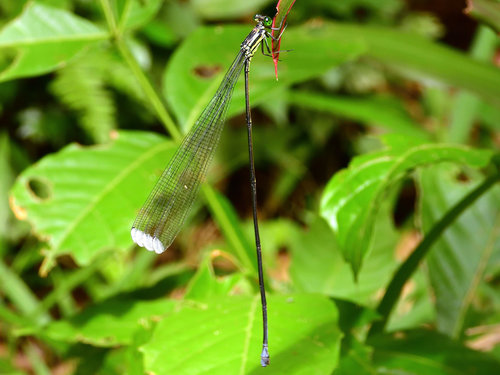
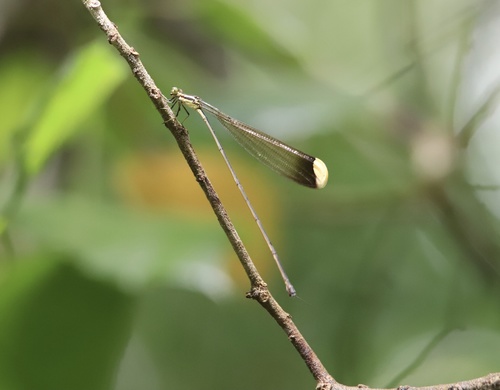
Megaloprepus caerulatus, also known as the blue-winged helicopter, is a forest giant damselfly of the family Coenagrionidae. Forest giant damselflies were previously recognized as their own family, Pseudostigmatidae. M. caerulatus is found in wet and moist forests in Central and South America. It has the greatest wingspan of any living damselfly or dragonfly, up to 19 centimetres (7.5 in) in the largest males. Its large size and the markings on its wings make it a conspicuous species; a hovering Megaloprepus has been described as a "pulsating blue-and-white beacon".

As an adult it feeds on orb-weaver spiders in the forest understory, which it plucks from their webs. It lays its eggs in water-filled holes in trees; males defend the larger holes as breeding territories. The naiad is a top predator in its tree-hole habitat, feeding on tadpoles and aquatic insects, including the larvae of mosquito species that are vectors of human disease.

Megaloprepus lays its eggs in the water that collects in tree hollows. These plant-borne bodies of water, known as phytotelmata, may form in a living tree when a branch breaks off or a burl rots and fills with water, in buttresses... Wikipedia →

Global Distribution

Parks Where Found

# Park Country Daily sighting probability
1 Braulio Carrillo National Park 🇨🇷 Costa Rica
~30%
2 Soberanía National Park 🇵🇦 Panama
~30%
3 Darién National Park 🇵🇦 Panama
~20%
4 Gandoca-Manzanillo Wildlife Refuge 🇨🇷 Costa Rica
~20%
5 Tortuguero National Park 🇨🇷 Costa Rica
~10%
6 Cahuita National Park 🇨🇷 Costa Rica
~10%
7 Arenal Volcano National Park 🇨🇷 Costa Rica
~10%
8 La Amistad International Park (Panama) 🇵🇦 Panama
<5%

Before you go

What are the chances of seeing a Blue-Winged Helicopter in Soberanía National Park?

Possible

About 30% of wildlife watchers report a Blue-Winged Helicopter sighting in Soberanía National Park on a given day, based on 90 verified sightings from GBIF citizen-science data from 2019 to 2026. It is the 5th most-seen of the 253 insects we can rate there. Over three days the chance rises to about 60%, and over a week to about 90%, if each day is a fresh chance.

When is the best time to see a Blue-Winged Helicopter in Soberanía National Park?

November

In that month about 40% of wildlife watchers report a Blue-Winged Helicopter in Soberanía National Park on a given day, against about 10% in April, the lowest month. That is one of Soberanía National Park's wettest months, with about 350 mm of rain against 25 mm in February.

What time of day is best to see a Blue-Winged Helicopter?

Between 10 am and 1 pm

Across all the parks we cover, that three-hour window holds the most Blue-Winged Helicopter sightings with a recorded time, and about 8 in 10 of them come between 6 am and 6 pm: it is a daytime animal.

Is Soberanía National Park the best place to see a Blue-Winged Helicopter?

Among the best

Of the 8 parks where we can rate Blue-Winged Helicopter sightings, Soberanía National Park ranks 2nd at about 30%, level with the leaders once rounded. The best odds are in Braulio Carrillo National Park (Costa Rica, about 30%).

Which relatives of the Blue-Winged Helicopter live in Soberanía National Park?

Same family: Coenagrionidae

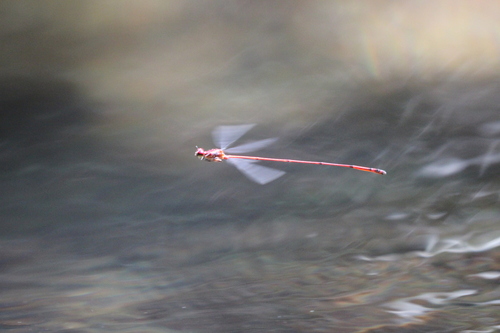
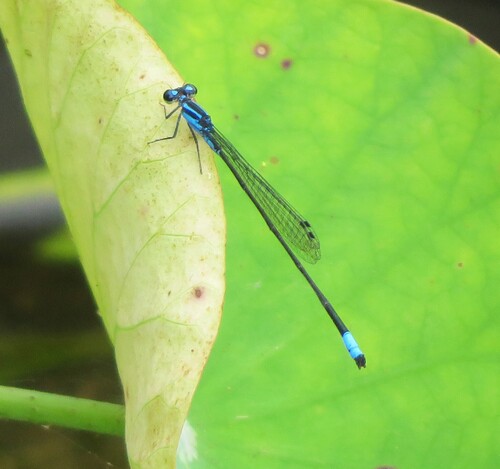
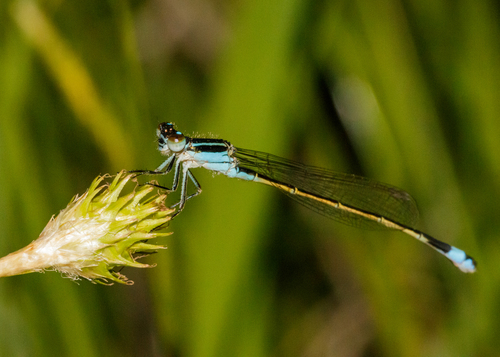
The closest relatives of the Blue-Winged Helicopter that you can see in Soberanía National Park (family Coenagrionidae, Narrow-winged Damselflies) are Oculate Dancer (about 20%), Purple Dancer (about 10%) and Striped Firetail (about 10%), with each one's daily chance of a sighting.

Where does the Blue-Winged Helicopter sighting chance come from?

GBIF citizen-science records

It is estimated from how often the Blue-Winged Helicopter is recorded against all the insects logged in Soberanía National Park (90 verified sightings from 2019 to 2026), calibrated against known sighting rates. Figures are rounded to the nearest 10% because citizen-science data supports honest approximations, not decimals, and months with records from fewer than five people show "—". How it works.

← Back to Soberanía National Park