Wandering Albatross

Wandering Albatross

Diomedea exulans

Silhouette: Alexandre Vong · PhyloPic

LCNTVUVulnerableENCR
Daily sighting probability ~10% · With luck
at South Georgia and the South Sandwich Islands

In 3 days ~40% in a week ~70%

137 Verified sightings at South Georgia and the South Sandwich Islands From 2019 to 2026
177 In all 3 parks
May Best month
☀️ Diurnal When it's spotted

About the Wandering Albatross

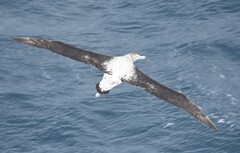
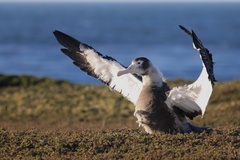
The snowy albatross (Diomedea exulans), also known as the wandering albatross, white-winged albatross, or goonie, is a large seabird from the family Diomedeidae; they have a circumpolar range in the Southern Ocean. It is the largest species of albatross and was long considered to be the same species as the Tristan albatross and the Antipodean albatross. Together with the Amsterdam albatross, it forms the wandering albatross species complex, which some began referring to more recently as "snowy".

The snowy albatross is one of the two largest members of the genus Diomedea (the great albatrosses), being similar in size to the southern royal albatross. It has the greatest known wingspan of any living bird and is also one of the most far-ranging birds. Some individual snowy albatrosses are known to circumnavigate the Southern Ocean three times in one year, covering more than 120,000 km (75,000 mi).

The taxonomic history of this species is long and complicated. The species was first described as Diomedea exulans by Carl Linnaeus in 1758, based on a specimen from the Cape of Good Hope. Diomedea refers to Diomedes from Greek mythology whose companions turned to birds, and exulans...

Wikipedia →

Sounds

Call0:39

New Zealand · 2022

© Barry Edmonston · XC796375 · CC BY-NC-SA 4.0

?0:39

United Kingdom · 2005

© Santiago Imberti · XC14563 · CC BY-NC-ND 2.5

Call0:09

France · 2020

© Hichem MACHOUK · XC623847 · CC BY-NC-SA 4.0

Global Distribution

Parks Where Found

# Park Country Daily sighting probability
1 South Georgia and the South Sandwich Islands 🇬🇸 South Georgia and the South Sandwich Islands
~10%
2 Antarctic Peninsula & South Shetland Islands 🇦🇶 Antarctica
<5%
3 Falkland Islands 🇫🇰 Falkland Islands
<5%

Before you go

What are the chances of seeing a Wandering Albatross in South Georgia and the South Sandwich Islands?

With luck

About 10% of wildlife watchers report a Wandering Albatross sighting in South Georgia and the South Sandwich Islands on a given day, based on 137 verified sightings from GBIF citizen-science data from 2019 to 2026. It is the 24th most-seen of the 37 birds we can rate there. Over three days the chance rises to about 40%, and over a week to about 70%, if each day is a fresh chance.

When is the best time to see a Wandering Albatross in South Georgia and the South Sandwich Islands?

March–May and December–January

In those months about 20% of wildlife watchers report a Wandering Albatross in South Georgia and the South Sandwich Islands on a given day, against about 10% in February, June and September–November, the lowest months. July and August have too few records to rate.

What time of day is best to see a Wandering Albatross?

Between 8 and 11 am

Across all the parks we cover, that three-hour window holds the most Wandering Albatross sightings with a recorded time, and about 9 in 10 of them come between 6 am and 6 pm: it is a daytime animal.

Is South Georgia and the South Sandwich Islands the best place to see a Wandering Albatross?

Yes

Of the 3 parks where we can rate Wandering Albatross sightings, South Georgia and the South Sandwich Islands has the highest daily chance: about 10%. Next come Antarctic Peninsula & South Shetland Islands (Antarctica, under 5%) and Falkland Islands (Falkland Islands, under 5%).

Where does the Wandering Albatross sighting chance come from?

GBIF citizen-science records

It is estimated from how often the Wandering Albatross is recorded against all the birds logged in South Georgia and the South Sandwich Islands (137 verified sightings from 2019 to 2026), calibrated against known sighting rates. Figures are rounded to the nearest 10% because citizen-science data supports honest approximations, not decimals, and months with records from fewer than five people show "—". How it works.

← Back to South Georgia and the South Sandwich Islands