Pale-headed Rosella

Pale-headed Rosella

Platycercus adscitus

Silhouette: Farelli (photo), John E. McCormack, Michael G. Harvey, Brant C. Faircloth, Nicholas G. Crawford, Travis C. Glenn, Robb T. Brumfield & T. Michael Keesey · PhyloPic

LCLeast ConcernNTVUENCR Endemic
Daily sighting probability ~10% · With luck
at Springbrook National Park

In 3 days ~30% in a week ~60%

46 Verified sightings at Springbrook National Park From 2019 to 2026
227 In all 3 parks
December Best month
☀️ Diurnal When it's spotted

About the Pale-headed Rosella

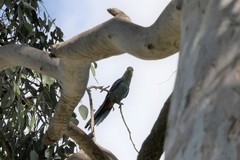
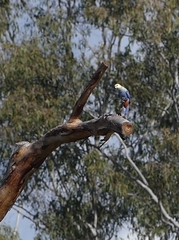
The pale-headed rosella (Platycercus adscitus), is a broad-tailed parrot of the genus Platycercus native to northeastern Australia. It is a moderate-size parrot with a pale yellow head, predominantly white cheeks, scalloped black and gold back and pale blue underparts. Two subspecies are recognised, although some authorities consider it to be conspecific with the eastern rosella of southeastern Australia.

Found in open woodland, it feeds on seeds and fruit. As with other rosellas, the pale-headed rosella nests in hollows of large trees. It readily adapts to aviculture and is sold as a cagebird. The pale-headed rosella was formally described in 1790 by the English ornithologist John Latham and given the binomial name Psittacus adscitus. The specific epithet is from Latin asciscere meaning "to approve". Latham did not specify a locality but in 1912 Gregory Mathews designated the locality as Cooktown, Queensland in northeast Australia. The pale-headed rosella is now placed in the genus Platycercus that was introduced in 1925 by Nicholas Aylward Vigors.

There are two subspecies, the nominate adscitus (Cape York Peninsula) and the better known palliceps (eastern Queensland... Wikipedia →

Sounds

Call0:16

Australia · 2020

© James Lambert · XC593967 · CC BY-NC-SA 4.0

Flight call0:11

Australia · 2018

© Marc Anderson · XC434511 · CC BY-NC-ND 4.0

Call0:19

Australia · 2009

© Simon Elliott · XC592629 · CC BY-NC-ND 4.0

Global Distribution

Parks Where Found

# Park Country Daily sighting probability
1 Springbrook National Park 🇦🇺 Australia
~10%
2 Noosa National Park 🇦🇺 Australia
~10%
3 Lamington National Park 🇦🇺 Australia
<5%

Cities Where Found

# City Country Daily sighting probability
1 Brisbane 🇦🇺 Australia
~20%

Zoos & Centres Where Found

# Zoo / Centre Country
1 Disney's Animal Kingdom 🇺🇸 United States In captivity
2 Kyiv Zoo 🇺🇦 Ukraine In captivity
3 Almaty Zoo 🇰🇿 Kazakhstan In captivity
4 Loro Parque 🇪🇸 Spain In captivity
5 Discovery Cove 🇺🇸 United States In captivity
6 Featherdale Sydney Wildlife Park 🇦🇺 Australia In captivity
7 Flying High Bird Sanctuary 🇦🇺 Australia In captivity
8 Fauna Reserve 🇦🇺 Australia In captivity
9 Wildlife Habitat Port Douglas 🇦🇺 Australia In captivity

Before you go

What are the chances of seeing a Pale-headed Rosella in Springbrook National Park?

With luck

About 10% of wildlife watchers report a Pale-headed Rosella sighting in Springbrook National Park on a given day, based on 46 verified sightings from GBIF citizen-science data from 2019 to 2026. It is the 64th most-seen of the 136 birds we can rate there. Over three days the chance rises to about 30%, and over a week to about 60%, if each day is a fresh chance.

When is the best time to see a Pale-headed Rosella in Springbrook National Park?

December

In that month about 20% of wildlife watchers report a Pale-headed Rosella in Springbrook National Park on a given day, against under 5% in October, the lowest month.

What time of day is best to see a Pale-headed Rosella?

Between 7 and 10 am

Across all the parks we cover, that three-hour window holds the most Pale-headed Rosella sightings with a recorded time, and nearly all of them come between 6 am and 6 pm: it is a daytime animal.

Is Springbrook National Park the best place to see a Pale-headed Rosella?

Yes

Of the 3 parks where we can rate Pale-headed Rosella sightings, Springbrook National Park has the highest daily chance: about 10%. Next come Noosa National Park (Australia, about 10%) and Lamington National Park (Australia, under 5%).

Where does the Pale-headed Rosella sighting chance come from?

GBIF citizen-science records

It is estimated from how often the Pale-headed Rosella is recorded against all the birds logged in Springbrook National Park (46 verified sightings from 2019 to 2026), calibrated against known sighting rates. Figures are rounded to the nearest 10% because citizen-science data supports honest approximations, not decimals, and months with records from fewer than five people show "—". How it works.

← Back to Springbrook National Park