Scaly-breasted Lorikeet

Scaly-breasted Lorikeet

Trichoglossus chlorolepidotus

Silhouette: Farelli (photo), John E. McCormack, Michael G. Harvey, Brant C. Faircloth, Nicholas G. Crawford, Travis C. Glenn, Robb T. Brumfield & T. Michael Keesey · PhyloPic

LCLeast ConcernNTVUENCR Endemic
Daily sighting probability ~10% · With luck
at Springbrook National Park

In 3 days ~30% in a week ~50%

41 Verified sightings at Springbrook National Park From 2019 to 2026
329 In all 6 parks
April Best month
☀️ Diurnal When it's spotted

About the Scaly-breasted Lorikeet

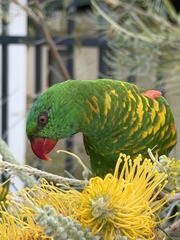
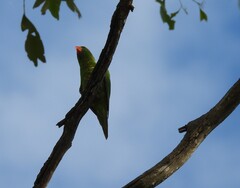
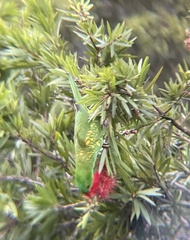
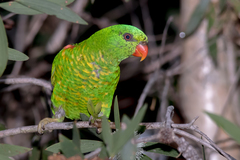
The scaly-breasted lorikeet (Trichoglossus chlorolepidotus) is an Australian lorikeet found in woodland in eastern Australia. The common name aptly describes this bird, which has yellow breast feathers broadly edged with green that look like scales.

The scaly-breasted lorikeet was first described by German zoologist Heinrich Kuhl in 1820. Other names this bird is known by include the gold and green lorikeet, greenie, green lorikeet, green and yellow lorikeet, green keet, green parrot, green leek, and green leaf. It is often colloquially referred to as a "scaly". Its specific epithet is derived from the Ancient Greek root khlōros 'green, yellow', and lepidōtos 'scaly'.

The scaly-breasted lorikeet is about 23 cm (9.1 in) long. The crown and sides of head are emerald-green slightly tinged with blue, while the feathers of the back of the neck and throat and breast are yellow, broadly edged with green, giving scaly appearance. The tail is green with the base of the outer tail-feathers marked with orange-red. The lower flanks, thighs and undertail-coverts green are strongly marked with yellow, while the underwing-coverts are orange-red. They have orange-red... Wikipedia →

Sounds

Call0:17

Australia · 2026

© Marc Anderson · XC1085217 · CC BY-NC-ND 4.0

Uncertain0:15

Australia · 2021

© nick talbot · XC663438 · CC BY-NC-SA 4.0

Flight call0:07

Australia · 2020

© James Lambert · XC588151 · CC BY-NC-SA 4.0

Global Distribution

Parks Where Found

# Park Country Daily sighting probability
1 Noosa National Park 🇦🇺 Australia
~10%
2 Springbrook National Park 🇦🇺 Australia
~10%
3 Daintree National Park 🇦🇺 Australia
<5%
4 Lamington National Park 🇦🇺 Australia
<5%
5 Royal National Park 🇦🇺 Australia
<5%
6 Blue Mountains National Park 🇦🇺 Australia
<5%

Cities Where Found

# City Country Daily sighting probability
1 Brisbane 🇦🇺 Australia
~40%
2 Sydney 🇦🇺 Australia
<5%
3 Melbourne 🇦🇺 Australia
<5%

Zoos & Centres Where Found

# Zoo / Centre Country
1 Prague Zoo 🇨🇿 Czechia In captivity
2 Taronga Western Plains Zoo 🇦🇺 Australia In captivity
3 Healesville Sanctuary 🇦🇺 Australia In captivity
4 Taronga Zoo 🇦🇺 Australia In captivity
5 Singapore Zoo 🇸🇬 Singapore In captivity
6 Bird Paradise 🇸🇬 Singapore In captivity
7 Rainforest Wild Asia 🇸🇬 Singapore In captivity
8 Hartley’s Crocodile Adventures 🇦🇺 Australia In captivity
9 Loro Parque 🇪🇸 Spain In captivity
10 Tamworth Marsupial Park & Adventure Playground 🇦🇺 Australia In captivity
11 North Carolina Aquarium at Fort Fisher 🇺🇸 United States In captivity
12 Palmitos Park 🇪🇸 Spain In captivity
13 Featherdale Sydney Wildlife Park 🇦🇺 Australia In captivity
14 Zoo Lagos 🇵🇹 Portugal In captivity
15 Aquarium of the Pacific 🇺🇸 United States In captivity
16 Living Shores Aquarium 🇺🇸 United States In captivity
17 Birdworld Kuranda 🇦🇺 Australia In captivity
18 Kuranda Koala Gardens 🇦🇺 Australia In captivity
19 Rákosův pavilon 🇨🇿 Czechia In captivity
20 Velemlokárium 🇨🇿 Czechia In captivity
21 Ranger Red’s Zoo & Conservation Park 🇦🇺 Australia In captivity

Before you go

What are the chances of seeing a Scaly-breasted Lorikeet in Springbrook National Park?

With luck

About 10% of wildlife watchers report a Scaly-breasted Lorikeet sighting in Springbrook National Park on a given day, based on 41 verified sightings from GBIF citizen-science data from 2019 to 2026. It is the 69th most-seen of the 136 birds we can rate there. Over three days the chance rises to about 30%, and over a week to about 50%, if each day is a fresh chance.

When is the best time to see a Scaly-breasted Lorikeet in Springbrook National Park?

March and April

In those months about 20% of wildlife watchers report a Scaly-breasted Lorikeet in Springbrook National Park on a given day, against under 5% in January–February and June, the lowest months.

What time of day is best to see a Scaly-breasted Lorikeet?

Between 3 and 6 pm

Across all the parks we cover, that three-hour window holds the most Scaly-breasted Lorikeet sightings with a recorded time, and nearly all of them come between 6 am and 6 pm: it is a daytime animal.

Is Springbrook National Park the best place to see a Scaly-breasted Lorikeet?

Among the best

Of the 6 parks where we can rate Scaly-breasted Lorikeet sightings, Springbrook National Park ranks 2nd at about 10%, level with the leaders once rounded. The best odds are in Noosa National Park (Australia, about 10%).

Where does the Scaly-breasted Lorikeet sighting chance come from?

GBIF citizen-science records

It is estimated from how often the Scaly-breasted Lorikeet is recorded against all the birds logged in Springbrook National Park (41 verified sightings from 2019 to 2026), calibrated against known sighting rates. Figures are rounded to the nearest 10% because citizen-science data supports honest approximations, not decimals, and months with records from fewer than five people show "—". How it works.

← Back to Springbrook National Park