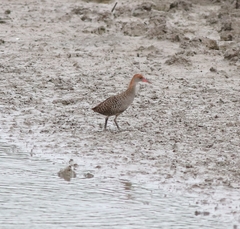
Slaty-breasted Rail

Slaty-breasted Rail

Gallirallus striatus

Silhouette: T. Michael Keesey (vectorization) and HuttyMcphoo (photography) · PhyloPic

Daily sighting probability ~10% · With luck
at Sundarbans National Park

In 3 days ~20% in a week ~30%

68 Verified sightings at Sundarbans National Park From 2019 to 2026
77 In all 2 parks
January Best month
☀️ Diurnal When it's spotted

About the Slaty-breasted Rail

The slaty-breasted rail (Lewinia striata) is a rail species native to the Indian subcontinent and Southeast Asia. Despite traditionally being considered part of Gallirallus, recent genetic studies have consistently placed it in the genus Lewinia, which is now formally recognized by the IUCN and IOC.

L. s. paraterma The slaty-breasted rail is mostly found in wetlands, up to elevations of typically 1,000 m (3,300 ft), but also up to 1,500 m (4,900 ft) and 1,850 m (6,070 ft) in Sri Lanka. A medium sized rail, it measures 25–30 cm (9.8–11.8 in) in length and weighs 100–142 g (3.5–5.0 oz). In coloration, the slaty-breasted rail has a chestnut crown and nape, a blue-grey breast, and a long, reddish bill. Breeding season can vary by location. It lays 5–9 eggs, which are incubated by both sexes for 19–22 days. Chicks can leave the nest soon after hatching, they are fed and cared for by their parents.

It feeds on worms, molluscs, crustaceans, and the seeds of marsh plants. Wikipedia →

Sounds

Recording0:11

China · 2023

© Lucas liu · iNaturalist · CC BY-NC 4.0

Recording0:12

China · 2024

© 大鹅Goose · iNaturalist · CC BY-NC 4.0

Global Distribution

Parks Where Found

# Park Country Daily sighting probability
1 Sundarbans National Park 🇮🇳 India
~10%
2 Manas National Park 🇮🇳 India
<5%

Cities Where Found

# City Country Daily sighting probability
1 Fuzhou 🇨🇳 China
~10%
2 Singapore 🇸🇬 Singapore
<5%
3 Tamluk 🇮🇳 India
<5%
4 Phnom Penh 🇰🇭 Cambodia
<5%
5 Kuala Lumpur 🇲🇾 Malaysia
<5%
6 Kolkata 🇮🇳 India
<5%
7 Vasai-Virar 🇮🇳 India
<5%
8 Kozhikode 🇮🇳 India
<5%
9 Chennai 🇮🇳 India
<5%
10 Colombo [Sri Jayawardenepura Kotte] 🇱🇰 Sri Lanka
<5%

Zoos & Centres Where Found

# Zoo / Centre Country
1 Parco Natura Viva 🇮🇹 Italy In captivity

Before you go

What are the chances of seeing a Slaty-breasted Rail in Sundarbans National Park?

With luck

About 10% of wildlife watchers report a Slaty-breasted Rail sighting in Sundarbans National Park on a given day, based on 68 verified sightings from GBIF citizen-science data from 2019 to 2026. It is the 101st most-seen of the 177 birds we can rate there. Over three days the chance rises to about 20%, and over a week to about 30%, if each day is a fresh chance.

When is the best time to see a Slaty-breasted Rail in Sundarbans National Park?

January

In that month about 20% of wildlife watchers report a Slaty-breasted Rail in Sundarbans National Park on a given day, against under 5% in February, April and July–November, the lowest months. That is one of Sundarbans National Park's driest months, with about 15 mm of rain against 480 mm in July. May and June have too few records to rate.

What time of day is best to see a Slaty-breasted Rail?

Between 7 and 10 am

Across all the parks we cover, that three-hour window holds the most Slaty-breasted Rail sightings with a recorded time, and about 8 in 10 of them come between 6 am and 6 pm: it is a daytime animal.

Is Sundarbans National Park the best place to see a Slaty-breasted Rail?

Yes

Of the 2 parks where we can rate Slaty-breasted Rail sightings, Sundarbans National Park has the highest daily chance: about 10%. Next come Manas National Park (India, under 5%).

Where does the Slaty-breasted Rail sighting chance come from?

GBIF citizen-science records

It is estimated from how often the Slaty-breasted Rail is recorded against all the birds logged in Sundarbans National Park (68 verified sightings from 2019 to 2026), calibrated against known sighting rates. Figures are rounded to the nearest 10% because citizen-science data supports honest approximations, not decimals, and months with records from fewer than five people show "—". How it works.

← Back to Sundarbans National Park