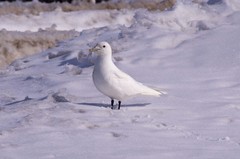
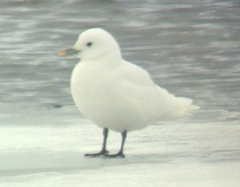
About the Ivory Gull
The ivory gull (Pagophila eburnea) is a small gull, the only species in the genus Pagophila. It is a resident breeding bird in the high Arctic and has a circumpolar distribution through Greenland, northernmost North America, and Eurasia.
The ivory gull was initially described by Constantine Phipps, 2nd Baron Mulgrave in 1774 as Larus eburneus from a specimen collected on Spitsbergen during his 1773 expedition towards the North Pole. Johann Jakob Kaup later noted the unique traits of the ivory gull and gave it a monotypic genus Pagophila in 1829. Johan Ernst Gunnerus later gave the species a new specific name, Pagophila alba. The genus name Pagophila is from Ancient Greek pagos, "sea-ice", and philos, "-loving", and specific eburnea is Latin for "ivory-coloured", from ebur, "ivory". Today only a few authors consider the ivory gull not deserving of its monotypic genus, instead choosing to merge it, along with the other monotypic gulls, back into Larus. However, most authors have not chosen to do so. The ivory gull has no subspecies. No fossil members of this genus are known.
This gull has traditionally been believed to be most closely related to either the kittiwakes,... Wikipedia →