Iceland Gull

Iceland Gull

Larus glaucoides

Silhouette: Sharon Wegner-Larsen · PhyloPic

LCLeast ConcernNTVUENCR
Daily sighting probability <5% · Rare
at Svalbard

In 3 days ~10% in a week ~20%

34 Verified sightings at Svalbard From 2019 to 2026
1,931 In all 12 parks
June Best month
☀️ Diurnal When it's spotted

About the Iceland Gull

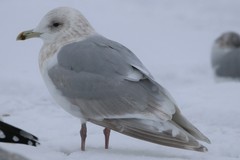
The Iceland gull (Larus glaucoides) is a medium-sized gull that breeds in the Arctic regions of Canada and Greenland, but not in Iceland (as its name suggests), where it is only seen during winter. The genus name is from Latin larus, which appears to have referred to a gull or other large seabird. The specific name glaucoides denotes its resemblance to Larus glaucus, a synonym of Larus hyperboreus, the glaucous gull; -oides is Ancient Greek and means "resembling".

The Iceland gull is a medium-sized gull, although relatively slender and light in weight. In length, it can measure from 50 to 64 cm (20 to 25 in), wingspan is from 115 to 150 cm (45 to 59 in), and weight is from 480 to 1,100 g (1.06 to 2.43 lb). Among standard measurements, the wing chord is 37.9 to 44.3 cm (14.9 to 17.4 in), the bill is 3.6 to 5.4 cm (1.4 to 2.1 in), and the tarsus is 4.9 to 6.7 cm (1.9 to 2.6 in). It is smaller and thinner-billed than the very large glaucous gull, and is usually smaller than the herring gull. It takes four years to reach maturity.

The call is a "laughing" cry like the herring gull, but higher pitched. It is migratory, wintering from in the North... Wikipedia →

Sounds

Begging call0:18

Ireland · 2022

© Irish Wildlife Sounds · XC717674 · CC BY-NC-ND 4.0

Call0:16

Netherlands · 2020

© Frank Roos · XC523094 · CC BY-NC-SA 4.0

Call0:14

Belgium · 2018

© Hans Matheve · XC402260 · CC BY-NC-ND 4.0

Global Distribution

Parks Where Found

# Park Country Daily sighting probability
1 Vatnajokull National Park 🇮🇸 Iceland
~20%
2 Cape Breton Highlands National Park 🇨🇦 Canada
~10%
3 Great Bear Rainforest 🇨🇦 Canada
~10%
4 Pacific Rim National Park Reserve 🇨🇦 Canada
~10%
5 Redwood National Park 🇺🇸 United States
~10%
6 Gros Morne National Park 🇨🇦 Canada
<5%
7 Olympic National Park 🇺🇸 United States
<5%
8 Svalbard 🇳🇴 Norway
<5%
9 Channel Islands National Park 🇺🇸 United States
<5%
10 Point Pelee National Park 🇨🇦 Canada
<5%
11 Merritt Island National Wildlife Refuge 🇺🇸 United States
<5%
12 Acadia National Park 🇺🇸 United States
<5%

Cities Where Found

# City Country Daily sighting probability
1 Toronto 🇨🇦 Canada
<5%
2 San Francisco 🇺🇸 United States
<5%
3 Sacramento 🇺🇸 United States
<5%
4 Vancouver 🇨🇦 Canada
<5%
5 Seattle 🇺🇸 United States
<5%
6 Montreal 🇨🇦 Canada
<5%
7 Portland 🇺🇸 United States
<5%
8 Los Angeles 🇺🇸 United States
<5%
9 Denver 🇺🇸 United States
<5%
10 Calgary 🇨🇦 Canada
<5%

Zoos & Centres Where Found

# Zoo / Centre Country
1 Chimelong Spaceship 🇨🇳 China In captivity

Before you go

What are the chances of seeing an Iceland Gull in Svalbard?

Rare

Under 5% of wildlife watchers report an Iceland Gull sighting in Svalbard on a given day, based on 34 verified sightings from GBIF citizen-science data from 2019 to 2026. It is the 35th most-seen of the 48 birds we can rate there. Over three days the chance rises to about 10%, and over a week to about 20%, if each day is a fresh chance.

When is the best time to see an Iceland Gull in Svalbard?

Any time of year

In every month with enough records, under 5% of wildlife watchers report an Iceland Gull in Svalbard on a given day, so our monthly data shows no clear season. November to January have too few records to rate.

What time of day is best to see an Iceland Gull?

Between 11 am and 2 pm

Across all the parks we cover, that three-hour window holds the most Iceland Gull sightings with a recorded time, and about 9 in 10 of them come between 6 am and 6 pm: it is a daytime animal.

Where does the Iceland Gull sighting chance come from?

GBIF citizen-science records

It is estimated from how often the Iceland Gull is recorded against all the birds logged in Svalbard (34 verified sightings from 2019 to 2026), calibrated against known sighting rates. Figures are rounded to the nearest 10% because citizen-science data supports honest approximations, not decimals, and months with records from fewer than five people show "—". How it works.

← Back to Svalbard