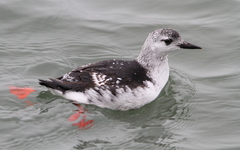
Black Guillemot

Black Guillemot

Cepphus grylle

Silhouette: Sheatherius · PhyloPic

LCLeast ConcernNTVUENCR
Daily sighting probability ~90% · Very likely
at Svalbard
2,383 Verified sightings at Svalbard From 2019 to 2026
9,526 In all 5 parks
July Best month
☀️ Diurnal When it's spotted

About the Black Guillemot

The black guillemot or tystie (Cepphus grylle) is a medium-sized seabird of the Alcidae family, native throughout northern Atlantic coasts and eastern North American coasts. It is resident in much of its range, but large populations from the high arctic migrate southwards in winter. The bird can be seen in and around its breeding habitat of rocky shores, cliffs and islands in single or smalls groups of pairs. They feed mainly by diving towards the sea floor feeding on fish, crustaceans or other benthic invertebrates. They are listed on the IUCN red list as a species of least concern.

Both sexes have very similar appearances with black plumage and a large white patch on the upper side of their wings in summer. The bill is also black, being rather long and slender, while the feet are coral-red. In winter adult underparts are white and the upperparts are a pale grey with the back and shoulders exhibiting barred light grey and white patterning.

The birds breed in solitary pairs or small groups during their breeding season starting in late February and early May. Pairs nest above the high tide mark, usually in cliff crevices or gaps in boulders. Many pairs lack true nests and lay directly on the ground. Breeding pairs will typically lay 2-egg clutches and raise 2 chicks to fledging. The eggs are dull white to pale green, boldly marked with dark spots and blotches. Incubation by both parents typically lasts 28 to 32 days. Once hatched, chicks are covered with black down and receive care from the parents until they fledge aged 30 – 40 days, unaccompanied by their parents. Once fledged, chicks are totally independent and by age three or four years they will begin to re-join their natal colony. Wikipedia →

Sounds

Call0:09

Ireland · 2022

© Irish Wildlife Sounds · XC734750 · CC BY-NC-ND 4.0

Song0:31

Denmark · 2022

© Manuel Tacke · XC729676 · CC BY-NC-SA 4.0

Begging call1:28

Iceland · 2018

© Stanislas Wroza · XC487600 · CC BY-NC-SA 4.0

Global Distribution

Parks Where Found

# Park Country Daily sighting probability
1 Svalbard 🇳🇴 Norway
~90%
2 Acadia National Park 🇺🇸 United States
~40%
3 Cape Breton Highlands National Park 🇨🇦 Canada
~30%
4 Gros Morne National Park 🇨🇦 Canada
~10%
5 Wadden Sea National Park 🇩🇪 Germany
<5%

Cities Where Found

# City Country Daily sighting probability
1 Dublin 🇮🇪 Ireland
~10%
2 Helsinki 🇫🇮 Finland
<5%

Zoos & Centres Where Found

# Zoo / Centre Country
1 Tierpark Hagenbeck 🇩🇪 Germany In captivity
2 Oregon Coast Aquarium 🇺🇸 United States In captivity
3 National Aquarium 🇺🇸 United States In captivity
4 Montreal Biodome 🇨🇦 Canada In captivity

Before you go

What are the chances of seeing a Black Guillemot in Svalbard?

Very likely

About 90% of wildlife watchers report a Black Guillemot sighting in Svalbard on a given day, based on 2,383 verified sightings from GBIF citizen-science data from 2019 to 2026. It is the 3rd most-seen of the 48 birds we can rate there.

When is the best time to see a Black Guillemot in Svalbard?

February and May–July

In those months about 90% of wildlife watchers report a Black Guillemot in Svalbard on a given day, against about 70% in September and October, the lowest months. November to January have too few records to rate.

What time of day is best to see a Black Guillemot?

Between 10 am and 1 pm

Across all the parks we cover, that three-hour window holds the most Black Guillemot sightings with a recorded time, and about 9 in 10 of them come between 6 am and 6 pm: it is a daytime animal.

Is Svalbard the best place to see a Black Guillemot?

Yes

Of the 5 parks where we can rate Black Guillemot sightings, Svalbard has the highest daily chance: about 90%. Next come Acadia National Park (United States, about 40%) and Cape Breton Highlands National Park (Canada, about 30%).

Which relatives of the Black Guillemot live in Svalbard?

Same family: Alcidae

The closest relatives of the Black Guillemot that you can see in Svalbard (family Alcidae, Auks, Murres, and Puffins) are Thick-billed Murre (about 70%), Dovekie (about 50%) and Atlantic Puffin (about 40%), with each one's daily chance of a sighting.

Where does the Black Guillemot sighting chance come from?

GBIF citizen-science records

It is estimated from how often the Black Guillemot is recorded against all the birds logged in Svalbard (2,383 verified sightings from 2019 to 2026), calibrated against known sighting rates. Figures are rounded to the nearest 10% because citizen-science data supports honest approximations, not decimals, and months with records from fewer than five people show "—". How it works.

← Back to Svalbard