
Cape Skink

Cape Skink

Trachylepis capensis

Silhouette: David Orr · PhyloPic

LCLeast ConcernNTVUENCR
Daily sighting probability ~30% · Possible
at Table Mountain National Park

In 3 days ~60% in a week ~90%

510 Verified sightings at Table Mountain National Park From 2019 to 2026
590 In all 5 parks
October Best month
☀️ Diurnal When it's spotted

About the Cape Skink

Trachylepis capensis is a species of skink, a lizard in the family Scincidae. The species is native to southern Africa. Named for the Cape of Good Hope, T. trachylepis is commonly known as the Cape skink or Cape three-lined skink, and it has recently been reassigned to the genus Trachylepis (previously it was classified in Mabuya).

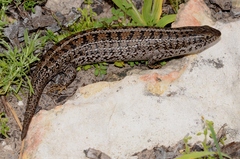
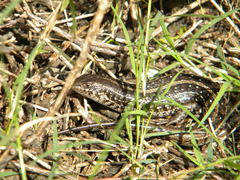
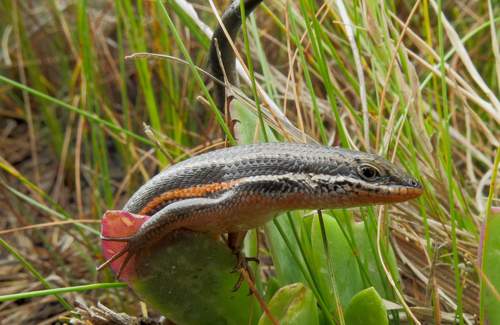
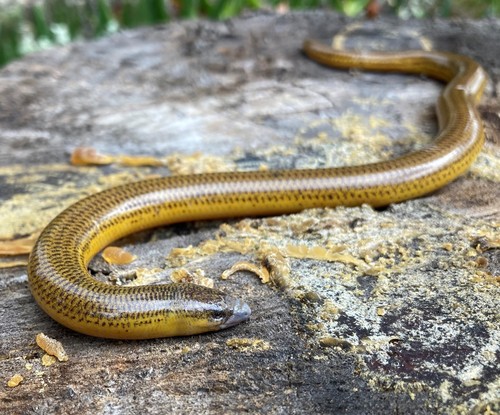
T. capensis is a large (sometimes quite fat) skink, with three light stripes running down its back. Its skin is olive-brown to gray, and between the stripes and on its flanks are many small dark spots. The belly is greyish white. Occasionally the stripes on the back can be quite pale.

Its body is rather elongated and the limbs are short. T. capensis is indigenous to South Africa and can be found throughout most of the country. It also occurs in Botswana, Namibia, and Zambia; a few isolated (probably relict) populations have been found in Zimbabwe. T. capensis is still common in suburban gardens across South Africa and because of this, the Cape skink is probably the best known lizard in the country. Furthermore, in the presence of humans it gradually becomes domesticated and after some time it... Wikipedia →

Global Distribution

Parks Where Found

# Park Country Daily sighting probability
1 De Hoop Nature Reserve 🇿🇦 South Africa
~30%
2 West Coast National Park 🇿🇦 South Africa
~30%
3 Table Mountain National Park 🇿🇦 South Africa
~30%
4 Addo Elephant National Park 🇿🇦 South Africa
~10%
5 Garden Route National Park 🇿🇦 South Africa
~10%

Cities Where Found

# City Country Daily sighting probability
1 Cape Town 🇿🇦 South Africa
~30%

Before you go

What are the chances of seeing a Cape Skink in Table Mountain National Park?

Possible

About 30% of wildlife watchers report a Cape Skink sighting in Table Mountain National Park on a given day, based on 510 verified sightings from GBIF citizen-science data from 2019 to 2026. It is the 6th most-seen of the 41 reptiles we can rate there. Over three days the chance rises to about 60%, and over a week to about 90%, if each day is a fresh chance.

When is the best time to see a Cape Skink in Table Mountain National Park?

April and September–November

In those months about 30% of wildlife watchers report a Cape Skink in Table Mountain National Park on a given day, against about 20% in May–August and December–March, the lowest months.

What time of day is best to see a Cape Skink?

Between noon and 3 pm

Across all the parks we cover, that three-hour window holds the most Cape Skink sightings with a recorded time, and nearly all of them come between 6 am and 6 pm: it is a daytime animal.

Is Table Mountain National Park the best place to see a Cape Skink?

Among the best

Of the 5 parks where we can rate Cape Skink sightings, Table Mountain National Park ranks 3rd at about 30%, level with the leaders once rounded. The best odds are in De Hoop Nature Reserve (South Africa, about 30%) and West Coast National Park (South Africa, about 30%).

Where does the Cape Skink sighting chance come from?

GBIF citizen-science records

It is estimated from how often the Cape Skink is recorded against all the reptiles logged in Table Mountain National Park (510 verified sightings from 2019 to 2026), calibrated against known sighting rates. Figures are rounded to the nearest 10% because citizen-science data supports honest approximations, not decimals, and months with records from fewer than five people show "—". How it works.

← Back to Table Mountain National Park